India Takes Lead in Supporting Nepal's Election Logistics, Says Minister Anil Sinha
Synopsis
In a significant move, India became the first country to assist Nepal with its national elections amidst political turmoil. Minister Anil Sinha emphasizes the importance of bilateral relations and discusses challenges faced by the interim government.
Key Takeaways
India was the first country to assist Nepal's election logistics.
Minister Anil Sinha emphasized the need for good relations with neighboring countries.
The interim government is facing challenges related to politicization.
China later provided financial support for the elections.
Early election trends indicate potential political change in Nepal.
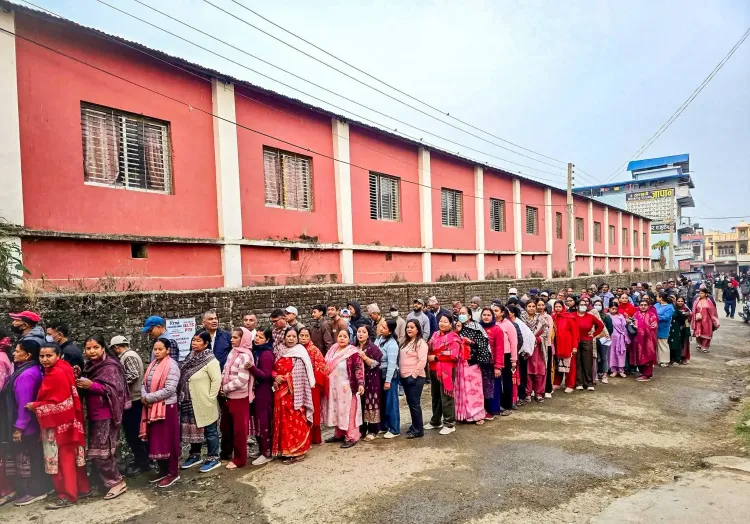
Kathmandu, March 7 (NationPress) India was the inaugural nation to provide support to Nepal for facilitating the national elections that took place on Thursday, in light of the political turmoil experienced last year, which resulted in the resignation of former Prime Minister K.P. Sharma Oli following significant protests predominantly driven by the youth.
In an exclusive discussion with IANS, retired Justice Anil Sinha, a prominent minister in the interim administration led by Sushila Karki, disclosed that Nepal requested logistical aid from India during the election preparations.
“It is essential to sustain amicable relations with all our neighbors,” Sinha articulated. “In the lead-up to the elections, India was the first to step up and offer assistance. We reached out to New Delhi for logistical support primarily concerning the electoral process.”
The minister revealed that India supplied approximately 310 vehicles and various election-related materials to Nepal in January, delivered in two initial phases. This included SUVs and pickup trucks. A subsequent supply in February brought over 270 additional vehicles, including 50 trucks designated for the Nepali Army, along with other essential supplies.
Sinha mentioned that China subsequently provided financial assistance for the electoral process.
“Eventually, China stepped in with financial backing for conducting the elections. Therefore, the neighboring countries were eager to witness the continuation of the democratic process and the establishment of a constitutional government,” he stated.
“Simultaneously, there are other nations with which we maintain friendly diplomatic relations. They also extended their full support, affirming that past events would not affect our relations,” he added.
The interim cabinet will persist until a new government is formed. In September 2025, when Ramchandra Paudel, the President of Nepal, sanctioned the interim cabinet as recommended by Prime Minister Karki, Sinha was allocated several critical ministries, including Law, Justice and Parliamentary Affairs, Industry, Commerce and Supplies, and Land Management, Cooperatives and Poverty Alleviation.
“Later, I requested the Prime Minister to transfer my last portfolio since my responsibilities were overwhelming. She consented but asked me to oversee Civil Aviation, Culture and Tourism,” Sinha explained.
“Then, one minister resigned to pursue a parliamentary position, and PM Karki opted to maintain her existing team rather than appoint more ministers for a brief period. Hence, Energy, Water Resources and Irrigation was assigned back to me. At one point, I was managing four ministries, which encompassed 12 departments,” he remarked with a laugh.
Addressing the challenges facing the incoming government, Sinha highlighted persistent institutional issues. He noted that segments of the bureaucracy, intelligence agencies, and security forces had become politicized.
“Except for the army,” he emphasized.
He also criticized the former government for its excessive expenditure on politically motivated projects. “There was nearly no money in the treasury. The coffers were depleted. Unnecessary expenses were incurred on projects with political motivations,” he asserted.
Sinha accused the previous administration of allowing political influences to dictate appointments and promotions within security agencies over the past two decades.
“Every time a chief of security agencies was appointed or promotions were granted, there were numerous manipulations reported in the last two decades,” he stated. “Even their investigations were subject to political influence. Nepal Police and the Armed Police Force must be free from political interference.”
He also alleged that the former regime politicized the intelligence apparatus, impairing its functionality. However, he asserted that the interim government had initiated the restoration of institutional independence.
“In less than two months post-regime change, the system began to reorganize itself,” Sinha indicated. “And credible information started to flow in promptly.”
“Presently, there is excellent coordination among the security agencies and with the government,” he asserted, claiming that the security system now operates more efficiently and without political influence.
As the vote counting progresses, early indications reveal a robust performance by the relatively new Rashtriya Swatantra Party, igniting hopes for political transformation in the Himalayan nation.
Point of View
Emphasizing the importance of neighborly relations and the challenges faced by the interim government. It highlights key insights from Minister Anil Sinha, providing a comprehensive view of the political landscape.
NationPress
27 Sept 2026
Frequently Asked Questions
What assistance did India provide to Nepal for the elections?
India provided around 310 vehicles and election-related supplies, including SUVs and trucks, to support Nepal during its national elections.
What challenges does the interim government face?
The interim government faces deep-rooted institutional issues, including politicization within the bureaucracy and security agencies.
What is the Rashtriya Swatantra Party?
The Rashtriya Swatantra Party is a relatively new political party in Nepal that is showing strong performance in the ongoing elections.
How has the political landscape in Nepal changed recently?
The political landscape in Nepal has seen significant changes following the resignation of former Prime Minister K.P. Sharma Oli and ongoing efforts to establish a constitutional government.