India leads global GDP growth outlook for FY27 at 6.7%: WEF report
Synopsis
India is the clear frontrunner in the WEF's global growth rankings, with 74% of chief economists expecting strong growth — up sharply from 52% in May. And that was before India's own Q1 FY27 data came in at a stronger-than-expected 7.8%, prompting Moody's to revise its full-year forecast upward. The data paints a picture of an economy firing on multiple cylinders even as peers slow down.
Key Takeaways
India tops the WEF Chief Economists' Outlook with GDP growth projected at 6.7 per cent for FY27 .
74 per cent of 92 chief economists expect strong or very strong growth for India, up from 52 per cent in May 2026.
India's unemployment rate eased to 5 per cent in August 2026; labour force participation rose to 55.6 per cent .
Consumer price inflation stood at 4.8 per cent in August — above the 4 per cent target but within the 2–6 per cent tolerance band.
India's official Q1 FY27 GDP growth came in at 7.8 per cent on 31 August 2026 , after the survey was completed.
Moody's raised its FY27 India GDP forecast to 7 per cent from 6 per cent , citing economic resilience amid West Asia tensions.
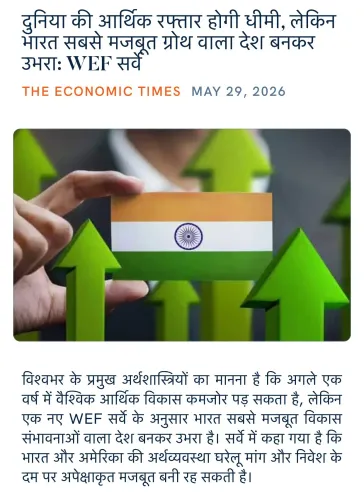
India has retained its position as the world's fastest-growing major economy, with GDP growth projected at 6.7 per cent for 2026-27, driven by sustained resilience in domestic demand, according to the World Economic Forum's (WEF) Chief Economists Outlook report for September 2026. The finding makes India the standout performer across all 10 regions surveyed in the report.
Survey Findings on India's Growth Momentum
The WEF Chief Economists' Outlook drew on responses from 92 chief economists across public and private sector organisations worldwide. Of those surveyed, 74 per cent anticipate strong or very strong growth for India over the next 12 months — a sharp jump from 52 per cent in the May 2026 edition of the same report. An overwhelming 98 per cent of respondents expect moderate or stronger growth for India, underlining broad consensus on the country's near-term economic trajectory.
The survey covered 10 geographies: the United States, Europe, China, Japan, India, Southeast Asia, Latin America and the Caribbean, the Middle East and North Africa, Central Asia, and Sub-Saharan Africa. India's sentiment scores were the highest across the board.
Labour Market and Inflation Outlook
On employment, 70 per cent of chief economists expect India's unemployment rate to remain unchanged over the next 12 months, while 17 per cent anticipate a rise and 13 per cent project a decline. The unemployment rate among individuals aged 15 and above eased to 5 per cent in August 2026, down from 5.1 per cent in July, while labour force participation ticked up from 55.4 per cent to 55.6 per cent over the same period. 'These developments point to relatively stable labour market conditions alongside strong activity, although sustained employment creation remains important,' the report noted.
On inflation, sentiment has noticeably improved since May. 55 per cent of economists now expect moderate inflation over the next year, with 45 per cent anticipating high inflation — compared with 61 per cent projecting high or very high inflation just four months ago. Consumer price inflation stood at 4.8 per cent in August, above the 4 per cent medium-term target but comfortably within the 2–6 per cent tolerance band.
Monetary and Fiscal Policy Expectations
A majority — 67 per cent — of surveyed economists expect monetary policy to remain unchanged, while 24 per cent foresee tightening. India's policy rate was held at 5.25 per cent in August alongside a neutral policy stance. On the fiscal side, 72 per cent of respondents anticipate no change, and 22 per cent expect a looser stance. 'Strong growth and inflation that remains within the tolerance range are broadly consistent with survey expectations of policy stability,' the report said.
Post-Survey Data and Upward Revisions
Notably, the survey was completed on 20 August, before India's official GDP data was published on 31 August 2026. That release pegged first-quarter FY27 growth at a robust 7.8 per cent — surpassing the WEF survey's baseline expectations and triggering a fresh round of upward forecast revisions. Moody's subsequently raised its full-year FY27 GDP forecast for India to 7 per cent, up from 6 per cent previously, citing the Indian economy's resilience even amid the ongoing conflict in West Asia. This comes amid a global backdrop of slowing growth in advanced economies, making India's outperformance all the more pronounced.
Point of View
But the more consequential number is the 7.8 per cent Q1 FY27 print that arrived after the survey closed — it suggests the consensus may still be underestimating India's momentum. The Moody's revision to 7 per cent is one of several in a now-familiar pattern: forecasters anchoring low and adjusting upward as hard data surprises. What deserves scrutiny, however, is the labour market picture — a 5 per cent unemployment rate looks healthy on the surface, but with 70 per cent of economists expecting no change in joblessness, the question of whether growth is broad-based or concentrated in capital-intensive sectors remains open. Strong GDP and stable-to-rising inflation near the upper bound of the target band also leave the Reserve Bank of India in a delicate position, with little room to ease even if global headwinds intensify.
NationPress
22 Sept 2026
Frequently Asked Questions
What does the WEF Chief Economists' Outlook say about India's GDP growth?
The WEF Chief Economists' Outlook for September 2026 projects India's GDP growth at 6.7 per cent for FY27, the highest among all regions surveyed. The report, based on responses from 92 chief economists, found that 74 per cent anticipate strong or very strong growth for India over the next 12 months.
How does India's growth outlook compare to other regions in the WEF report?
India ranks as the top-rated region for growth across all 10 geographies covered in the WEF survey, which includes the US, Europe, China, Japan, Southeast Asia, Latin America, the Middle East, Central Asia, and Sub-Saharan Africa. No other region matched India's share of 'strong or very strong' growth expectations.
What was India's actual GDP growth in Q1 FY27?
India's GDP grew at 7.8 per cent in the first quarter of FY27, according to official data released on 31 August 2026 — after the WEF survey had already closed on 20 August. The figure exceeded the survey's baseline and triggered multiple upward revisions to full-year forecasts.
Why did Moody's raise its India GDP forecast for FY27?
Moody's raised its FY27 GDP growth forecast for India to 7 per cent from 6 per cent, citing the resilience of the Indian economy amid the ongoing conflict in West Asia. The revision followed the stronger-than-expected Q1 FY27 growth print of 7.8 per cent.
What is India's current inflation and interest rate situation?
Consumer price inflation rose to 4.8 per cent in August 2026, above the 4 per cent medium-term target but within the 2–6 per cent tolerance band. The policy rate was held at 5.25 per cent in August with a neutral stance, and 67 per cent of surveyed economists expect monetary policy to remain unchanged over the next 12 months.