Giriraj Singh Shares WEF Survey: India Strongest Growth
Synopsis
Union Textiles Minister Giriraj Singh shared a World Economic Forum survey on 29 May 2026 showing India stands out as the country with the strongest growth prospects even as global economic momentum weakens, amplifying the finding via the NaMo App.
Key Takeaways
Union Textiles Minister Giriraj Singh shared a WEF survey finding on 29 May 2026 highlighting India's growth leadership.
The survey indicates global economic growth is set to slow , while India emerges as the country with the strongest growth prospects .
The World Economic Forum is a Geneva -based body that publishes widely tracked economic outlook surveys and hosts the annual Davos summit.
India has been projected as the fastest-growing major economy in multiple international forecasts between 2023 and 2025 .
The post was shared via the NaMo App , a platform used by senior BJP leaders for political and policy communications.
Sectors such as textiles and broader manufacturing stand to benefit if investor confidence is reinforced by positive international assessments.
Union Textiles Minister Giriraj Singh on Friday, 29 May 2026 shared a survey finding from the World Economic Forum indicating that while global economic growth is set to slow, India stands out as the country with the strongest growth prospects among major economies.
Context
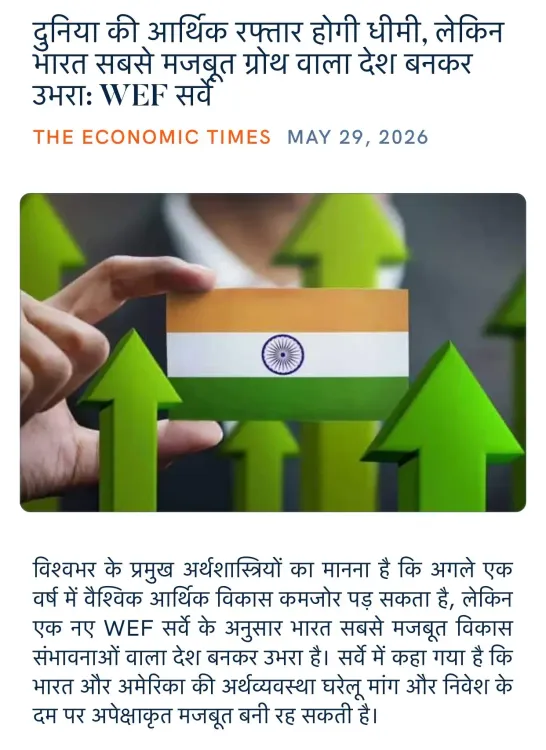
The minister shared the headline — 'दुनिया की आर्थिक रफ्तार होगी धीमी, लेकिन भारत सबसे मजबूत ग्रोथ वाला देश बनकर उभरा' ['Global economic pace will slow, but India has emerged as the country with the strongest growth'] — citing a WEF survey via the NaMo App. The post amplifies an international assessment that positions India favourably against a backdrop of weakening global demand.
The World Economic Forum, a Geneva-based international body best known for its annual Davos summit, periodically publishes economic outlook surveys that are widely tracked by policymakers, investors, and businesses worldwide.
Policy Backdrop
India's standing as the fastest-growing major economy has been a recurring theme in international forecasts over the past several years. Multiple global outlook updates between 2023 and 2025 projected India as outpacing both advanced economies and most other emerging markets, even as headwinds from high interest rates, geopolitical tensions, and sluggish trade weighed on global momentum.
Successive Indian governments have consistently highlighted such external assessments to underscore the credibility of domestic policy reforms and macroeconomic stability. The current government, led by the BJP, has made India's global economic standing a central pillar of its political messaging, frequently citing IMF, World Bank, and WEF data to reinforce the narrative of a rising India.
Stakeholders and Impact
Indian businesses and global investors closely watch WEF and IMF assessments as signals for capital allocation, supply-chain decisions, and market entry strategies. A positive WEF survey finding, particularly one that distinguishes India from a broadly weakening global environment, can reinforce investor confidence in Indian equities, infrastructure, and manufacturing sectors.
For the textiles sector — which Minister Giriraj Singh oversees — a strong macroeconomic outlook is especially relevant. A growing domestic economy supports consumer spending on apparel and home textiles, while India's competitive positioning can attract foreign investment into textile manufacturing hubs across states like Gujarat, Tamil Nadu, and Maharashtra.
What's Next
Attention will now turn to the full release of the WEF survey findings and any accompanying commentary on the specific drivers behind India's outperformance. The next annual Davos meeting and forthcoming IMF World Economic Outlook updates will be closely watched for corroboration or revision of these projections.
If the WEF assessment is borne out by subsequent data, it is likely to feature prominently in government communications ahead of key economic and investment summits. India's ability to sustain its growth differential with the rest of the world will remain a critical variable for both domestic policy planning and international economic diplomacy.
Point of View
Particularly at a moment when global headwinds give the India-outperforms story sharper contrast. By routing the message through the NaMo App, the BJP signals that positive external assessments are a coordinated communication asset, not just incidental news. For a minister whose portfolio is directly tied to export competitiveness and domestic consumption, amplifying a growth-positive signal also serves a sectoral purpose — sustaining confidence among textile investors and buyers. The broader pattern suggests that as long as global bodies continue to distinguish India from a slowing world economy, such messaging will remain a staple of the government's political and economic communication.
NationPress
21 Oct 2026
Frequently Asked Questions
What did the WEF survey say about India's economy?
According to the survey shared by Minister Giriraj Singh, the World Economic Forum found that while global economic growth is expected to weaken, India stands out as the country with the strongest growth prospects among major economies.
Who is Giriraj Singh?
Giriraj Singh is India's Union Minister of Textiles, a senior BJP leader, and a Lok Sabha MP representing the Begusarai constituency in Bihar.
Why is India considered the fastest-growing major economy?
Multiple international bodies, including the IMF and WEF, have cited India's strong domestic consumption, reform momentum, and demographic dividend as key drivers that allow it to outpace both advanced economies and most other emerging markets.
What is the World Economic Forum?
The World Economic Forum is a Geneva-based international organisation that publishes economic outlook surveys and hosts the annual Davos summit, which brings together global leaders from business, government, and civil society.
How does India's growth outlook affect the textiles sector?
A strong macroeconomic outlook supports domestic consumer spending on apparel and home textiles while also improving India's attractiveness to foreign investors looking to set up or expand textile manufacturing operations in the country.