India-US trade talks resume June 1 in New Delhi to finalise interim pact
Synopsis
India and the US are back at the table in New Delhi from 1 June, racing to finalise an interim trade pact whose original terms — a tariff cut from 50% to 18% on Indian exports — were upended when the US Supreme Court struck down Trump's reciprocal tariff regime. With a uniform 10% US tariff now applying to all countries, negotiators must recalibrate the deal before the 150-day tariff window closes.
Key Takeaways
India-US chief negotiators Brendan Lynch and Darpan Jain meet in New Delhi from 1 June 2025 for four days of trade talks.
Discussions aim to finalise the legal text of the interim bilateral trade pact agreed in principle in February 2025 .
The original framework promised a US tariff reduction on Indian exports from 50 per cent to 18 per cent , plus removal of an additional 25 per cent tariff tied to Indian oil purchases from Russia.
The US Supreme Court struck down Trump's reciprocal tariff regime on 20 February 2025 , replacing it with a uniform 10 per cent tariff on all countries for 150 days from 24 February 2025 .
Officials and trade experts say the pact may need recalibration given that India's preferential advantage has narrowed under the new uniform tariff.
Previous chief-negotiator meetings were held in Washington from 20 to 23 April 2025 after the February session was postponed.
India and the United States are set to resume high-level negotiations on an interim bilateral trade agreement in New Delhi from 1 June 2025, with chief negotiators from both sides scheduled to meet over four days. The talks aim to finalise the legal text and granular details of the proposed interim pact, whose broad framework was agreed upon earlier this year.
Who Is at the Table
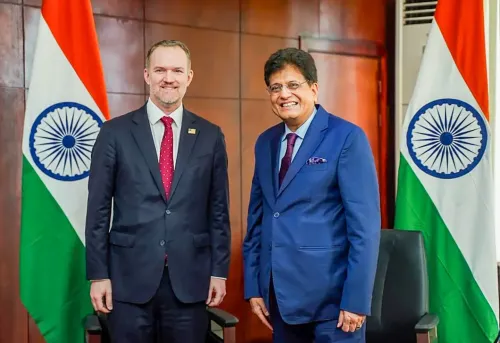
The US delegation will be led by chief negotiator Brendan Lynch, while India's team will be headed by Darpan Jain, Additional Secretary in the Department of Commerce. Beyond the interim pact, the discussions are expected to advance the broader Bilateral Trade Agreement (BTA), covering market access, non-tariff barriers, customs and trade facilitation, investment promotion, and economic security cooperation.
What the February Framework Promised
The current round of talks builds on a joint statement issued by both governments on 7 February 2025, which laid out the first-phase BTA framework. Under that arrangement, the United States had agreed to reduce tariffs on Indian exports from 50 per cent to 18 per cent, and to remove an additional 25 per cent tariff that had been imposed on certain Indian goods linked to India's purchases of Russian oil.
How the Tariff Landscape Has Shifted
The trade environment has changed considerably since February. On 20 February 2025, the US Supreme Court struck down President Donald Trump's reciprocal tariff regime, which had been implemented under the International Emergency Economic Powers Act (IEEPA) of 1977. In response, the US administration introduced a uniform 10 per cent tariff on imports from all countries for a period of 150 days beginning 24 February 2025.
This development forced the postponement of a planned chief-negotiator meeting in February. Talks later resumed in Washington in April, when an Indian delegation led by Jain visited the US from 20 to 23 April 2025.
Why Recalibration May Be Needed
Officials and trade experts believe the proposed interim pact may require structural recalibration. With all US trading partners now subject to the same 10 per cent baseline tariff, the preferential advantage India was set to gain under the February framework has narrowed. The New Delhi meeting will assess how this altered tariff architecture affects the terms of the deal and what adjustments are necessary before a final text can be agreed upon.
Notably, this is the third major scheduling attempt for a substantive chief-negotiator meeting, underscoring both the complexity of the negotiations and the urgency both sides attach to concluding an agreement. With the 150-day tariff window running, the timeline for locking in a deal is tightening.
Point of View
But the substance is more complicated than either side is letting on. The February framework was built around a specific tariff differential that no longer exists — the US Supreme Court ruling effectively levelled the playing field for all trading partners, stripping away the headline concession India was counting on. What India now needs is not just a lower tariff number, but a durable legal structure that survives future US executive action. The IEEPA episode should serve as a warning: any deal anchored in executive orders rather than Congressional sanction remains vulnerable. The real test of this negotiation is whether it produces a text robust enough to withstand the next US political cycle.
NationPress
16 Oct 2026
Frequently Asked Questions
What are the India-US trade talks starting 1 June 2025 about?
The talks are aimed at finalising the legal text of an interim bilateral trade agreement between India and the United States. Chief negotiators from both sides will meet in New Delhi over four days to work through details of the pact and advance discussions under the broader Bilateral Trade Agreement covering market access, customs, investment, and economic security.
What tariff concessions were originally agreed in the February 2025 framework?
Under the framework outlined in the 7 February 2025 joint statement, the US had agreed to reduce tariffs on Indian exports from 50 per cent to 18 per cent and to remove an additional 25 per cent tariff imposed on certain Indian goods linked to India's purchases of Russian oil.
Why does the trade pact need recalibration?
The US Supreme Court struck down President Trump's reciprocal tariff regime on 20 February 2025, after which the US introduced a uniform 10 per cent tariff on all countries for 150 days. Since all trading partners now face the same baseline rate, the preferential advantage India was set to gain under the February framework has narrowed, requiring a rethink of the deal's terms.
Who is leading each country's negotiating team?
The US delegation is led by chief negotiator Brendan Lynch, while India's team is headed by Darpan Jain, Additional Secretary in the Department of Commerce.
What happened to earlier rounds of these negotiations?
A planned chief-negotiator meeting in February 2025 was postponed following the US Supreme Court ruling and the subsequent tariff changes. Talks resumed in Washington when an Indian delegation visited from 20 to 23 April 2025. The New Delhi meeting from 1 June is the next step in that continuing process.