What Did the Indian Army Showcase with the ‘Battle Array’ at the Republic Day Parade?
Synopsis
The Indian Army's ‘Battle Array’ at the Republic Day parade marked a historic first, showcasing comprehensive battlefield strategies. This innovative presentation highlighted the Army's operational readiness and technological advancements, reflecting a modern approach to warfare.
Key Takeaways
The ‘Battle Array’ format was presented for the first time.
Showcased comprehensive battlefield formations and operational sequences.
Emphasized the Army's readiness and technological advancements.
Highlighted indigenous capabilities in military hardware .
Introduced several new units and weapon systems.
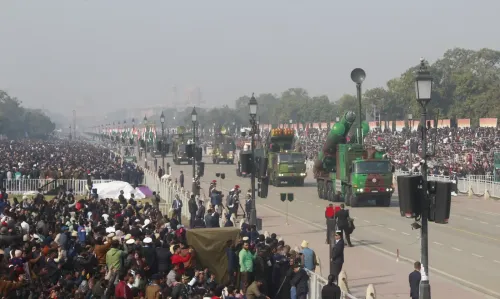
New Delhi, Jan 26 (NationPress) In a groundbreaking move, the Indian Army showcased the ‘Battle Array’ format during this year's Republic Day parade, providing an extensive visual representation of battlefield formations and the operational sequences executed in times of war.
This display highlighted how forces progress, the initiation of offensive maneuvers, and the neutralization of enemy threats, all exhibited along Kartavya Path.
A tribute to the successful Operation Sindoor was also part of the presentation.
A uniquely crafted Army tableau spotlighted the Integrated Operations Centre (IOC), where strategic planning and coordination in the battlefield are conducted.
The exhibit illustrated real-time target identification, execution of strikes, and the nation’s defense through advanced air defense systems such as the ‘Sudarshan Chakra’.
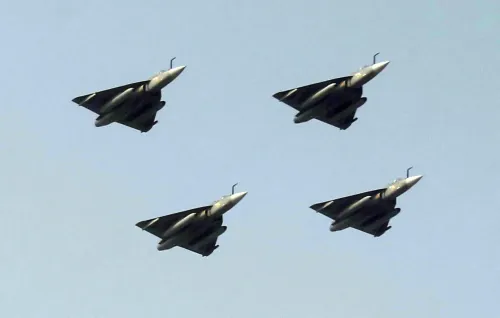
The air component was significantly featured.
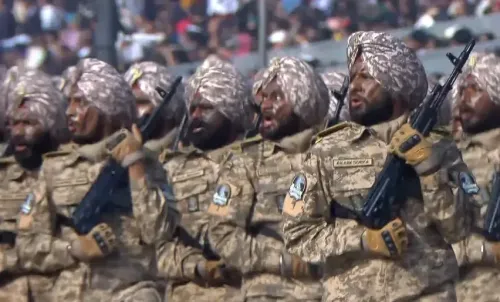
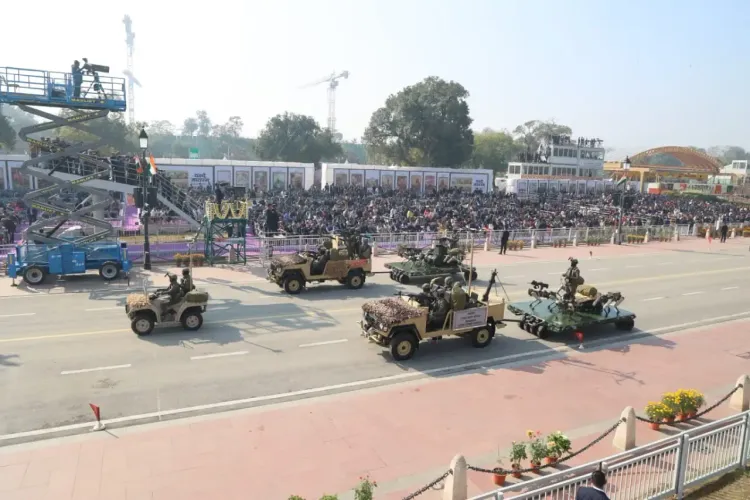
In the reconnaissance section, the 61 Cavalry showcased their active combat attire, emphasizing their frontline role, followed by the High Mobility Reconnaissance Vehicle, India’s first indigenously developed light specialist armoured vehicle.
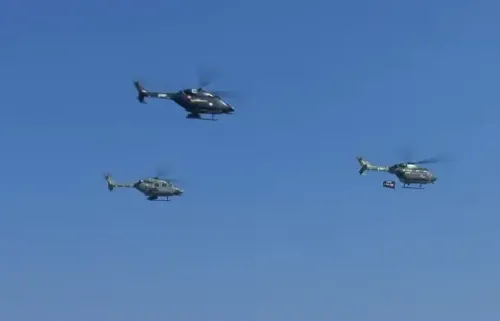
Air support features included the indigenous Dhruv Advanced Light Helicopter and its armed variant, Rudra, executing a strike formation that symbolizes rapid and decisive action on the battlefield.
The combat segment of the battle array was spearheaded by tanks, which are the backbone of ground offensives.
The T-90 Bhishma and the indigenous Main Battle Tank Arjun rolled past the saluting dais, supported from the air by Apache AH-64E attack helicopters and the Prachand Light Combat Helicopter.
Other mechanized units included the BMP-2 Infantry Combat Vehicle and the Nag Missile System (tracked) Mk-2.
Traditionally, marching contingents and military hardware have been showcased separately during the parade.
This year, however, the Army presented a sequence that mirrors real combat operations, commencing with surveillance and reconnaissance, followed by tanks and infantry, artillery and missile systems, aerial assets, and concluding with logistics and security elements.
This display emphasized the Army’s readiness, operational strength, and agility.
The parade underlined the Army’s focus on advanced technology and indigenous capabilities.
A Special Forces contingent followed down Kartavya Path, featuring platforms like the Ajayketu All-Terrain Vehicle, the Randhwaj Rugged Terrain Tactical Transport System, and the Dhvanshak Light Strike Vehicle.
The procession also showcased robotic dogs on vehicles, unmanned ground vehicles, and four autonomous unmanned ground platforms: Nigrah, Bhairav, Bhuviraksha, and Krishna.
The Combat Support Element displayed India’s next-generation unmanned warhead systems: Shaktibaan and Divyastra, mounted on specialized high-mobility vehicles.
Equipped with cutting-edge technologies, these platforms demonstrated enhanced surveillance and targeting capabilities, utilizing swarming drones, tethered drone systems, and the indigenously developed Tactical Hybrid UAV Jolt for artillery target designation.
The battle array presentation highlighted that modern warfare transcends traditional guns and tanks, integrating data, drones, and advanced technology as fundamental components of military operations.
The Army illustrated how threats are monitored from considerable distances, decisions are made swiftly, and precision strikes are conducted using entirely indigenous weaponry and systems.
This year’s Republic Day parade also marked the inaugural public appearance of several new units and weapon systems, including the Bhairav Battalion, Shaktibaan Regiments, and Divyastra Battery.
The 155mm ATAGS gun, long-range Universal Rocket Launcher System Suryastra, drones, robotic dogs, unmanned vehicles, and loitering munitions were also showcased for the first time, providing insight into the Indian Army’s future-ready combat capabilities.
Point of View
It is evident that the Indian Army's ‘Battle Array’ not only showcases their military capabilities but also signifies a shift towards integrating advanced technology in warfare. This reflects a commitment to national security and readiness, resonating with the aspirations of a modern India.
NationPress
23 Sept 2026
Frequently Asked Questions
What is the Battle Array format?
The Battle Array format is a comprehensive visual representation of battlefield formations and operational sequences used by the Indian Army during wartime.
What was showcased in the Battle Array?
The display included reconnaissance units, air support, tanks, infantry, artillery, and advanced unmanned systems, illustrating the Army's operational capabilities and readiness.
What is Operation Sindoor?
Operation Sindoor is a military operation that was highlighted during the parade, symbolizing the success of India's strategic initiatives.
How does the display reflect technological advancements?
The presentation underscored the Army's emphasis on modern technology, including indigenous systems like drones, robotic vehicles, and advanced artillery.
What new units were introduced during the parade?
The parade featured new units such as the Bhairav Battalion, Shaktibaan Regiments, and Divyastra Battery, showcasing India's future-ready combat capabilities.