India's 2025 Maritime Doctrine: A Strategic Shift in Naval Policy
Synopsis
Discover how India's 2025 Maritime Doctrine marks a pivotal change in its naval policy, emphasizing its role as a preferred security partner and addressing contemporary maritime challenges. This report explores the implications of India's expanded maritime outlook.
Key Takeaways
2025 Maritime Doctrine redefines India's naval strategy.
Focus on being a preferred security partner in the Indo-Pacific.
Emphasis on grey-zone operations and modern conflict dynamics.
Integration of cognitive elements in naval operations.
Recognition of the Indo-Pacific as a vital component of strategy.
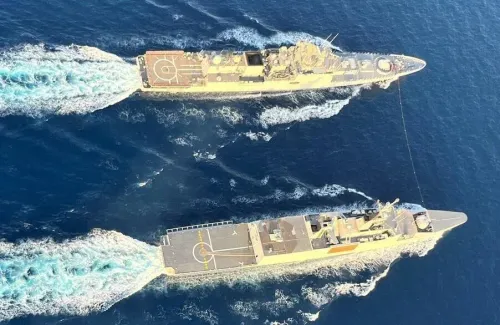
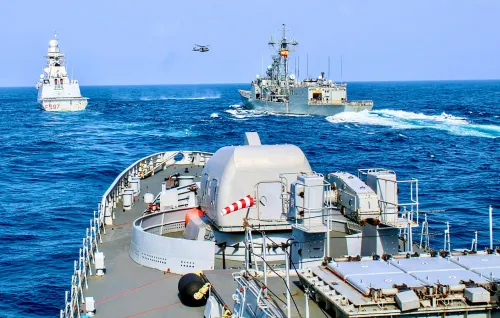
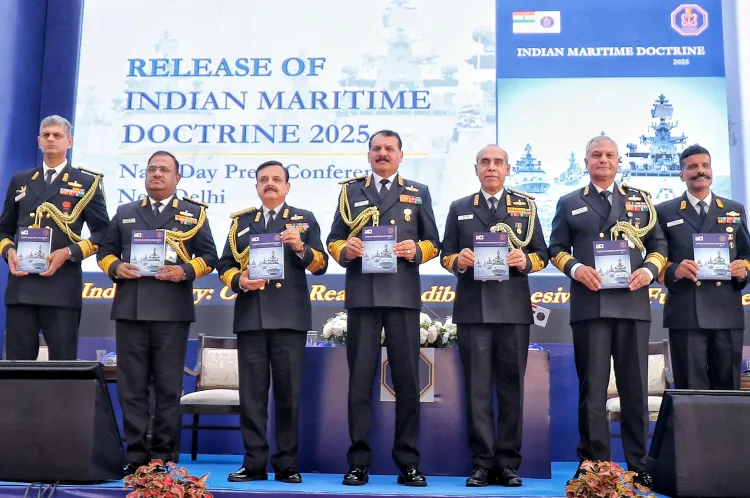
Canberra, March 14 (NationPress) India’s 2025 Maritime Doctrine reflects its goal of becoming a “preferred security partner” and “first responder” in the region, representing a significant transition from the frequent articulation of these phrases in diplomatic contexts to their formal adoption within a naval policy.
As highlighted by the Australia-based think tank Lowy Institute in its report titled ‘The Interpreter’, this doctrine has broadened its geographic focus, moving beyond the Indian Ocean Region (IOR) as the primary stage for India’s maritime strategy. The 2015 version of the doctrine expanded India’s maritime perspective by identifying principal and secondary areas of concern beyond the IOR.
The report elaborated that the doctrine positions India, the Indian Ocean Region, and the Indo-Pacific as an integrated continuum rather than a tiered system of operational priorities. This is a notable development as it incorporates the Indo-Pacific concept into the foundational framework of India’s naval strategy.
“Importantly, the new doctrine acknowledges that modern conflicts rarely fit neatly into the categories of peace and war. The document frequently mentions a state defined as “No War No Peace”—a space where nations pursue their goals without crossing the line into direct armed conflict. Instead of viewing war as a standalone event, the doctrine places it along a spectrum of cooperation, competition, confrontation, and conflict,” the report explained.
“Contemporary maritime rivalries rarely escalate into open warfare. Instead, they manifest through various pressures, including ships monitoring each other, heightened patrols, and contesting legal claims. The doctrine’s focus on these dynamics indicates that the Indian Navy perceives maritime competition as a continuous struggle for dominance,” it further stated.
The report emphasized that the doctrine is responsive to the current strategic landscape, addressing “grey-zone operations”—a concept that has gained traction in the last decade, particularly in the context of the South China Sea. Such operations exploit legal and political uncertainties, often using proxies or indirect methods to exert pressure on adversaries without triggering traditional retaliation.
“By outlining grey-zone operations, the doctrine aims to clarify a domain where terms like hybrid or irregular warfare are often conflated. This illustrates that the Indian Navy considers such activities a constant aspect of the maritime arena, rather than an unusual occurrence,” the report stated.
The doctrine also highlights that modern naval operations extend beyond direct fleet confrontations, incorporating a “cognitive” dimension.
“This involves shaping how opponents interpret situations and make choices. This emphasis is evident in discussions of “manoeuvre warfare”, typically linked with mobility and surprise, but also as a strategy to undermine an opponent’s unity and decision-making processes. This indicates a shift in Indian military doctrine, recognizing that the struggle for influence occurs in the realm of narratives and perceptions,” the report concluded.
Point of View
India's updated Maritime Doctrine reflects a strategic response to evolving maritime challenges. By formally integrating key concepts into policy, India aims to enhance its role in regional security and adapt to contemporary geopolitical dynamics while fostering a cooperative maritime environment.
NationPress
12 Oct 2026
Frequently Asked Questions
What is the main focus of India's 2025 Maritime Doctrine?
The doctrine focuses on establishing India as a preferred security partner and first responder in the Indo-Pacific region, emphasizing an integrated approach to maritime strategy.
What are grey-zone operations?
Grey-zone operations refer to activities that exploit legal and political ambiguities to exert pressure on adversaries without engaging in direct armed conflict.
How does the doctrine view modern conflicts?
The doctrine acknowledges that modern conflicts often exist on a continuum of cooperation, competition, and confrontation, rather than as distinct events.
What is the significance of the Indo-Pacific in this doctrine?
The Indo-Pacific is integrated into India's maritime strategy, reflecting a broader perspective that connects various regional interests and operational priorities.
How does the doctrine redefine naval operations?
It emphasizes that modern naval operations include cognitive elements, influencing adversaries' perceptions and decision-making processes.