What Are the Three Key Goals of India’s AI Impact Summit in Davos?

Synopsis
As India prepares to host the AI Impact Summit in New Delhi next month, the focus will center on three essential objectives: enhancing efficiency through AI, ensuring accessibility for developing nations, and establishing safety protocols. This summit aims to solidify India's role as a trusted global partner in the AI landscape.
Key Takeaways
Focus on Impact: Enhance productivity and efficiency through AI.
Accessibility for All: Ensure AI solutions are available for developing countries.
Safety First: Build regulatory frameworks to address AI-related concerns.
Investment in Startups: Support and encourage innovation within India’s thriving startup ecosystem.
Global Collaboration: Foster partnerships with major tech companies to strengthen India's AI capabilities.
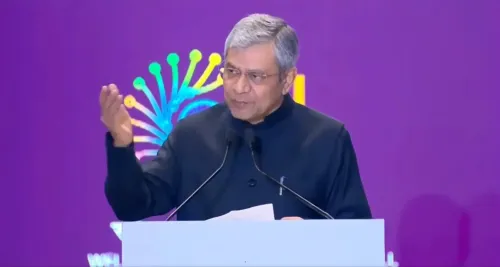
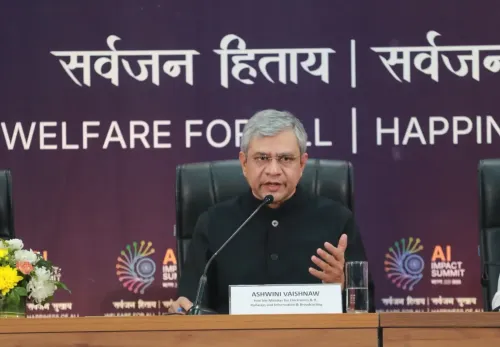
Davos, Jan 21 (NationPress) The forthcoming AI Impact Summit in New Delhi next month aims to accomplish three significant goals, as India positions itself as a credible global partner, bolstered by sovereign models, safety frameworks, and a robust semiconductor ecosystem, according to Union Minister Ashwini Vaishnaw.
The first goal is impact — exploring how AI models, applications, and the overall AI ecosystem can enhance efficiency, boost productivity, and generate a multiplier effect for the economy.
The second goal, as stated by Vaishnaw, is accessibility, particularly for India and the Global South.
By drawing comparisons with India’s success in developing the UPI and Digital Public Infrastructure (DPI) stack, Vaishnaw emphasized that the world is now looking to India to determine if a similar, scalable, and affordable stack can be established for AI.
The third aim of the AI Impact Summit is safety. He highlighted the necessity to mitigate fears surrounding AI by implementing suitable guardrails, guidelines, and safety features, asserting that the regulatory and safety framework for AI should also be developed in India.
Next month’s AI Impact Summit will feature participation from global leaders and technology experts, along with investment announcements and the unveiling of India’s AI models.
Currently, India boasts nearly 200,000 startups and ranks among the top three startup ecosystems worldwide. The minister pointed out that 24 Indian startups are involved in chip design, which is one of the most challenging areas for startups, with 18 of them having secured venture capital funding, reflecting robust confidence in India’s deep-tech capabilities.
Vaishnaw further elaborated on India’s semiconductor strategy, indicating that about 75 percent of global chip volume is concentrated in the 28nm to 90nm range, covering applications such as electric vehicles, automobiles, railways, defense systems, telecom equipment, and a considerable share of consumer electronics.
He mentioned that India is concentrating on mastering manufacturing in this segment first before advancing to more sophisticated nodes. Collaborating with industry partners, including IBM, India has a clearly defined roadmap from 28nm to 7nm by 2030, and 3nm by 2032.
Vaishnaw also met with Google Cloud CEO Thomas Kurian in Davos. Google is reinforcing its commitment to India’s AI ecosystem, including a $15 billion AI data center in Vizag, Andhra Pradesh, and establishing partnerships with Indian startups. He also engaged with Joel Kaplan, Chief Global Affairs Officer, Meta in Davos, discussing how to safeguard social media users from deepfakes and AI-generated content.
Point of View
The AI Impact Summit signifies a proactive step by India towards establishing itself as a global leader in AI technology. By focusing on critical areas such as impact, accessibility, and safety, India is not only aiming to enhance its own technological landscape but also to provide valuable solutions for the Global South, fostering international collaboration and trust.
NationPress
29 Sept 2026
Frequently Asked Questions
What are the main objectives of the AI Impact Summit?
The summit aims to improve efficiency through AI, ensure accessibility for developing nations, and establish safety protocols for AI technology.
Who is participating in the AI Impact Summit?
The event will feature global leaders and technology experts, along with key investment announcements.
What is India's semiconductor strategy?
India focuses on mastering chip manufacturing in the 28nm to 90nm range before progressing to advanced nodes, with a roadmap to reach 3nm by 2032.