What Notable Progress Has India Made in School Enrolment and Higher Education Institutions?
Synopsis
India is witnessing substantial improvements in school enrolment and higher education institutions, as highlighted in the Economic Survey 2025-26. This progress is underpinned by crucial policies and initiatives aimed at enhancing educational infrastructure and teacher capacity.
Key Takeaways
India's GER is 90.9% for primary education.
HEIs increased from 51,534 to 70,018.
NEP and Right to Education are pivotal policies.
Significant growth in premier institutes like IITs and IIMs.
Need for a holistic approach to education.
New Delhi, Jan 29 (NationPress) The government revealed that India has achieved significant progress in both school enrolment and higher education institutions, according to the Economic Survey 2025-26 presented on Thursday.
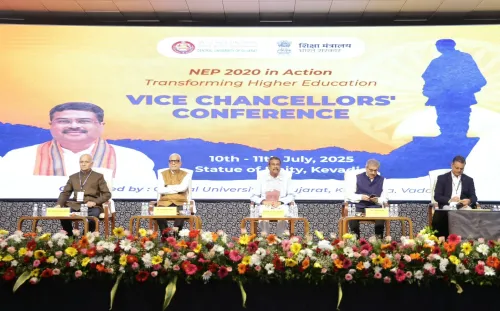
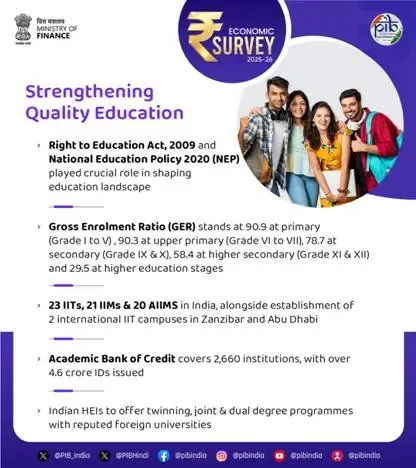
This Survey, introduced in the Parliament by Union Minister for Finance and Corporate Affairs, Nirmala Sitharaman, attributed these advancements to enhanced infrastructure and improved teacher capacity. Key policies like the Right to Education Act of 2009 and the National Education Policy 2020 (NEP) were highlighted as pivotal in this transformation.
Additional initiatives include revised UGC guidelines, regulations for academic partnerships, mutual qualification recognition, and approvals for foreign branch campuses, including those established in GIFT City.
“The education sector's accomplishments are evident through increased literacy rates, rising school and higher education enrolments, and the availability of vocational education options. The Right to Education Act 2009 and NEP 2020 have been instrumental in broadening access to quality education for all, fostering equity, and encouraging innovation in teaching and learning,” the Survey noted.
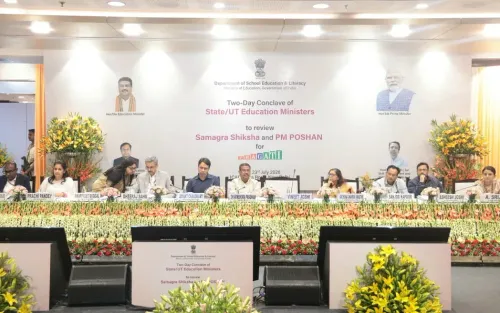
“India has notably improved school enrolment by fortifying infrastructure and enhancing teacher capacity, with programs like Poshan Shakti Nirman and Samagra Shiksha Abhiyan facilitating access and equity,” it further mentioned.
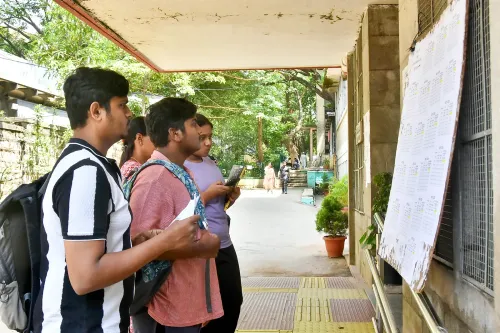
The Gross Enrolment Ratio (GER) is recorded at 90.9% for primary education (Grades I to V), 90.3% for upper primary (Grades VI to VIII), 78.7% for secondary (Grades IX and X), and 58.4% for higher secondary (Grades XI and XII).
Moreover, the Survey noted a rise in the number of higher education institutions (HEIs), increasing from 51,534 in 2014-15 to 70,018 as of June 2025, demonstrating substantial growth in both universities and colleges.
The count of premier HEIs has significantly risen from 2014-15 to 2024-25, now comprising 23 IITs, 21 IIMs, and 20 AIIMS, alongside two international IIT campuses established in Zanzibar and Abu Dhabi.
The All-India Survey on Higher Education (AISHE) for 2022-23 (Provisional) indicates an uptick in student enrolment from 4.33 crore in 2021-22 to 4.46 crore in 2022-23.
“The education sector in India needs consistent attention to realize the nation’s full potential through integrated, accountable, and adaptive policy frameworks to cultivate a future-ready workforce,” it added.
The Survey also proposed a comprehensive lifecycle approach to increase the country’s Expected Years of Schooling (EYS) to 15 years as outlined in NEP’s 5+3+3+4 schooling model for ages 3-18.
This strategy, which includes “early childhood education, foundational literacy and numeracy (FLN), universal secondary schooling, and the smooth incorporation of vocational and digital skills,” is aimed at transforming India’s vast human resources into high-quality human capital, as per the Survey.
Point of View
The advancements in India's education system are commendable. However, continuous commitment and innovative strategies are essential to ensure that this progress translates into meaningful educational outcomes for all citizens. The nation's future depends on its ability to nurture a well-educated and skilled workforce.
NationPress
27 Sept 2026
Frequently Asked Questions
What is the Gross Enrolment Ratio (GER) in India?
The Gross Enrolment Ratio (GER) in India is recorded at 90.9% for primary education, 90.3% for upper primary, 78.7% for secondary, and 58.4% for higher secondary stages.
How has the number of higher education institutions changed?
The number of higher education institutions (HEIs) in India has increased from 51,534 in 2014-15 to 70,018 as of June 2025.
What role do policies like NEP play?
Policies like the National Education Policy 2020 (NEP) play a crucial role in expanding access to quality education, promoting equity, and driving innovation in teaching methods.
What initiatives support school enrolment in India?
Initiatives such as Poshan Shakti Nirman and Samagra Shiksha Abhiyan are designed to strengthen infrastructure and teacher capacity, thereby promoting school enrolment.
What is the proposed approach for the education sector?
The proposed approach emphasizes a holistic lifecycle strategy to raise the Expected Years of Schooling (EYS) to 15 years, incorporating early childhood education and vocational skills.