Tata Group stocks lose ₹46,000 crore as Chandrasekaran exits chairman role
Synopsis
A single boardroom disagreement — one director's dissent blocking a unanimous extension — has set off a ₹46,000 crore market rout across Tata Group. Chandrasekaran's exit by February 2027 leaves India's largest conglomerate without a named successor, and the public disclosure of an unresolved board split is itself an unusual and unsettling signal for investors.
Key Takeaways
Chandrasekaran announced on 12 August he will not seek reappointment as Tata Sons chairman when his term ends in February 2027 .
Tata Group stocks lost approximately ₹46,000 crore in market value on the news.
TCS fell as much as 5.95 per cent to ₹2,300.10 ; Tata Motors Passenger Vehicles shed close to 4 per cent ; Tata Steel dropped over 2 per cent to ₹183.60 .
Both Tata trusts had unanimously backed a five-year extension, but one board member withheld support, blocking the proposal.
Chandrasekaran has chaired Tata Sons since 2017 , overseeing major acquisitions and investments across the group.
No successor has been named; the transition deadline is February 2027 .
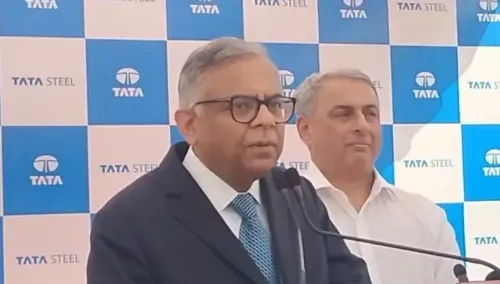
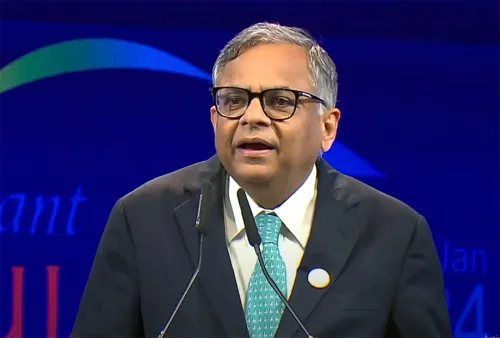
Tata Group stocks came under intense selling pressure on Wednesday, 12 August, shedding as much as 5.95 per cent and wiping out approximately ₹46,000 crore in combined market value after N. Chandrasekaran announced he would not seek reappointment as chairman of Tata Sons when his current term expires in February 2027. The announcement ended months of speculation over his future at the helm of India's largest conglomerate but opened a fresh bout of uncertainty over who leads next.
Market Reaction: Top Laggards
Tata Consultancy Services (TCS) bore the sharpest blow, falling as much as 5.95 per cent to an intraday low of ₹2,300.10 on the National Stock Exchange (NSE). Tata Motors Passenger Vehicles (TMPV) shed close to 4 per cent, while Tata Steel declined more than 2 per cent to ₹183.60. Broader group companies — including Tata Elxsi, Tata Communications, Tata Technologies, Tata Power, and Trent — also traded down by up to 2 per cent.
Why Chandrasekaran Is Stepping Down
In a formal statement, Chandrasekaran said both the Sir Dorabji Tata Trust and the Sir Ratan Tata Trust had unanimously recommended a five-year extension of his term, and that this recommendation had been recorded by the Tata Sons Nomination and Remuneration Committee and the board. However, the proposal stalled because one board member withheld support.
'I chose to defer the matter then because I felt strongly that such an important decision should not proceed without unanimous support,' Chandrasekaran said. 'It has been 6 months since that Board meeting, and no resolution has been reached till date.'
Citing the need for leadership clarity as Tata Sons executes several strategic projects, he said he had decided not to put himself forward for reappointment when his present term concludes.
Chandrasekaran's Tenure at Tata Sons
Chandrasekaran joined Tata Sons as chairman in 2017, having previously led Tata Consultancy Services. Over the past eight years, he has overseen major investments and acquisitions across the group's diverse portfolio — spanning IT services, steel, automobiles, aviation, and retail. His exit marks the end of a formative chapter for the conglomerate, which has expanded significantly under his watch.
What Happens Next
With February 2027 as the transition deadline, Tata Sons faces the task of identifying and installing a successor — a process that, given the board-level disagreement already on record, may prove more contentious than a routine handover. Analysts note that succession uncertainty at a holding company of Tata Sons' scale can weigh on group stocks until a credible name emerges. Investors will be watching for any board-level communication in the weeks ahead.
Point of View
000 crore verdict is as much about process as about personality. The fact that Chandrasekaran had to publicly disclose a board-level dissent — and that no resolution was reached in six months — suggests a governance fault line at Tata Sons that goes beyond one person's tenure. Succession at India's most storied conglomerate has historically been opaque; this episode is unusually transparent, and not in a reassuring way. Until a credible successor is named and the board speaks with one voice, the group's listed stocks carry a leadership-risk premium that fundamentals alone cannot offset.
NationPress
12 Aug 2026
Frequently Asked Questions
Why is N. Chandrasekaran leaving as Tata Sons chairman?
Chandrasekaran said he chose not to seek reappointment because a board member withheld support for his five-year extension, preventing the unanimous consensus he felt was necessary for such a decision. With no resolution reached in six months, he decided to step aside when his term ends in February 2027 to ensure leadership clarity for Tata Sons.
When does Chandrasekaran's term as Tata Sons chairman end?
His current term as chairman of Tata Sons expires in February 2027. He confirmed he will not offer himself for reappointment at that point.
Which Tata Group stocks fell the most on 12 August?
TCS was the top laggard, falling as much as 5.95 per cent to ₹2,300.10 on the NSE. Tata Motors Passenger Vehicles dropped close to 4 per cent, and Tata Steel fell over 2 per cent to ₹183.60. Tata Elxsi, Tata Communications, Tata Technologies, Tata Power, and Trent also declined by up to 2 per cent.
How much market value did Tata Group lose after the announcement?
Tata Group's listed companies lost approximately ₹46,000 crore in combined market capitalisation on Wednesday following Chandrasekaran's announcement.
Who might succeed Chandrasekaran as Tata Sons chairman?
No successor has been publicly named as of 12 August. The board of Tata Sons will need to identify and appoint a new chairman before February 2027. The unresolved internal disagreement that preceded Chandrasekaran's exit suggests the succession process may be closely watched by investors and analysts.