Tata Sons Chairman Warns of Potential Global Supply Chain Disruption Due to Ongoing Iran Conflict
Synopsis
Tata Sons Chairman Natarajan Chandrasekaran highlights the risks of a prolonged Iran war affecting global supply chains while reassuring that Tata Group and India remain unaffected for now. His insights come during a visit to Jamshedpur for a significant commemorative event.
Key Takeaways
Chandrasekaran warns of potential global supply chain disruptions due to the Iran conflict.
No immediate impact on India or Tata Group operations reported.
The Tata Group workforce has expanded significantly in recent years.
Employee safety and wellbeing are top priorities for the company.
Tata aims to increase female representation in its workforce.
New Delhi, March 3 (NationPress) Natarajan Chandrasekaran, the Chairman of Tata Sons, raised alarms regarding the ongoing strife involving the US, Israel, and Iran, cautioning that an extended conflict in the Middle East could lead to broader global repercussions.
Nevertheless, he emphasized that there has been no immediate effect on India or the Tata Group as of now.
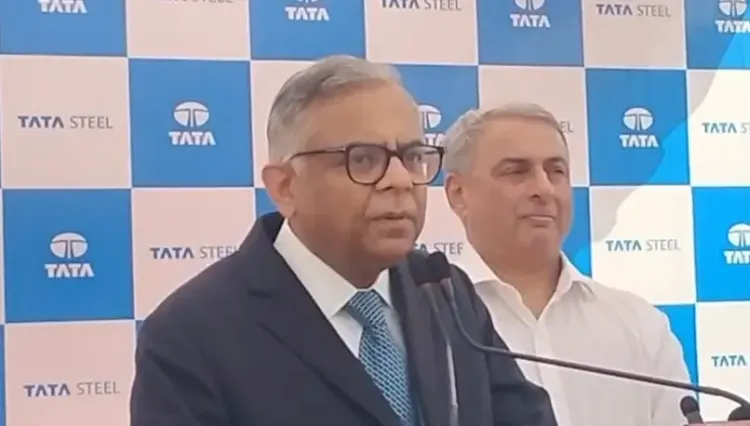
Chandrasekaran made these remarks to the press during his visit to Jamshedpur to commemorate the 187th birth anniversary of Jamsetji Tata, the founder of the Tata Group.
He honored the pioneering industrialist at the primary Founder’s Day event held at the Tata Steel site and conveyed his best wishes to the local populace.
Discussing the global climate, Chandrasekaran pointed out that the Middle East is a crucial source of raw materials such as limestone for the group.
“Considering Tata’s extensive international operations, any prolonged dispute could potentially disrupt global supply chains, logistics, delivery timelines, and sustainability initiatives,” he remarked.
However, he reiterated that the current situation has not had any discernible impact on the group’s activities or on India.
He also noted that Tata Group personnel are engaged in various sectors including manufacturing, services, and hospitality worldwide.
“Prioritizing the safety and welfare of our employees and their families is of utmost importance to us, and we are vigilantly monitoring developments while implementing necessary precautions,” he stated.
Regarding employment, Chandrasekaran observed that new ventures and expansion strategies are consistently generating job openings.
In the past five to six years, the workforce has expanded from around 700,000 employees to nearly 1.1 million.
The company now aims to boost this figure to 1.5 million in the next five to six years. He also added that efforts are in place to elevate the proportion of women employees to about 28-30 percent.
Addressing the IT sector and emerging technologies, he acknowledged that concerns about job displacement due to new technologies are understandable.
Point of View
The ongoing conflict in the Middle East, particularly involving Iran, raises significant concerns about potential disruptions in global supply chains. However, it is crucial to note that, as per Tata Sons Chairman Natarajan Chandrasekaran, there is currently no immediate impact on India or the Tata Group. This perspective highlights the need for vigilance while also emphasizing the resilience of Indian businesses.
NationPress
19 Sept 2026
Frequently Asked Questions
What did Natarajan Chandrasekaran say about the Iran conflict?
He expressed concerns that a prolonged conflict could disrupt global supply chains but noted no immediate impact on India or the Tata Group.
How has Tata Group's workforce changed recently?
The workforce has grown from around 700,000 to approximately 1.1 million in the past five to six years, with plans to reach 1.5 million.