Will J&K Government Maximize IWT Abeyance? CM Omar Abdullah Speaks
Synopsis
In a significant announcement, Jammu and Kashmir's Chief Minister Omar Abdullah revealed plans to leverage the current abeyance of the Indus Water Treaty (IWT) for strategic water infrastructure projects. This move aims to address the long-term water needs of Jammu, reflecting a shift in resource management amid ongoing challenges.
Key Takeaways
Utilization of IWT Abeyance: The government aims to capitalize on the current suspension of the IWT.
Long-Term Water Solutions: Plans are in place to address water needs for the next 30 to 50 years.
Collaboration with the Centre: Close cooperation is underway on major water projects.
Historical Context: The IWT has historically limited water resource development in the region.
Future Opportunities: The current situation presents a chance to revisit crucial water supply projects.
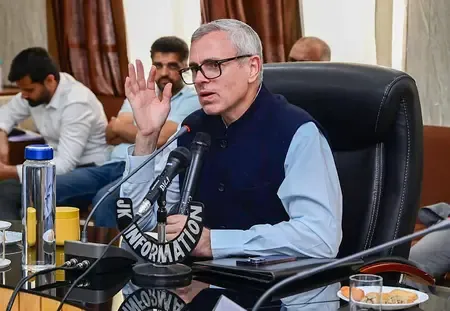
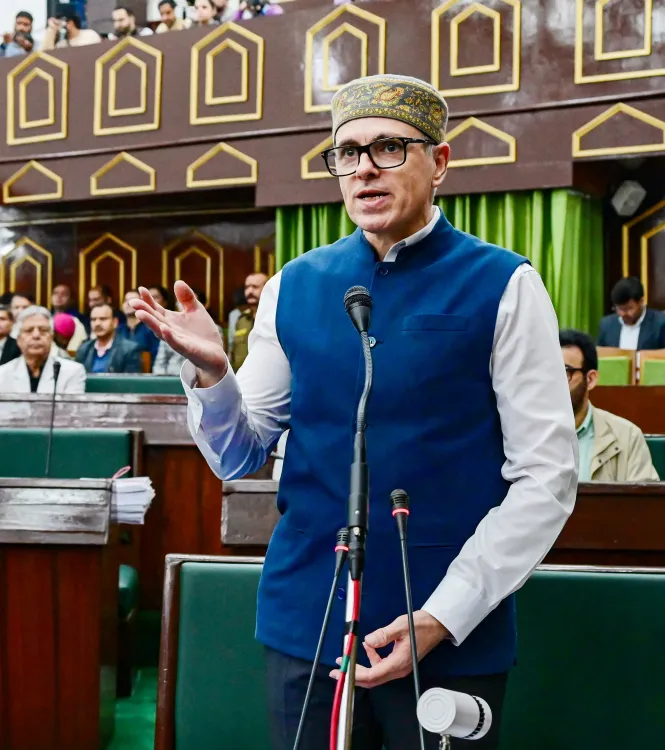
Jammu, Feb 10 (NationPress) The Chief Minister of Jammu and Kashmir, Omar Abdullah, announced on Tuesday that the government of the union territory intends to make the most of the Indus Water Treaty (IWT) abeyance to execute multiple water infrastructure initiatives.
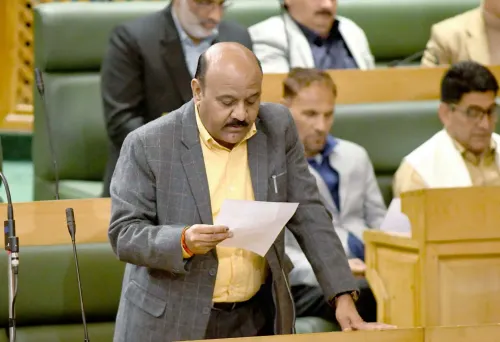
The Legislative Assembly saw BJP MLAs, including former minister Sham Lal Sharma, highlight the issues surrounding numerous inactive tubewells and other water resource projects during the Question Hour.
CM Omar Abdullah acknowledged that the short-term fixes for water issues in Jammu resemble merely putting a band-aid on a wound, as accurately pointed out by Sham Lal Sharma. He stressed the necessity for the government to devise long-term strategies that address water requirements for the next 30 to 50 years, given that traditional water sources will not be adequate for future demands.
He reflected on how, during the coalition government with the NC and Congress, when Sham Lal Sharma was a minister, a plan to provide water to Jammu city from the Chenab river could not be actualized due to the IWT.
“The proposal was forwarded to the Asian Development Fund via the Economic Reconstruction Agency (ERA), but was turned down due to IWT restrictions,” CM Omar noted.
He informed the Assembly that with the IWT currently in abeyance, there is a chance to revisit the Chenab River water supply project for Jammu city.
“Our government is collaborating closely with the Centre to seize the full potential of the IWT abeyance,” he stated.
“We are engaged with the Centre on two key projects: the Tulbul Navigation Barrage on the Jhelum river near Sopore in north Kashmir and lifting water from the Chenab river in Akhnoor to supply Jammu city with water.
“We are optimistic about obtaining approvals for both initiatives soon, enabling us to commence work,” CM Abdullah remarked.
It is noteworthy that the IWT was signed between India and Pakistan on September 19, 1960.
The treaty granted India control over three major rivers of Punjab: the Sutlej, Ravi, and Beas, while Pakistan retained the Indus, Jhelum, and Chenab rivers flowing through Jammu and Kashmir.
India is allowed to fully utilize the waters of the rivers assigned to it, but it cannot construct dams or barrages that would obstruct the rivers assigned to Pakistan in Jammu and Kashmir.
Only run-of-the-river projects with limited hydropower capacity are permitted in Jammu and Kashmir.
Thus, the IWT has restricted Jammu and Kashmir from fully harnessing the potential of the Indus, Chenab, and Jhelum rivers.
Following the terrorist attack in Pahalgam on April 22 last year, which resulted in the deaths of 26 innocents, including 25 tourists and one local pony owner, India declared its decision to suspend the IWT, and this suspension continues to this day.
Point of View
It is essential to recognize the implications of Jammu and Kashmir's strategic water management decisions. The focus on long-term planning in light of the IWT abeyance reflects a necessary shift towards sustainable resource utilization. This approach aligns with national interests and fosters regional development.
NationPress
3 Oct 2026
Frequently Asked Questions
What is the Indus Water Treaty?
The Indus Water Treaty is a water-sharing agreement signed between India and Pakistan in 1960, allocating control over six major rivers.
What does it mean for the IWT to be in abeyance?
The current abeyance of the IWT indicates a temporary suspension of its regulations, allowing for potential new projects to be considered.
Why is water infrastructure important for Jammu?
Long-term water infrastructure is crucial for addressing future demands and ensuring sustainable resources for the growing population in Jammu.
What projects are being planned in Jammu?
The Jammu government is planning projects like the Tulbul Navigation Barrage and lifting water from the Chenab river to improve water supply.
How does the IWT affect Jammu and Kashmir's water resources?
The IWT restricts the construction of dams on rivers assigned to Pakistan, limiting Jammu and Kashmir's ability to fully utilize its water resources.