Japan's Defence Minister Strongly Defends Military Enhancements Against Chinese Criticism
Synopsis
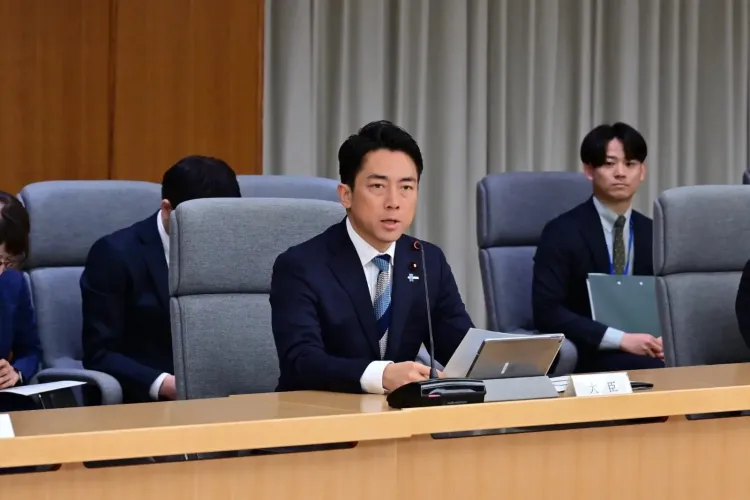
In a strong rebuttal, Japanese Defence Minister Shinjiro Koizumi defends Japan's military capabilities against Chinese criticism, emphasizing the need for enhanced defence in light of rising security threats. The ongoing tensions highlight the complexities of international relations in the region.
Key Takeaways
Shinjiro Koizumi defends Japan's military enhancements against China ’s criticisms.
Japan's defence strategy is influenced by rising security threats.
China is the fourth-largest arms exporter globally.
Japan emphasizes the importance of international law and dialogue.
Ongoing tensions between Japan and China highlight regional complexities.
Tokyo, February 27 (NationPress) – In a robust response to China's recent criticisms regarding Japan's defence enhancements, Japanese Defence Minister Shinjiro Koizumi has firmly defended Tokyo's actions, as reported by local media on Friday.
When questioned about the government's initiative to lift restrictions on defence equipment transfers, which currently limit them to five non-combat purposes—rescue, transport, warning, surveillance, and minesweeping—Koizumi remarked, "It seems China is conducting a propaganda campaign against us, implying that Japan is becoming militaristic," according to Kyodo News.
During a press conference, Koizumi emphasized that the government's strategy is primarily motivated by the escalating security challenges posed by China, referencing data from the Stockholm International Peace Research Institute.
He highlighted that China’s arms exports between 2015 and 2024 are projected to reach approximately USD 17 billion, positioning it as the fourth-largest arms exporter globally, while Japan does not even rank among the top 50.
China has criticized Japan and enacted various economic sanctions following comments made by Japanese Prime Minister Sanae Takaichi in November, suggesting that a Chinese aggression against Taiwan could provoke a response from Japan’s Self-Defence Forces. China regards Taiwan as part of its territory and insists on reunification, potentially by force.
In the context of today's security landscape, Koizumi stated, "It is crucial for us to enhance our own defence capabilities without relying on a specific nation for parts procurement," as reported by Kyodo News.
Last December, Japan's Permanent Representative to the United Nations, Yamazaki Kazuyuki, addressed a letter to UN Secretary General Antonio Guterres, branding China's critiques of Takaichi's comments about Taiwan as "inconsistent with the facts, unsubstantiated, and unacceptable."
In his response to China's letter to the UN Secretary General, Yamazaki reiterated, "The claims made in China's previous letter dated November 21 are not based on factual evidence, and are entirely unacceptable. Japan’s stance is detailed in my letter of November 24, which I am attaching again for your reference."
"Since the conclusion of World War II, Japan has consistently upheld international law, including the UN Charter, and has actively contributed to maintaining and strengthening a free and open global order rooted in the rule of law, alongside promoting the sustainable development of the international community. This steadfast commitment by Japan is widely acknowledged internationally. As a peace-loving nation, Japan will continue to contribute to global peace, stability, and prosperity, in full compliance with international law," he added.
He expressed Japan's belief that differences in opinion should be resolved through dialogue, reiterating Tokyo's readiness to engage in discussions. Yamazaki's recent correspondence with the UN was prompted by ongoing Chinese criticisms of Takaichi's statement in parliament on November 7, where she articulated that an attack on Taiwan could pose an existential threat to Japan and necessitate a response from its Self-Defence Forces, according to Kyodo News.
Yamazaki's latest letter to the UN follows a second communication from China’s Permanent Representative to the UN, Fu Cong, warning that "the international community must remain vigilant against Japan's ambitions to bolster its military capabilities and revive militarism."
Point of View
Japan's assertive stance on their defence capabilities reflects a necessary response to regional security threats, particularly from China. The situation underscores the importance of maintaining a balance between national security and international diplomacy.
NationPress
6 Oct 2026
Frequently Asked Questions
What prompted Japan to enhance its defence capabilities?
Japan's push to enhance its defence capabilities has been largely driven by rising security threats from China, as indicated by Japanese Defence Minister Shinjiro Koizumi.
How has China reacted to Japan's defence initiatives?
China has criticized Japan's initiatives and imposed various economic measures in response to comments from Japanese officials regarding potential military actions.
What are the historical concerns regarding Japan's military?
Japan's military history is sensitive due to its actions during World War II, and any perceived militarization raises concerns both domestically and internationally.
What role does the UN play in this situation?
The UN serves as a platform for diplomatic communication, where Japan has addressed its stance against China's criticisms of its military policies.
What is Japan's official stance on international law?
Japan maintains that it has consistently respected international law and aims to contribute to global peace and stability in accordance with the UN Charter.