Karnataka Faces ₹10,000 Crore Revenue Gap This Year, Says CM Siddaramaiah
Synopsis
Karnataka's Chief Minister Siddaramaiah highlights a projected revenue shortfall of ₹10,000 crore in the current financial year due to GST rate rationalization by the Central Government. The impact on state finances raises concerns about future funding and fiscal stability.
Key Takeaways
Karnataka faces a revenue shortfall of Rs 10,000 crore this financial year.
GST is the primary tax revenue source, making up 43% of the state's tax income.
The state ranks second in the nation for GST collections.
Revenue growth has significantly dropped from 10% to 4% after GST rate changes.
There are calls for compensation from the Centre to address revenue losses.
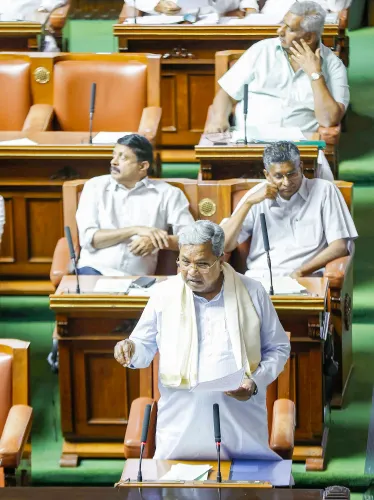
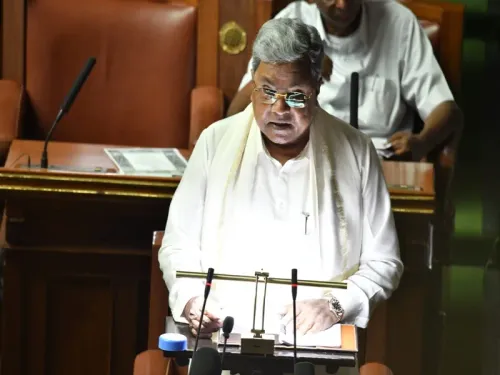
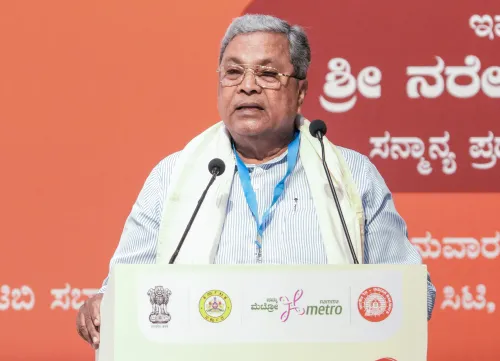
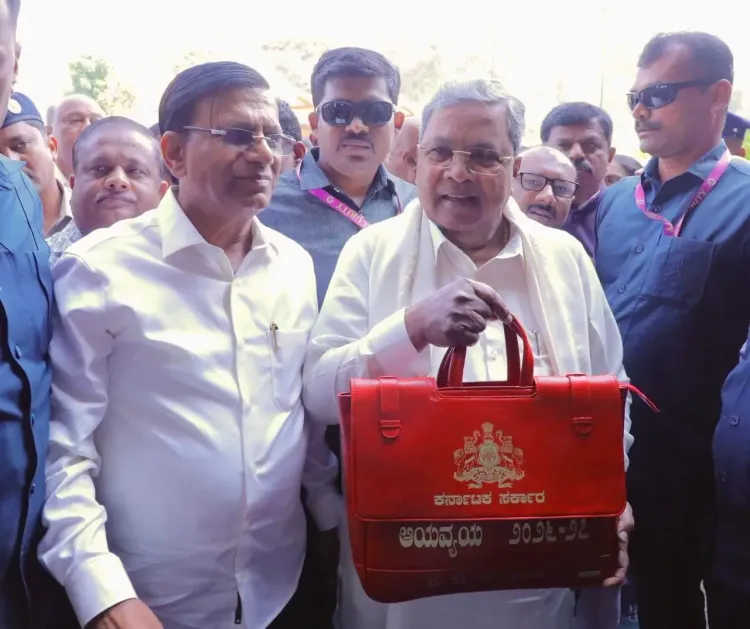
Bengaluru, March 6 (NationPress) Karnataka's Chief Minister Siddaramaiah stated on Friday that the recent adjustments to the Goods and Services Tax (GST) rates by the Central Government have negatively impacted the state's revenue, resulting in a considerable deficit for the current financial year.
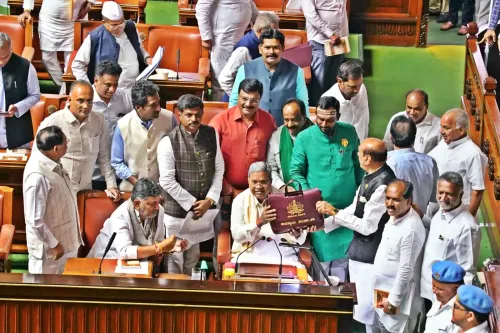
While presenting the state Budget for 2026–27, Siddaramaiah projected that these rate modifications are likely to culminate in an anticipated revenue shortfall of approximately Rs 10,000 crore for this financial year, with an estimated Rs 15,000 crore shortfall anticipated for the following year.
The Chief Minister emphasized that GST constitutes the primary source of tax revenue for Karnataka, contributing to 43 percent of the state's own tax revenue. Karnataka stands as the second highest state in the nation for GST revenue collection.
Siddaramaiah noted that the state’s revenue has dwindled following the unexpected GST rate rationalization by the Centre mid-financial year. Prior to the adjustments in 2025–26, the state enjoyed an average monthly GST revenue growth rate of 10 percent (net of refunds). However, this growth rate has plummeted to 4 percent post-revision.
He further expressed concern that GST collection at the national level has also been underwhelming.
"In comparison to the Union Government's Budget predictions for 2025–26, GST collections have decreased by 11 percent in the revised estimates and by 13.4 percent in the 2026–27 Budget estimates. These figures are below the actual collections recorded in 2024–25," he remarked.
Overall, national GST collections are projected to fall short by Rs 1.3 lakh crore this year and Rs 2 lakh crore next year, leading to a reduction in the share of taxes allocated to states.
Siddaramaiah highlighted that the decline in GST collections has significantly strained state finances. He noted that the restructuring of tax rates and regulations has had a more immediate effect on state revenues compared to the Centre's finances.
Meanwhile, the Centre is still generating revenue from cess and various levies on items such as luxury goods and tobacco, with all proceeds directed to the Union government's treasury.
The Chief Minister expressed support for GST rate rationalization in principle but underscored the necessity of protecting states' financial interests. Karnataka, along with seven other states, has submitted a collective memorandum to the GST Council advocating for measures to preserve state revenues and compensate for losses stemming from the rate changes.
He reiterated the state's demand for the Centre to provide essential compensation to mitigate the revenue losses incurred due to GST rationalization.
Addressing tax devolution, Siddaramaiah remarked that the share of central taxes allocated to states has become increasingly vital given the limitations on Karnataka's own tax revenues. The Fourteenth Finance Commission had suggested a tax devolution share of 4.713 percent for Karnataka, but this was reduced to 3.647 percent during the Fifteenth Finance Commission, reflecting a 23 percent decline.
He mentioned that the state has experienced an overall loss of about Rs 65,000 crore over the six-year duration of the Fifteenth Finance Commission. Furthermore, the Centre has not released the special grant of Rs 5,495 crore and the state-specific grant of Rs 6,000 crore as recommended by the commission.
Siddaramaiah urged the Sixteenth Finance Commission to adopt a tax devolution formula that balances equity and growth, taking into account the fiscal performance and economic contributions of states.
He acknowledged the commission's recommendation of a tax share of 4.131 percent for Karnataka for the period 2026–31, signifying a 13 percent increase compared to the share proposed by the Fifteenth Finance Commission. Although the state had anticipated the restoration of the 4.713 percent share previously recommended, the new guideline somewhat alleviates the tax devolution imbalance.
Siddaramaiah commended the commission’s decision to factor in a state’s contribution to the national GDP when determining the tax devolution formula, highlighting it as a crucial step that recognizes the economic achievements and growth potential of states.
Despite the challenges in revenue generation, the Chief Minister affirmed the state government's commitment to prudent expenditure management to achieve a balance among economic development, welfare initiatives, and fiscal responsibility.
Since launching the government's guarantee schemes, the state has allocated a total of Rs 1,21,598 crore up to February 2026. The government has fulfilled its obligations to the public while adhering to fiscal discipline.
Despite the dwindling revenues attributed to GST rationalization and reduced tax devolution from the Centre, the government has maintained fiscal discipline over the past three years. As per the Karnataka Fiscal Responsibility Act, the state has kept the fiscal deficit within 3 percent of the Gross State Domestic Product (GSDP) and total public liabilities within 25 percent of GSDP.
He reaffirmed the state’s dedication to upholding fiscal discipline and ensuring long-term financial sustainability.
Point of View
Raising important questions about state revenue sustainability and fiscal management. The situation calls for a thorough examination of the impacts on state economies and the need for protective measures.
NationPress
29 Sept 2026
Frequently Asked Questions
What is the projected revenue shortfall for Karnataka this year?
The projected revenue shortfall for Karnataka this financial year is approximately ₹10,000 crore.
Why has Karnataka's revenue collection decreased?
The decrease in Karnataka's revenue collection is primarily due to the Central Government's rationalization of GST rates, which has negatively affected the state's GST revenues.
What is the main source of tax revenue for Karnataka?
The main source of tax revenue for Karnataka is the Goods and Services Tax (GST), which accounts for 43 percent of the state's tax revenue.
How does Karnataka's GST collection compare to other states?
Karnataka ranks second in the country for GST revenue collection.
What measures is Karnataka seeking from the Central Government?
Karnataka is seeking compensation from the Central Government to offset the revenue losses incurred due to GST rationalization.