Karnataka Government Affirms No Media Restrictions at Vidhana Soudha, Defends Prior Directives
Synopsis
The Karnataka government asserts that there are no restrictions on media in Vidhana Soudha, defending its earlier directive requiring media interactions to take place exclusively at the West Gate, amid rising concerns over press freedom.
Key Takeaways
Karnataka government claims no media restrictions exist in Vidhana Soudha.
Media must gather responses only at the West Gate for security reasons.
Previous directives regarding media access have faced significant criticism.
Concerns over press freedom have been raised by opposition parties.
Recent theft incident may have influenced the government's media policies.
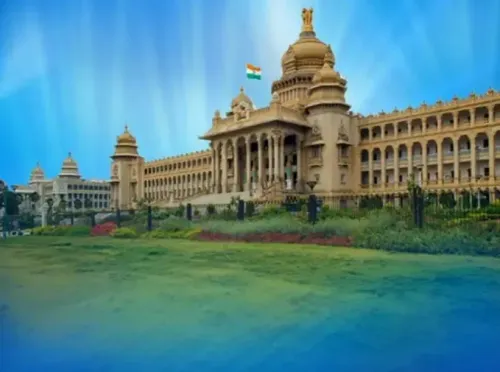
Bengaluru, March 9 (NationPress) The Karnataka administration clarified on Monday that it has not imposed any limitations on the media's access within Vidhana Soudha. The government also stood by its previous directive, which mandated that media representatives gather responses solely at the West Gate of Vidhana Soudha.
This clarification was issued by K.G. Jagadeesha, Secretary to the Government, Department of Personnel and Administrative Reforms (DPAR), in reply to a correspondence from R. Ashoka, Leader of the Opposition in the Assembly.
Ashoka's letter, dated February 23, requested the government to reinstate unrestricted access for media personnel to report on events inside Vidhana Soudha.
The government asserted, “Media personnel holding accreditation cards from the Information and Broadcasting Department face no restrictions when covering any event, workshop, press conference, or meeting at Vidhana Soudha. Journalists are currently reporting from such events, eliminating the need for a separate order.”
Additionally, the government reminded the Leader of the Opposition that media access to the Legislators’ House had been constrained previously, with an order issued on February 18, 2020.
It is noteworthy that in 2020, the BJP administration led by former CM B.S. Yediyurappa was in control of Karnataka.
The earlier directive from DPAR, instructing journalists to conduct interviews at the portico near the West Gate in an organized manner, aimed solely at ensuring security.
This declaration is expected to generate debate, as the past order faced significant resistance.
The Karnataka government had previously restricted media access within the State Legislature complex, which drew sharp criticism from opposition factions and raised alarms regarding press freedom.
The DPAR had mandated that journalists conduct interviews with legislators and solicit their responses only at a designated area, specifically the portico near the West Gate of Vidhana Soudha.
The order also stipulated that the Chief Minister, Deputy Chief Minister, ministers, and other dignitaries should not be pursued for comments within the complex.
In correspondence sent by the DPAR Secretary to the Director of the Information and Public Relations Department, officials were instructed to ensure compliance among all media representatives.
A copy of this communication was also forwarded to the Deputy Commissioner of Police overseeing Vidhana Soudha's security. The letter emphasized the necessity for the media to gather responses only at a specified location.
The government justified this move as essential for safety and security.
Critics, however, claimed that it infringes on freedom of expression and restricts access to elected officials within the legislative complex. Some opposition leaders have also alleged that these limitations could obstruct their ability to engage openly with journalists on-site.
This controversy arises shortly after allegations surfaced regarding the purported theft of 300 grams of gold within Vidhana Soudha, allegedly involving a DPAR staff member. Critics suggest that the department is tightening media access to divert attention from this incident.
The JD(S) and BJP parties accused the ruling Congress of feeling threatened by challenging questions from journalists.
The party contended that restricting media movement inside Vidhana Soudha signifies insecurity within the government and questioned why ministers and MLAs would be apprehensive of scrutiny.
The JD(S) labeled this action as an assault on democratic values and press freedom, imploring the Chief Minister to promote transparency rather than suppress the media.
Point of View
The previous directives have drawn criticism, highlighting the tensions between transparency and safety in political reporting.
NationPress
15 Sept 2026
Frequently Asked Questions
What are the current media access rules in Vidhana Soudha?
The Karnataka government has clarified that media personnel holding accreditation cards can access events without restrictions, but must gather responses only at the West Gate.
What did the opposition leader request from the government?
R. Ashoka, the Leader of the Opposition, urged the government to restore unrestricted media access to cover news from within Vidhana Soudha.
Why did the government implement prior restrictions on media access?
The previous restrictions were justified by the government as necessary for ensuring the safety and security of the legislative complex.
What criticism has the government faced regarding media restrictions?
The government has faced accusations of curtailing press freedom and limiting journalists' ability to communicate with elected representatives.
What recent incident has fueled concerns over media access?
Concerns were heightened following reports of a theft involving a DPAR staff member, leading critics to suggest the government is attempting to distract from the issue.