Is KCR Fueling Water Disputes to Bolster the BRS?
Synopsis
Telangana's Chief Minister A. Revanth Reddy accuses former CM K. Chandrasekhar Rao of instigating conflicts over water resources between Andhra Pradesh and Telangana. This controversial claim raises questions about the BRS's political motives amid electoral struggles. The ongoing water rights debate reflects the complexities of regional politics in India.
Key Takeaways
Revanth Reddy's allegations against KCR highlight political strife in Telangana.
Water rights remain a contentious issue between Andhra Pradesh and Telangana.
The Palamuru-Rangareddy project faces scrutiny over mismanagement.
Electoral challenges for BRS may influence KCR's political maneuvers.
Regional sentiments continue to shape political narratives.
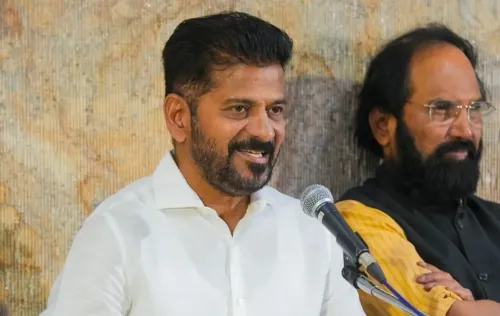
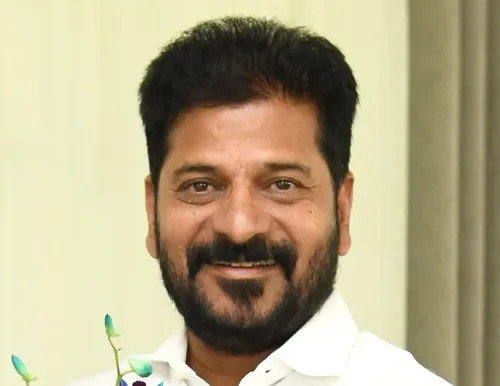
Hyderabad, Jan 1 (NationPress) The Chief Minister of Telangana, A. Revanth Reddy, accused former Chief Minister K. Chandrasekhar Rao (KCR) on Thursday of instigating water disputes between Andhra Pradesh and Telangana as a strategy to sustain his political party.
The Chief Minister charged KCR with attempting to preserve the Bharat Rashtra Samithi (BRS) by arousing regional sentiments and invoking N. Chandrababu Naidu, the Chief Minister of Andhra Pradesh, in Telangana.
He also claimed that KCR, the President of BRS, avoided attending the state Assembly out of fear of being interrogated regarding the alleged misappropriation of funds tied to irrigation initiatives.
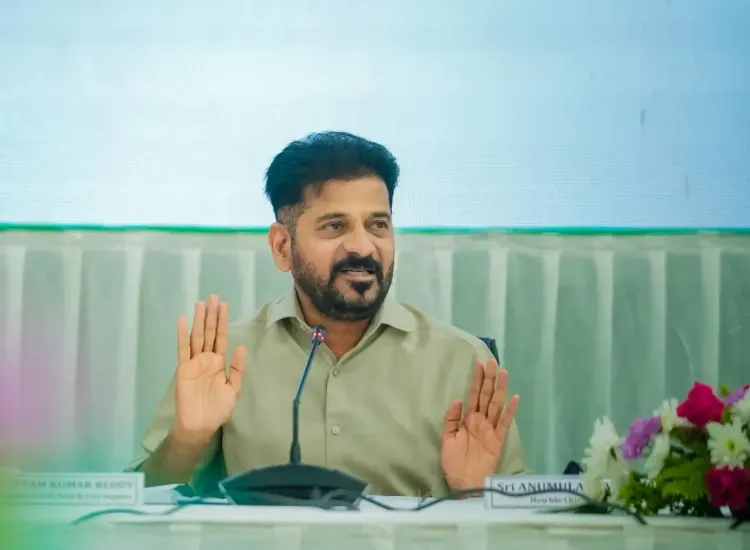
Revanth Reddy made these remarks during a meeting where State Irrigation Minister Uttam Kumar Reddy delivered a presentation on irrigation projects and river water challenges to Ministers, Congress legislators, and senior officials.
This presentation aimed to equip Ministers and MLAs to effectively respond to challenges posed by the Opposition BRS in the upcoming Assembly discussions on irrigation and river water matters.
The Chief Minister challenged KCR to engage in the Assembly debate.
Revanth Reddy reminded attendees that the movement for Telangana was primarily about securing water rights.
"Had the water from the Krishna and Godavari rivers been fully utilized during the 10-year BRS tenure, Telangana could have achieved tremendous growth," he stated.
He pointed out that before bifurcation, 811 TMC of Krishna water was allocated to undivided Andhra Pradesh, which received 512 TMC post-bifurcation, while Telangana was assigned 299 TMC.
The Chief Minister asserted that KCR had signed documents agreeing to the 299 TMC allocation for Telangana.
"KCR's signature inadvertently favored Andhra Pradesh, as it allotted 66 percent of the water share to them and only 34 percent to Telangana," he claimed.
Revanth Reddy remarked that if the course of the Krishna river were scrutinized, Telangana should receive 71 percent of its water.
"KCR has failed to present compelling arguments regarding this. Presently, the Krishna River Management Board acknowledges that KCR consented to the 299 TMC allocation," he stated.
Additionally, he noted that the BRS's survival is jeopardized following electoral defeats in the state Assembly and Lok Sabha elections, along with state Assembly bypolls.
"Acknowledging this reality, KCR is once again attempting to provoke water disputes between the states to salvage his party. He is spreading misinformation against the Congress government as part of this agenda," he asserted.
The Chief Minister criticized KCR for not submitting a detailed project report (DPR) for the Palamuru-Rangareddy Irrigation Project over seven years.
"Despite the absence of a DPR, he allocated Rs 27,000 crore. Due to the lack of a DPR, the project did not receive environmental clearance," he added.
When the Supreme Court intervened to halt construction of the Palamuru project without approvals, KCR's government submitted an affidavit claiming it was not an irrigation project.
He added that the Supreme Court was informed that the project would only utilize 7.15 TMC for drinking water purposes.
Revanth Reddy alleged that KCR disbursed Rs 27,000 crore to pump and lift companies as commissions.
"He (KCR) orchestrated a scheme to classify it as a lift project to enhance his commission profits," the Chief Minister remarked.
He explained that the Palamuru project was initially intended to draw water from Jurala, but KCR realized that doing so would eliminate the need to lift water.
"Thus, KCR switched it to Srisailam, but only 0.25 TMC could be extracted from the Srisailam backwaters," he concluded.
Point of View
The ongoing accusations between political leaders in Telangana underscore the challenges of water resource management and regional politics in India. The claims made by Chief Minister Revanth Reddy reflect deeper concerns about transparency and governance, which resonate with citizens seeking accountability from their elected officials.
NationPress
19 Sept 2026
Frequently Asked Questions
What accusations did Revanth Reddy make against KCR?
Revanth Reddy accused KCR of inciting water disputes between Andhra Pradesh and Telangana to protect the BRS party and evade accountability for alleged financial mismanagement in irrigation projects.
What is the significance of the Palamuru-Rangareddy Irrigation Project?
The Palamuru-Rangareddy Irrigation Project is critical for water management in Telangana. Revanth Reddy criticized KCR for not submitting a detailed project report, which is essential for environmental clearance and project legitimacy.
How have the water allocations changed after the bifurcation?
Post-bifurcation, Andhra Pradesh was allocated 512 TMC of Krishna water, while Telangana received 299 TMC, which Revanth Reddy argues is insufficient for Telangana’s needs.
What does the Krishna River Management Board state?
The Krishna River Management Board acknowledges that KCR agreed to the 299 TMC allocation, which Revanth Reddy claims is disadvantageous for Telangana.
What political implications do these accusations hold?
These accusations highlight the growing tensions in regional politics and the potential impact on the electoral prospects of the BRS amidst allegations of governance failures.