What is the 'Orchha Kalam' Tradition in Historic Wall Paintings?
Synopsis
Discover the intriguing world of the 'Orchha Kalam' as a new book reveals its significance in historic wall paintings. Authored by Dr. Vishwapati Trivedi and Mona Trivedi, this publication highlights the urgent need for preservation of these artistic treasures that narrate Bundela royal history and mythology.
Key Takeaways
Orchha Kalam is a distinct artistic tradition.
The book emphasizes the need for preservation of historical artworks.
Orchha's murals depict the Bundela royal life and mythology.
Vishwapati Trivedi and Mona Trivedi conducted research over 40 years .
The publication serves as a valuable resource for art historians and conservationists.
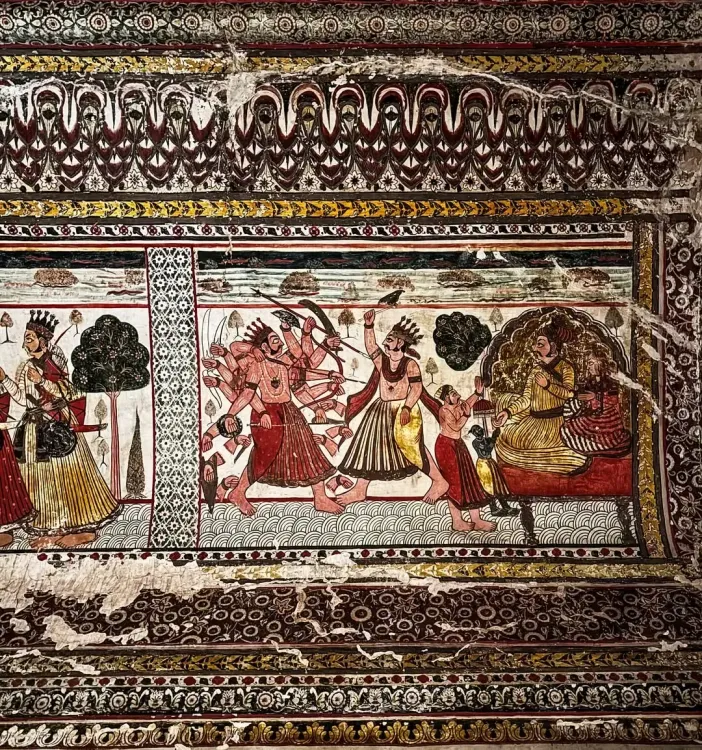
New Delhi, Jan 10 (NationPress) A recently released scholarly work has shed new light on the historic wall paintings of Orchha, Madhya Pradesh, by categorizing them as a unique and self-sufficient artistic tradition known as the 'Orchha Kalam'.
The publication, titled Orchha Kalam, is co-authored by Dr. Vishwapati Trivedi, IAS (Retd), a former Secretary to the Government of India, along with Mona Trivedi. Their research spans over four decades and includes rare photographic documentation and comprehensive studies.
The authors first discovered these remarkable murals in the late 1970s, when they noted a concerning trend of neglect and vandalism affecting Orchha’s ancient wall paintings.
Worried about the lack of systematic records, they initiated a thorough photographic survey of the artworks, initially aided by a research grant from the Indian Council of Historical Research (ICHR).
Orchha, a historic town in Madhya Pradesh, holds a special place in India. Alongside Ayodhya, it uniquely honors Lord Rama not just as a deity but as the reigning monarch of the town.
The centerpiece of this devotion is the Chaturbhuj Temple, which is dedicated to Lord Rama in his four-armed form. Constructed by Queen Ganesh Kunwar, the wife of Raja Madhukar Shah, in the late 16th century, its impressive spire and grand architecture make it one of Orchha's most notable landmarks.
Next to it lies the Raj Mandir (also referred to as Raja Mahal), built by Raja Madhukar Shah during his reign from 1554 to 1591. This palace-temple complex is adorned with exquisite murals and frescoes depicting scenes from the Ramayana, showcasing the artistic excellence of the Orchha painting tradition.
Over the past four decades, despite various professional obligations and periods abroad, the couple has persistently pursued their research. They collaborated with leading international institutions and art historians, utilizing rare photographic evidence and in-depth analysis to establish the paintings as a distinct school.
The book features rare visuals, detailed record-keeping, and expert interpretations, making it an invaluable resource for researchers, students, art historians, and conservationists.
By emphasizing the 'Orchha Kalam', the publication aims to foster awareness regarding the necessity for long-term preservation of these delicate cultural artifacts, vividly portraying Bundela royal life, mythology, and historical narratives.
This work accentuates Orchha's significance within India's mural painting legacy, contributing to broader initiatives aimed at preserving sites like the palaces and temples adorned with these artworks.
Point of View
It is imperative to recognize the unique cultural heritage embodied in the 'Orchha Kalam'. This publication not only revives interest in India's artistic traditions but also underscores the importance of preserving our historical narratives. Such scholarly works contribute to a deeper understanding of our collective past and the need for vigilance in conservation efforts.
NationPress
30 Sept 2026
Frequently Asked Questions
What is the 'Orchha Kalam'?
The 'Orchha Kalam' refers to a unique and independent artistic tradition represented in the wall paintings of Orchha, Madhya Pradesh.
Who are the authors of the book?
The book is authored by Dr. Vishwapati Trivedi, IAS (Retd), and Mona Trivedi.
What is the significance of Orchha's murals?
The murals reflect the rich cultural heritage and historical narratives of the Bundela dynasty, showcasing significant scenes from the Ramayana.
How long did the research take?
The research spans over four decades, including extensive photographic documentation.
Why is preservation important?
Preservation is crucial to protect these fragile cultural treasures and ensure that future generations can appreciate and learn from them.