Kerala Minister Muraleedharan defends Vande Mataram sit-down, cites freedom fighter lineage
Synopsis
Kerala Health Minister K. Muraleedharan sat down before Vande Mataram ended at a Kasaragod function — and when critics pounced, he invoked his freedom fighter father. The row has reignited a pointed question: is there any legal obligation to stand for India's National Song at all?
Key Takeaways
Kerala Health Minister K.
Muraleedharan sat down before the rendition of Vande Mataram was completed at the Mooliyar Family Health Centre inauguration in Kasaragod on 9 November 2026 .
MP Rajmohan Unnithan and MLA Kallatra Mahin also remained seated, while MLA K.
Neelakandan and DCC president P.K.
Faisal stood throughout.
The Minister defended himself, saying: 'No one needs to teach me patriotism.
I am the son of a freedom fighter.' He cited state government protocol, which mandates standing only for the National Anthem, Jana Gana Mana — not for Vande Mataram , the National Song.
No statute legally requires citizens or officials to stand during Vande Mataram , a distinction affirmed in past court rulings.
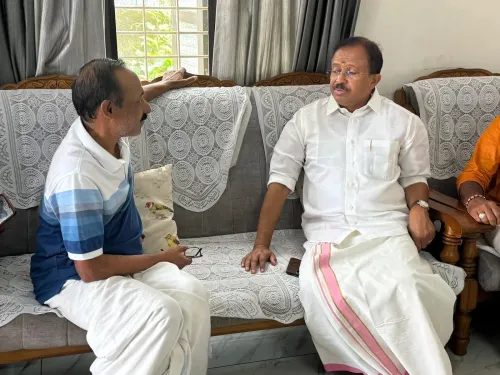
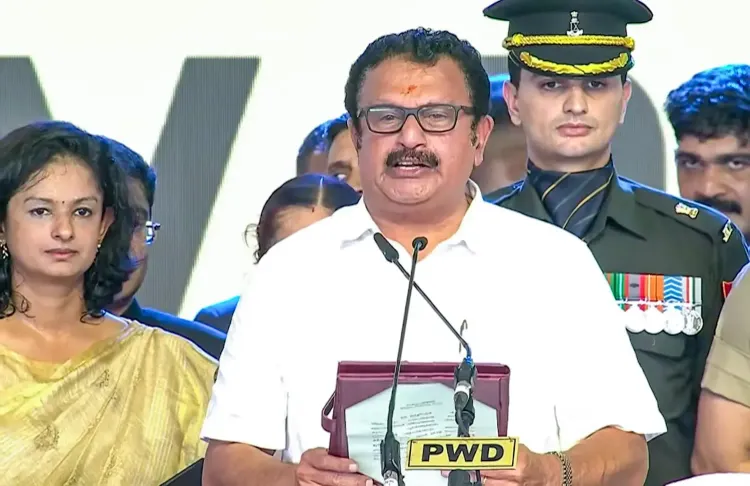
Kerala Health Minister K. Muraleedharan on Tuesday, 10 November 2026, defended his decision to remain seated during the rendition of Vande Mataram at a public function in Kasaragod, asserting that his patriotism needed no validation given his identity as the son of a freedom fighter. The remarks came a day after the Minister drew sharp criticism for not standing while the national song was being performed at the inauguration of a laboratory at the Mooliyar Family Health Centre in Kasaragod on Monday.
What Happened at the Function
During the inauguration ceremony on Monday, 9 November 2026, Vande Mataram was rendered beyond its first two stanzas. Minister Muraleedharan returned to his seat before the rendition was completed. Kasaragod MP Rajmohan Unnithan and MLA Kallatra Mahin, who were also seated on the dais, followed suit, with all three remaining seated while the song continued.
In contrast, MLA K. Neelakandan and District Congress Committee (DCC) president P.K. Faisal stood throughout the entire rendition. The contrasting conduct of the public representatives on the dais quickly became a flashpoint, with criticism directed primarily at the Minister.
The Minister's Defence
'No one needs to teach me patriotism. I am the son of a freedom fighter,' Muraleedharan said, hitting back at critics who questioned his conduct. He further explained that the state government's official protocol mandates standing only during the National Anthem, Jana Gana Mana — and argued that he had not breached any such protocol. He maintained that patriotism cannot be judged by a single incident at a public function.
National Anthem vs National Song: The Legal Distinction
The episode has reignited a long-standing debate over the legal status of Vande Mataram versus Jana Gana Mana. While Jana Gana Mana is India's constitutionally designated National Anthem — with standing mandated by the Prevention of Insults to National Honour Act, 1971 — Vande Mataram holds the status of National Song, and no statutory obligation to stand during its rendition exists in law. Notably, the Supreme Court and various high courts have affirmed this distinction in past rulings.
Political Fallout and Broader Context
The incident has drawn attention in Kerala amid a politically charged atmosphere, with rivals using the episode to question the ruling front's nationalist credentials. This is not the first time the rendition of Vande Mataram at official functions has sparked political controversy in the state. Critics argue that elected representatives set a symbolic precedent regardless of the legal position, while supporters of the Minister contend that manufactured patriotism controversies distract from substantive governance debates.
As the row continues to simmer, the episode underscores how the boundary between legal obligation and symbolic gesture remains a potent political battleground in India.
Point of View
And the Minister knows it. What is more revealing is how reflexively the incident was weaponised, exposing how performative displays of nationalism have become the default attack vector in state politics. That two other dais occupants also sat down received far less scrutiny than the Minister did, suggesting the controversy is less about protocol and more about targeting a specific political figure. Kerala's BJP and right-leaning commentators have long used such moments to frame the ruling front as insufficiently nationalist — a playbook that works precisely because optics override legal nuance in the court of public opinion.
NationPress
10 Nov 2026
Frequently Asked Questions
Why did Kerala Minister Muraleedharan sit during Vande Mataram?
Minister K. Muraleedharan sat down before the rendition of Vande Mataram was completed at a function in Kasaragod on 9 November 2026. He said the state government's official protocol only requires standing for the National Anthem, Jana Gana Mana, and that he had not violated any rule.
Is it compulsory to stand during Vande Mataram in India?
No. Vande Mataram is India's National Song, not the National Anthem. There is no statutory obligation under Indian law to stand during its rendition, unlike Jana Gana Mana, for which standing is mandated under the Prevention of Insults to National Honour Act, 1971. Courts have affirmed this distinction.
What did Minister Muraleedharan say in his defence?
Muraleedharan said, 'No one needs to teach me patriotism. I am the son of a freedom fighter.' He maintained that patriotism cannot be judged by a single incident and that he had adhered to official government protocol at the function.
Who else sat down during Vande Mataram at the Kasaragod function?
Kasaragod MP Rajmohan Unnithan and MLA Kallatra Mahin, who were also on the dais, sat down along with the Minister. MLA K. Neelakandan and DCC president P.K. Faisal remained standing throughout the full rendition.
What is the difference between the National Anthem and the National Song?
Jana Gana Mana is India's constitutionally designated National Anthem, and standing during its rendition is a legal requirement. Vande Mataram is the National Song — an honorary status carrying no equivalent statutory obligation, though it holds deep historical and cultural significance as a symbol of the independence movement.