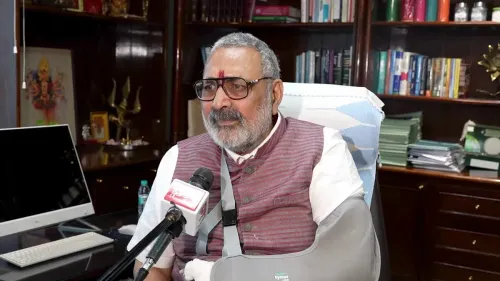
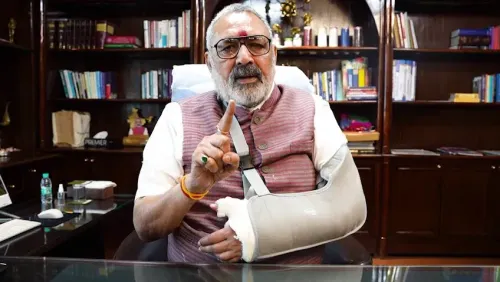
Giriraj Singh Hits Opposition Over 'Selective Outrage' on Godhra, Pahalgam
Synopsis
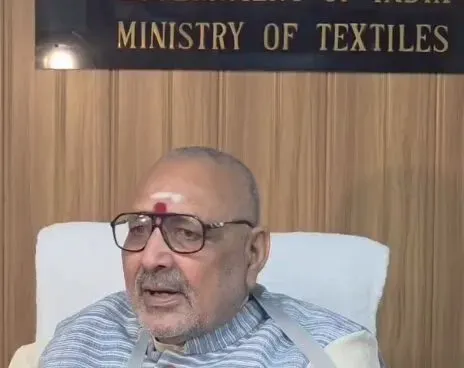
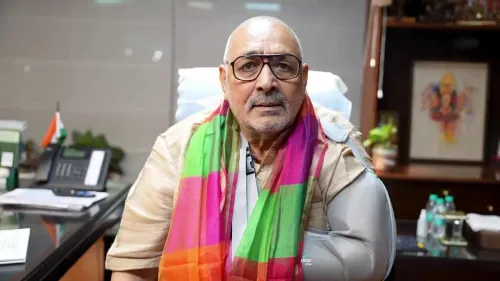
Union Textiles Minister Giriraj Singh on November 10 accused the opposition of awakening sympathy only for vote-bank constituencies, invoking Godhra and Pahalgam as evidence of selective outrage toward Hindu victims — a charge the country 'understands very well', he said.
Key Takeaways
Giriraj Singh posted on X on November 10, 2026 accusing the opposition of vote-bank-driven selective sympathy.
He invoked Godhra (2002) — where 59 Hindu kar sevaks were killed in a train burning — and Pahalgam, J&K as symbols of alleged opposition silence on Hindu suffering.
Singh used the phrase 'dohre charitra' (double character) to frame the opposition's conduct as deliberate hypocrisy.
The post is part of a long-standing BJP political narrative around asymmetric outrage in Indian communal discourse.
The specific Pahalgam incident referenced in the post could not be independently verified from available records.
A charge of calculated silence — that is what Union Textiles Minister Giriraj Singh levelled at the opposition on Tuesday, November 10, 2026, accusing political rivals of awakening their sympathies only when their vote banks demand it, not when incidents actually occur.
Posting in Hindi on X, Singh wrote: 'Ghatna dekhkar nahin, apna vote bank dekhkar inki samvedanaen jaagti hain!' — 'Their sympathies are not stirred by the incident itself, but by their vote bank!' He invoked two landmark reference points in India's communal memory — Godhra and Pahalgam — to argue that 'Sanatani victims' had been met with silence, while opposition grief was reserved for constituencies that deliver electoral returns.
Godhra and Pahalgam: Two Symbols in One Sentence
The pairing is deliberate and loaded. Godhra refers to the February 2002 burning of the Sabarmati Express in Gujarat, which killed 59 Hindu kar sevaks and triggered one of independent India's most devastating communal conflagrations. The incident has remained a fault line in Indian political discourse for over two decades — with BJP leaders consistently arguing that the initial train attack on Hindu pilgrims received inadequate outrage from secular parties.
Pahalgam, the scenic town in Anantnag district, Jammu and Kashmir, carries its own weight as a site associated with periodic security-related civilian violence. Singh's post does not name a specific incident — the research background notes that the precise Pahalgam episode alluded to cannot be independently verified — but its inclusion alongside Godhra signals an argument about a continuous, unbroken pattern of selective response.
The 'Double Character' Accusation
Singh's sharpest phrase is 'दोहरे चरित्र' — dohre charitra, meaning 'double character' or rank hypocrisy. 'The country understands their double character very well,' he wrote, framing the electorate itself as the ultimate judge of partisan grief.
This line of attack is not new to Indian electoral discourse. For years, parties across the spectrum have traded accusations of communally calibrated outrage — a cycle in which every expression of sympathy is immediately measured against what was said, or not said, after a rival community's tragedy. Singh is essentially calling out what he sees as the opposition's version of that calculation, using two of the most emotionally charged events in recent Indian political memory as his evidence.
BJP's Broader 'Hindu Victimhood' Political Frame
The post fits a well-established BJP communication strategy: keeping the memory of violence against Hindus alive in public discourse as a counter-narrative to opposition claims of minority protection. Senior leaders have long argued that mainstream political empathy in India flows asymmetrically — readily mobilised for minority communities, but conspicuously absent when the victims are Hindu.
Singh's standing as a Lok Sabha MP from Begusarai, Bihar — a constituency with its own complex communal and caste arithmetic — gives the post a dual audience: a national ideological argument and a pointed local signal ahead of any electoral cycle. Whether opposition parties respond, and in what register, will determine whether this becomes a sustained debate or a one-day skirmish on the political timeline.
The country, as Singh puts it, is watching. And in Indian politics, the audience's verdict on who grieves for whom — and when — tends to outlast the news cycle that sparked the debate.
Point of View
Sustaining a victimhood frame that mobilises Hindu consolidation across election cycles. What makes this politically significant is the timing — such posts typically precede or accompany a larger campaign push, suggesting the party may be preparing to sharpen its communal contrast messaging. The opposition's response, or silence, will itself become fodder for the next round.
NationPress
10 Nov 2026
Frequently Asked Questions
What did Giriraj Singh post about Godhra and Pahalgam?
On November 10, 2026, Giriraj Singh posted in Hindi accusing the opposition of feeling sympathy only when their vote banks are involved — citing Godhra and Pahalgam as examples where, he alleged, Sanatani victims were met with opposition silence.
What happened at Godhra in 2002?
In February 2002, a train carrying Hindu kar sevaks was set on fire at Godhra station in Gujarat, killing 59 people. The incident preceded large-scale communal riots and has remained a defining reference point in Indian political discourse.
Why does Giriraj Singh mention Pahalgam?
Pahalgam in Anantnag district, Jammu and Kashmir, has been associated with periodic security-related civilian incidents. Singh invoked it alongside Godhra to argue a pattern of opposition silence on violence affecting Hindu communities.
What does 'dohre charitra' mean and why did Singh use it?
'Dohre charitra' means 'double character' or hypocrisy in Hindi. Singh used it to argue that the opposition applies different standards of grief and outrage depending on which community the victims belong to.
Is Giriraj Singh's 'selective outrage' argument a new one?
No. Accusations of communally selective sympathy are a recurring feature of Indian electoral politics. BJP leaders have long argued that mainstream political empathy flows asymmetrically, and Singh's post follows that well-established party communication frame.