Kim Jong-un attends North Korea's 81st Workers' Party founding anniversary
Synopsis
North Korea kept its 81st Workers' Party founding anniversary deliberately low-key — no military parade, no weapons showcase, no formal statement from Kim Jong-un. The contrast with last year's Hwasong-20 missile unveiling is stark, and the question analysts are already asking is whether the restraint is tactical, diplomatic, or simply a function of it not being a milestone year.
Key Takeaways
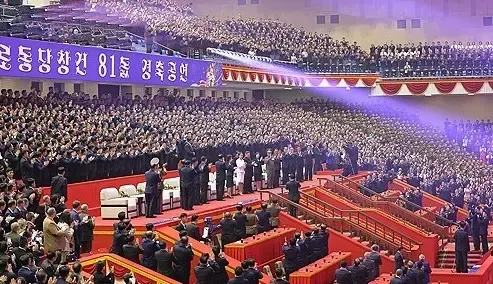
North Korea celebrated the 81st founding anniversary of the Workers' Party of Korea on 10 October 2026 with a performance at Pyongyang Indoor Stadium .
Kim Jong-un attended alongside his wife Ri Sol-ju and daughter Kim Ju-ae , per KCNA photos.
Kim did not issue a formal statement marking the anniversary.
This year's celebrations were modest in scale — no military parade or weapons exhibition, in contrast to last year's 80th anniversary display of the Hwasong-20 ICBM.
North Korea reserves large-scale milestone events for anniversaries ending in zero or five.
Party officials separately visited the Party Founding Museum , where they were briefed on Kim 's October 2025 visit.
North Korea marked the 81st founding anniversary of the Workers' Party of Korea (WPK) on 10 October 2026 with a celebratory performance at Pyongyang Indoor Stadium, attended by leader Kim Jong-un, state media reported. The event featured patriotic songs, acrobatics, and dance, with the programme centred on themes of loyalty to the party and its leader.
What the Ceremony Involved
Kim Jong-un, described by the Korean Central News Agency (KCNA) as 'representing the dignity and mightiness' of the country, waved to the audience 'as a token of his congratulations to all the participants on the party founding day' and expressed satisfaction with the performance. His wife, Ri Sol-ju, and daughter, Kim Ju-ae, were photographed accompanying him, per images released by the KCNA.
Diplomatic envoys and members of foreign missions attended alongside senior party and military officials and Pyongyang citizens, according to state media reports. Notably, Kim did not issue a formal statement marking the anniversary.
A Deliberately Modest Scale
The performance capped a series of relatively low-key events held over the anniversary period. Analysts note that North Korea traditionally reserves its grandest displays — large-scale military parades, mass gymnastics, and weapons exhibitions — for anniversaries ending in zero or five, which Pyongyang designates as milestone years.
By contrast, last year's 80th anniversary was marked with a massive late-night military parade at Kim Il Sung Square, at which the Hwasong-20 intercontinental ballistic missile was publicly unveiled for the first time. This year's scaled-back observance follows that precedent.
Party Museum Visit and Ideological Messaging
A separate KCNA dispatch reported that party officials visited the Party Founding Museum, where they were briefed on Kim's visit to the same museum in October 2025. The report did not specify the date of the officials' visit. The state media account framed Kim as 'ushering in a great heyday of building our Party in the new era and achieving comprehensive national rejuvenation,' signalling continued emphasis on ideological consolidation ahead of any major policy shifts.
Broader Context
The Workers' Party of Korea was founded on 10 October 1945, and the anniversary has historically served as one of Pyongyang's most important political dates, often used to project domestic solidarity and signal foreign policy posture. This year's muted celebrations come amid ongoing international scrutiny of North Korea's weapons programmes and its reported military cooperation with Russia. Observers will watch whether the relatively subdued tone signals a diplomatic opening or is simply a function of the non-milestone year.
Point of View
Deployed alongside Kim Ju-ae's continued public appearances, suggests a deliberate succession narrative is being built in parallel with domestic consolidation. The diplomatic envoys seated in the audience signal that North Korea is not in full isolation mode, even as its weapons cooperation with Russia draws international condemnation. The real test will come at the next milestone year in 2030 — and what the arsenal looks like by then.
NationPress
11 Oct 2026
Frequently Asked Questions
What did North Korea do to mark the 81st Workers' Party founding anniversary?
North Korea held a celebratory performance featuring patriotic songs, acrobatics, and dance at Pyongyang Indoor Stadium on 10 October 2026. Leader Kim Jong-un attended the event, which was reported by state media outlet KCNA.
Why were this year's North Korea anniversary celebrations smaller than usual?
North Korea traditionally reserves its largest displays — military parades, mass gymnastics, and weapons exhibitions — for anniversaries ending in zero or five, which it designates as milestone years. The 81st anniversary does not fall in that category, making a scaled-back observance consistent with precedent.
What happened at North Korea's 80th Workers' Party anniversary last year?
The 80th anniversary in 2025 was marked with a massive late-night military parade at Kim Il Sung Square, at which the Hwasong-20 intercontinental ballistic missile was publicly unveiled. That event drew significant international attention.
Who accompanied Kim Jong-un at the anniversary event?
Kim Jong-un was accompanied by his wife Ri Sol-ju and his daughter Kim Ju-ae, according to photographs released by the Korean Central News Agency (KCNA).
Did Kim Jong-un make any statement for the Workers' Party anniversary?
No. According to state media reports, Kim Jong-un did not issue a formal statement marking the 81st anniversary of the Workers' Party of Korea, which was noted as a departure from some prior observances.