Kim Dae-jung death anniversary: South Korea politicians urge unity at Seoul ceremony
Synopsis
On the 17th anniversary of Kim Dae-jung's death, South Korea's ruling and opposition politicians gathered at Seoul National Cemetery in a rare show of cross-party unity — with the newly elected Democratic Party chief invoking his personal ties to the Nobel laureate president. The ceremony is as much a political signal as a memorial, arriving at a moment of sharp domestic polarisation.
Key Takeaways
South Korea marked the 17th death anniversary of former President Kim Dae-jung on 18 August at Seoul National Cemetery .
National Assembly Speaker Cho Jeong-sik pledged to carry on Kim's 'spirit of unity and pragmatism.' Newly elected Democratic Party leader Kim Min-seok , who served as Kim Dae-jung's chief of staff in 2000 , attended as one of his first acts as party chief.
Jang Dong-hyeok skipped the ceremony to visit flood-hit South Gyeongsang Province ; the party issued a written statement instead.
Kim Dae-jung served as president from 1998 to 2003 , won the Nobel Peace Prize in 2000 , and held the first-ever inter-Korean summit with Kim Jong-il .
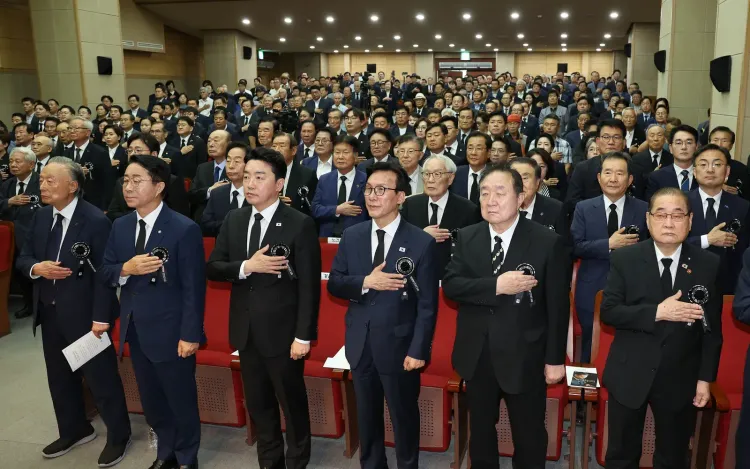
Key leaders from rival political parties in South Korea converged at Seoul National Cemetery on Tuesday, 18 August to mark the 17th death anniversary of former President Kim Dae-jung, pledging to uphold his legacy of democracy, dialogue, and national reconciliation. The cross-party attendance underscored a rare moment of political convergence in a country navigating deep partisan divisions.
Key Figures at the Ceremony
National Assembly Speaker Cho Jeong-sik and Kim Min-seok, the newly elected leader of the ruling Democratic Party (DP), were among the prominent attendees at the memorial held at the cemetery where the former president is entombed. Kim Min-seok had been elected DP chief just a day earlier, on Monday, making his attendance at the ceremony one of his first public acts as party leader.
'He defended democracy in the face of dictatorship, ultimately achieving a peaceful transfer of power and rebuilding the country's shattered economy,' Speaker Cho said during the service, adding that the National Assembly would do its utmost to 'carry on the president's spirit of unity and pragmatism.'
What the New DP Chief Said
Addressing the late president's grave, Kim Min-seok drew on a personal connection: he had served as chief of staff to Kim Dae-jung in 2000, when the former president led the Millennium Democratic Party — the predecessor of today's ruling party. 'Once your youngest chief of staff, I come before you today as the leader of the Democratic Party, following your footsteps,' he said, calling for bipartisan cooperation that transcends ideological divides.
Opposition Response
Rep. Jang Dong-hyeok, leader of the main opposition People Power Party (PPP), was originally scheduled to attend but redirected his visit to flood-affected areas in South Gyeongsang Province. In his absence, PPP chief spokesperson Park Choong-kwon issued a statement urging parliament to honour the former president's values of dialogue and compromise.
Kim Dae-jung's Legacy
The late president served from 1998 to 2003 and died in 2009. A longtime opposition figure and pro-democracy activist, he is widely credited with steering South Korea through the 1997 Asian financial crisis and advancing democratic consolidation. In 2000, he convened the first-ever inter-Korean summit with then North Korean leader Kim Jong-il — a landmark moment in peninsular diplomacy — and was awarded the Nobel Peace Prize that same year for his efforts to promote democracy and reconciliation with Pyongyang.
Why It Matters Now
The ceremony takes place against a backdrop of heightened political tension in South Korea, making the cross-party appeal for unity particularly notable. Speaker Cho's pledge that the National Assembly will 'further strengthen democracy, protect people's livelihoods and promote peace on the Korean Peninsula' signals that Kim Dae-jung's Sunshine Policy legacy remains a live reference point in contemporary South Korean politics. As the country navigates inter-Korean relations and domestic polarisation, the annual commemoration serves as both a ritual and a political signal.
Point of View
Not sentiment. The PPP's written-statement substitute, meanwhile, reveals the limits of that unity: the opposition leader prioritised flood optics over the ceremony. Kim Dae-jung's Sunshine Policy remains contested, and invoking his legacy is as much a forward-looking political argument about inter-Korean engagement as it is a backward-looking tribute.
NationPress
2 Oct 2026
Frequently Asked Questions
Who was Kim Dae-jung and why is he significant?
Kim Dae-jung was South Korea's president from 1998 to 2003, known for steering the country through the 1997 Asian financial crisis and advancing democracy. He won the Nobel Peace Prize in 2000 for promoting democracy and pursuing reconciliation with North Korea, including through the first-ever inter-Korean summit with Kim Jong-il.
What happened at the 17th death anniversary ceremony in Seoul?
Key politicians from rival parties gathered at Seoul National Cemetery on 18 August to pay tribute to the late president. National Assembly Speaker Cho Jeong-sik and new Democratic Party chief Kim Min-seok attended in person, while the People Power Party issued a written statement after its leader redirected to flood-hit areas.
Who is Kim Min-seok and what is his connection to Kim Dae-jung?
Kim Min-seok is the newly elected leader of South Korea's ruling Democratic Party, chosen on Monday, 17 August. He served as chief of staff to President Kim Dae-jung in 2000, when the latter led the Millennium Democratic Party, the predecessor of the current ruling party.
Why did the PPP leader skip the ceremony?
Rep. Jang Dong-hyeok, leader of the main opposition People Power Party, was originally scheduled to attend but chose instead to visit flood-affected areas in South Gyeongsang Province. The party's chief spokesperson issued a commentary in his place, urging parliament to uphold Kim Dae-jung's values of dialogue and compromise.
What is the significance of Kim Dae-jung's Sunshine Policy today?
Kim Dae-jung's Sunshine Policy — an engagement-first approach to North Korea — remains a reference point in South Korean political debate. Politicians invoking his legacy at the annual memorial are often signalling their stance on inter-Korean relations, making the ceremony as much a political statement as a tribute.