Korea-Africa Foreign Ministers' Meeting 2025: 50 nations gather in Seoul
Synopsis
Seoul convened its first-ever standalone Korea-Africa Foreign Ministers' Meeting, drawing 50 nations to discuss supply chains, trade, and geopolitical shifts. With Africa's critical minerals and growing economic weight in play, this is less a courtesy summit and more a strategic repositioning by South Korea in a fragmenting global order.
Key Takeaways
South Korea hosted the first-ever Korea-Africa Foreign Ministers' Meeting in Seoul on 2 June 2025 .
50 of 54 invited African nations participated, alongside four regional bodies including the African Union and AfCFTA .
The meeting was co-chaired by Foreign Minister Cho Hyun and Ghanaian FM Samuel Okudzeto Ablakwa .
Key agenda items included trade and investment, supply chain resilience, climate change, and health cooperation.
A Korea-Africa Business Forum with approximately 300 participants, including Hyundai president Sung Kim , was scheduled for Tuesday .
South Korea completed diplomatic ties with all 54 African UN member states in 2011 after establishing relations with South Sudan .
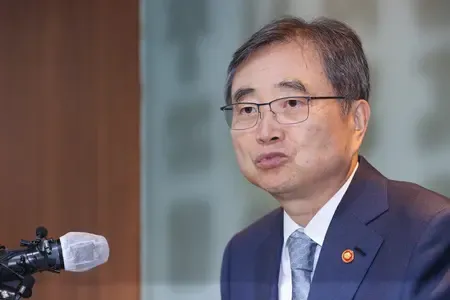
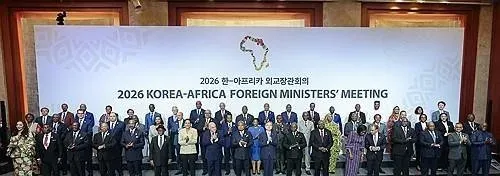
Foreign Minister Cho Hyun of South Korea convened the inaugural Korea-Africa Foreign Ministers' Meeting in Seoul on 2 June 2025, bringing together representatives from 50 African countries and four regional bodies to chart a new course for bilateral cooperation on trade, supply chains, climate, and global security. It is the first such ministerial gathering hosted independently by the South Korean government.
Who Was in the Room
The meeting, held under the theme 'Partnership for Joint Responses to Global Challenges', drew participation from 50 of the 54 invited African nations. Four continental institutions were also represented: the African Union (AU), the African Development Bank (AfDB), the African Continental Free Trade Area (AfCFTA), and the Africa Centres for Disease Control and Prevention. The session was co-chaired by Cho and Ghanaian Foreign Minister Samuel Okudzeto Ablakwa, whose country holds the vice-chairmanship of the African Union this year.
Key Statements from the Opening
In his opening address, Cho framed the meeting as a response to a world in flux. 'We gather today at a critical juncture where the global order is rapidly shifting. The world is facing multi-faceted challenges across various sectors, such as supply chains, energy and food security,' he said. He also pointed to the rising geopolitical weight of the continent: 'Amid continued instability in the Middle East and uncertainty surrounding the Strait of Hormuz, African countries are gaining increasing geopolitical and economic significance on the global stage ... Closer cooperation between Korea and Africa is more important than ever.'
Ablakwa called on both sides 'to move beyond traditional models of cooperation toward transformative economic collaboration.' He also praised Seoul for proceeding with the meeting despite an Ebola scare in parts of Africa, saying it demonstrates that South Korea 'will not stigmatise Africa or engage in generalisations.'
Agenda and Areas of Focus
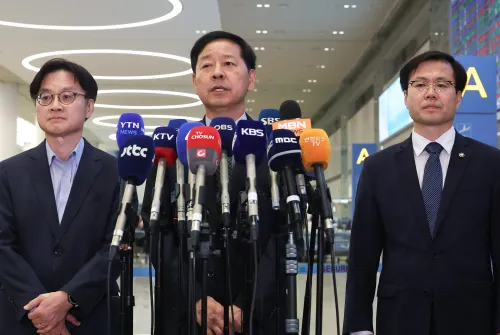
The plenary session covered trade and investment, science and technology, and supply chain resilience. Participants also explored expanded cooperation on climate change, health, peace and security, development assistance, and people-to-people exchanges. A joint statement was expected to be adopted at the conclusion of the ministerial meeting. On the sidelines, Cho was scheduled to hold bilateral talks with all participating foreign ministers to address issues of mutual interest.
Korea-Africa Business Forum on Tuesday
The diplomatic dialogue is set to be followed on Tuesday by the Korea-Africa Business Forum, which will bring together approximately 300 business leaders, experts, government officials, and representatives from both sides. Sung Kim, president of Hyundai Motor Company and a former US ambassador to South Korea, and Wamkele Keabetswe Mene, secretary-general of the AfCFTA, are scheduled to deliver keynote addresses. The forum is co-organised by the Korea-Africa Foundation, the Korea Trade-Investment Promotion Agency, and the Korea International Trade Association.
Historical and Strategic Context
South Korea first established diplomatic ties with six African countries in 1961, completing its full diplomatic roster with all 54 African UN member states after formalising relations with South Sudan in 2011. Seoul has since deepened its Africa engagement, driven by the continent's rapid economic growth, abundant natural resources — including oil and critical minerals — and its growing strategic relevance amid Middle East instability and intensifying global competition for supply chains. This meeting signals a further institutionalisation of that relationship at the highest diplomatic level.
Point of View
And to host the event independently rather than under a multilateral umbrella, signals genuine strategic intent. The real question is whether the follow-through matches the symbolism: past Korea-Africa engagement has been episodic, and the continent's patience with summitry that does not translate into investment is wearing thin. The Business Forum on Tuesday will be a more telling indicator of where this relationship is actually headed.
NationPress
24 Sept 2026
Frequently Asked Questions
What is the Korea-Africa Foreign Ministers' Meeting?
It is the first ministerial-level meeting hosted independently by the South Korean government, bringing together foreign ministers from 50 African countries and four regional organisations in Seoul on 2 June 2025. The meeting focused on trade, supply chains, climate, health, and broader global challenges.
Why is South Korea strengthening ties with Africa now?
South Korea is deepening Africa engagement due to the continent's growing strategic importance, including its abundant critical minerals and oil, rapid economic development, and rising geopolitical weight amid Middle East instability and global supply chain disruptions. Foreign Minister Cho Hyun described the moment as 'a critical juncture where the global order is rapidly shifting.'
Which African countries and organisations participated?
50 of the 54 invited African nations attended, along with the African Union, the African Development Bank, the African Continental Free Trade Area (AfCFTA), and the Africa Centres for Disease Control and Prevention.
What is the Korea-Africa Business Forum?
It is a follow-on event scheduled for Tuesday, bringing together approximately 300 business leaders, government officials, and experts from both sides to discuss trade expansion, industrial cooperation, and supply chain resilience. Hyundai Motor Company president Sung Kim and AfCFTA secretary-general Wamkele Keabetswe Mene are keynote speakers.
When did South Korea establish full diplomatic ties with Africa?
South Korea first established diplomatic relations with six African countries in 1961 and completed ties with all 54 African UN member states in 2011, following the formalisation of relations with South Sudan.