Is South Korean President Lee Meeting Prime Minister Takaichi in Japan for a Summit?
Synopsis
South Korean President Lee Jae Myung arrives in Japan for crucial summit discussions with Prime Minister Sanae Takaichi. This visit aims to strengthen bilateral ties and tackle significant regional and global issues amidst rising tensions between Tokyo and Beijing. Will this meeting pave the way for improved relations?
Key Takeaways
South Korean President Lee Jae Myung is in Japan for a two-day summit with Prime Minister Takaichi.
Key discussions will revolve around bilateral ties and regional tensions, especially with China.
The seafood import ban from Japan will be a significant agenda point.
Both leaders aim to address historical grievances and explore engagement with North Korea.
The visit includes cultural diplomacy, highlighting the importance of historical sites.
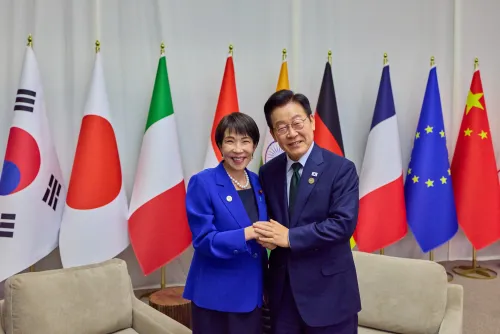
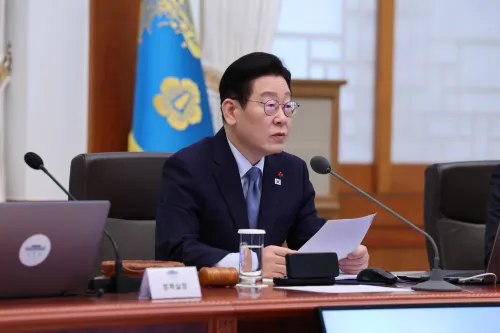
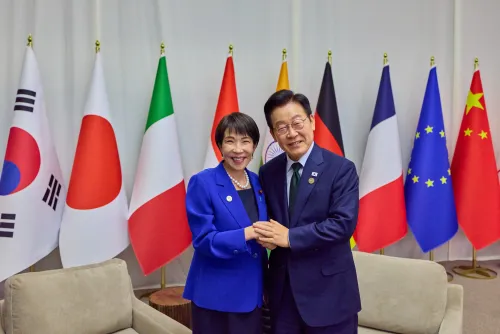
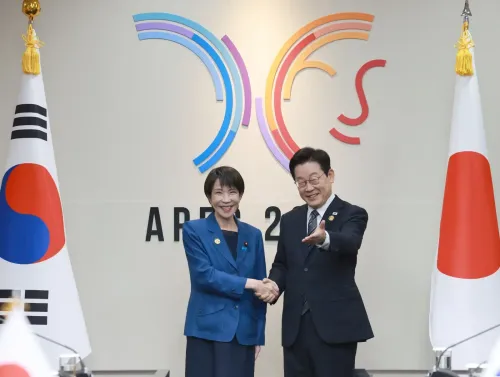
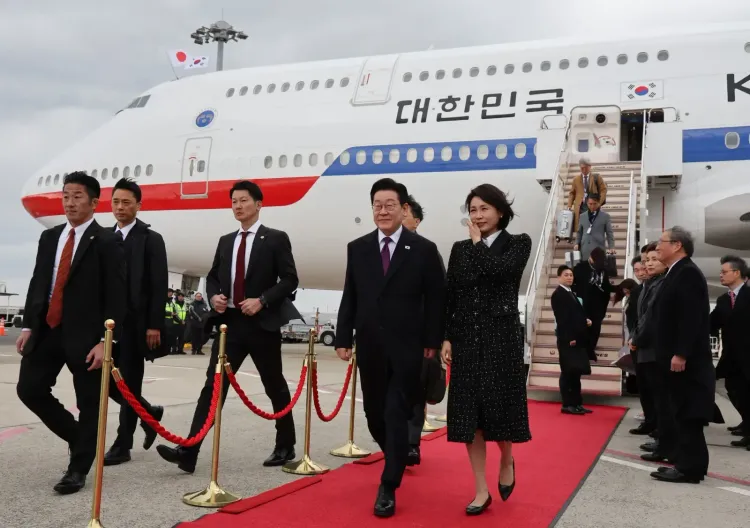
Nara, Jan 13 (NationPress) President Lee Jae Myung of South Korea has touched down in Japan on Tuesday for significant summit discussions with Prime Minister Sanae Takaichi. The two leaders are set to engage in talks concerning bilateral relations as well as pressing regional and global issues, particularly in light of rising tensions between Tokyo and Beijing.
Lee will be residing in Nara Prefecture, the home region of Takaichi, for a two-day visit that is part of leader-level exchanges known as 'shuttle diplomacy', designed to maintain the recent positive trajectory in their diplomatic relations.
This marks Lee's second journey to Japan following his August visit for discussions with Takaichi's predecessor, Shigeru Ishiba, and it will be the third occasion they meet since Takaichi assumed her position in October.
Lee and Takaichi initially convened for summit talks during the Asia-Pacific Economic Cooperation forum in Gyeongju in late October and had a brief encounter again during the Group of 20 leaders' summit in South Africa in November.
The upcoming meeting follows Lee's recent state visit to China, where he held discussions with President Xi Jinping. This comes at a time of escalating tensions between Beijing and Tokyo, particularly after Takaichi's comments regarding Taiwan.
In an interview with Japan's NHK on Monday, Lee highlighted that South Korea's relationship with Japan holds equal importance to its ties with China, stating that tensions regarding Taiwan are not an issue in which Seoul will intervene.
Furthermore, South Korea's ban on seafood imports from eight Japanese prefectures is anticipated to be a topic of discussion, as Tokyo has persistently urged Seoul to lift the restrictions imposed in 2013 over radiation concerns following the 2011 Fukushima nuclear disaster.
Lee noted that while easing these restrictions is crucial, it will require time to allay public concerns. However, he acknowledged that resolving this matter is a significant part of Seoul's diplomatic strategy, especially as it seeks Tokyo's backing for its inclusion in the Comprehensive and Progressive Agreement for Trans-Pacific Partnership.
The leaders are also likely to address North Korea, given both have shown an interest in engaging Pyongyang, according to reports from Yonhap news agency.
Lee welcomed Takaichi's intentions to discuss the abduction issue with North Korean leader Kim Jong-un, offering to facilitate dialogue between Tokyo and Pyongyang and assist in moving towards establishing formal diplomatic ties.
Moreover, historical issues are expected to feature prominently on the agenda, as the Lee administration is pursuing a 'two-track' strategy of enhancing future-oriented cooperation while also dealing with unresolved wartime history stemming from Japan's 1910–45 colonial rule of Korea.
National Security Adviser Wi Sung-lac expressed optimism that the forthcoming talks will foster collaboration to recover the remains of Korean forced laborers from the Chosei undersea coal mine in Yamaguchi Prefecture, where a flood in 1942 claimed 136 Korean lives.
On Wednesday, both leaders will participate in various diplomatic events, including a visit to Horyuji Temple, which features the world's oldest surviving wooden structures and is recognized as Japan's first UNESCO World Heritage Site.
Lee is also slated to engage with members of the Korean community in Japan before concluding his visit later in the day.
Point of View
It is essential to recognize the importance of these summit discussions between South Korea and Japan. Both nations face challenges that require cooperative solutions, particularly regarding their historical grievances and regional security concerns. The dialogue initiated by President Lee and Prime Minister Takaichi can potentially lead to a more stable and collaborative future.
NationPress
3 Oct 2026
Frequently Asked Questions
What are the main topics of discussion at the summit?
The summit will focus on bilateral relations, regional and global issues, tensions with China, and historical grievances.
Why is the seafood import ban from Japan significant?
The ban has been a point of contention since 2013 due to radiation concerns, and its resolution may facilitate stronger diplomatic relations.
How does this meeting impact North Korea relations?
Both leaders have expressed interest in engaging North Korea, which could lead to potential diplomatic progress.
What is the historical context affecting these discussions?
Historical issues stem from Japan's colonial rule over Korea from 1910 to 1945, impacting current diplomatic relations.
What cultural events will the leaders participate in during the visit?
They will visit Horyuji Temple, a UNESCO World Heritage Site, and engage with the Korean community in Japan.