What Are the Key Highlights of the Maha Cabinet's Approval for the Mumbai 3 Project?

Synopsis
The Maharashtra Cabinet has taken a significant step towards the development of the Mumbai 3 project by approving new land acquisition policies. This move aims to enhance urban growth while ensuring transparency and fairness in land dealings. Discover how these policies will reshape Mumbai's future.
Key Takeaways
Maharashtra Cabinet approves land acquisition policy for Mumbai 3 project .
Focus on fair compensation for landowners.
Integration of Maharashtra Industrial Development Corporation policies.
Launch of the 'My Village, Health-Prosperous Village' campaign.
Approval for international standard cricket stadium in Kolhapur.
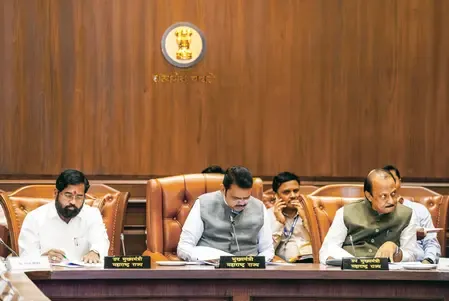
Mumbai, Feb 10 (NationPress) The Maharashtra Cabinet, under the leadership of Chief Minister Devendra Fadnavis, has approved a new land acquisition and allocation policy aimed at advancing the ambitious Mumbai 3 project. This policy is designed for future projects managed by the Karnala-Sai-Chirner (KSC) New Town Development Authority (NTDA) within the designated impact area of the Atal Bihari Vajpayee Sewri-Nhava Sheva Atal Setu project as well as the Mumbai Metropolitan Region Development Authority (MMRDA).
Spanning an extensive area of 323.44 square kilometers across 124 villages in the Uran, Panvel, and Pen talukas, the KSC NTDA project is set to drive significant urban development, although certain exemptions are made for forest lands, Coastal Regulation Zones (CRZ), and a 250-metre buffer zone around the Pen Municipal Council.
To facilitate land acquisition, the MMRDA has adopted a dual strategy. For landowners who voluntarily agree to surrender their land, 22.5 percent of the developed plot will be returned to them, reflecting the successful model of the City and Industrial Development Corporation (CIDCO). If the plot is less than 40 square meters, cash compensation will be offered instead.
Landowners also have the option to exchange their property for Floor Space Index (FSI) or Transferable Development Rights (TDR). Large landowners, possessing a minimum of 200 hectares, may propose joint development with the MMRDA through a Special Purpose Vehicle (SPV) via an Expression of Interest (EOI) model.
For those landowners who do not consent, land acquisition will proceed through the District Collector's office in compliance with the 2013 Land Acquisition Act, ensuring fair market compensation and transparency.
To transform the new town into an industrial hub, the MMRDA is implementing two key policies from the Maharashtra Industrial Development Corporation (MIDC). The Pass-Through Policy enables swift allotment of industrial land in undeveloped regions, while the Foreign Direct Investment (FDI) Priority Policy seeks to enhance the national GDP and local employment by prioritizing FDI investments, requiring a minimum investment of Rs 250 crore within five years on at least 100 acres of land.
The Maharashtra Cabinet has also sanctioned a long-term loan of Rs 15,000 crore from the National Bank for Agriculture and Rural Development (NABARD) for the completion of various irrigation projects, which will enhance the distribution system of 57 incomplete and 193 completed projects and create irrigation facilities for eight lakh hectares of agricultural land, aiding local farmers.
In other developments, the state Cabinet has approved the establishment of an international standard cricket stadium in Kolhapur district, allocating 12 hectares 76 R of government land in Vikaswadi (Karveer taluka) to promote sports in the region.
The Cabinet also established a Special Purpose Authority for the Purandar Airport in Pune district, approving a Rs 6,000 crore loan for land acquisition and associated activities, with MIDC, Maharashtra Airport Development Corporation (MADC), and CIDCO as partners responsible for loan repayment.
Additionally, the state is launching the 'My Village, Health-Prosperous Village' campaign aimed at enhancing health at the village level, with a budget allocation of Rs 80.75 crore annually for the campaign period from April 1, 2026 to March 31, 2027.
Moreover, the Cabinet has approved land transfer to MIDC for a new industrial estate at Ratnapuri Mala (Indapur taluka), which will create relief, investment, and job opportunities for entrepreneurs.
The state Cabinet has also sanctioned infrastructure facilities through the Maha Tennis Foundation at Kolekalyan (Andheri) in Mumbai, promoting tennis and establishing facilities for players.
In education, the Cabinet has increased prize money for state-level science exhibitions, benefiting students, teachers, and laboratory attendants. Furthermore, it has approved the Maharashtra Public-Private Partnership (PPP) Policy – 2026, empowering the Cabinet Committee on Infrastructure to approve projects valued over Rs 25 crore.
Lastly, the Cabinet has sanctioned financial aid to the Indrani Cooperative Spinning Mill in Parbhani district and approved the creation of 11 additional District Collector posts to expedite service provision across the state.
It has also approved a coal-to-chemical project on 117 hectares 19 R of land to be transferred to MIDC at Mauja Linga (Kalmeshwar) in Nagpur district, along with a budget of Rs 75.13 crore for sports facilities at Mouje Katfal under the Baramati District Sports Complex. This includes the construction of facilities such as a pavilion, swimming pool, skating ring, archery range, and basketball court.
The Cabinet has also authorized a simultaneous tendering process for transport contracts concerning the distribution of food grains and essential commodities, enhancing coordination across five zones and 34 districts within the Mumbai-Thane ration distribution area. Furthermore, it has approved a repair budget of Rs 6.60 crore for the small irrigation project at Pimpalshenda (Murtijapur taluka) in Akola district, benefiting 255 hectares of land.
Finally, the Cabinet has cleared the issuance of the Maharashtra (Amendment and Enactment) Ordinance concerning tax arrears and has initiated amendments to the Maharashtra Public Universities Act, 2016 and the Maharashtra Unaided Private Professional Educational Institutions (Admission and Fee Regulation) Act, 2015.
Point of View
The Maharashtra Cabinet's approval of the land acquisition policy for the Mumbai 3 project represents a strategic move towards sustainable urban development. The emphasis on transparency and fair compensation for landowners reflects a commitment to stakeholder engagement. This initiative not only aims to foster economic growth but also addresses the pressing need for infrastructural advancements in one of India's most dynamic regions.
NationPress
1 Oct 2026
Frequently Asked Questions
What is the Mumbai 3 project?
The Mumbai 3 project is an ambitious urban development initiative aimed at transforming a designated area in Mumbai to support large-scale urban growth.
What are the key features of the new land acquisition policy?
The new land acquisition policy includes provisions for voluntary land surrender, compensation models, and strategies for both consenting and non-consenting landowners.
How will the new policies impact local residents?
The new policies are designed to ensure fair compensation for landowners while promoting rapid urban development, potentially enhancing local infrastructure and job opportunities.
What role does the Maharashtra Industrial Development Corporation play?
The Maharashtra Industrial Development Corporation is crucial in implementing policies that facilitate industrial growth and development in the region.
When will the 'My Village, Health-Prosperous Village' campaign begin?
The campaign is set to commence on April 1, 2026, and will run until March 31, 2027, focusing on improving health at the village level.