WhatsApp University and reel culture shaping decisions, warns Maha FDA chief
Synopsis
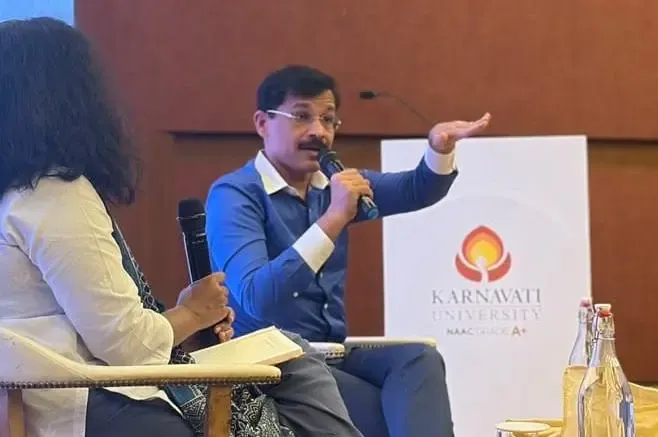
Maharashtra FDA Commissioner Tukaram Mundhe told students in Gandhinagar that social media algorithms and unchecked WhatsApp forwards constitute a 'new colonialism' — quietly outsourcing their thinking to platforms and content creators. His core challenge: 'Do you want to be ruled by a reel, or do you want to create a reel?'
Key Takeaways
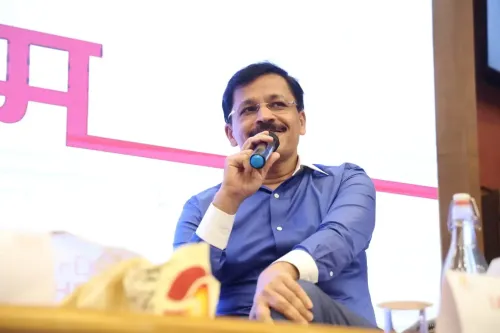
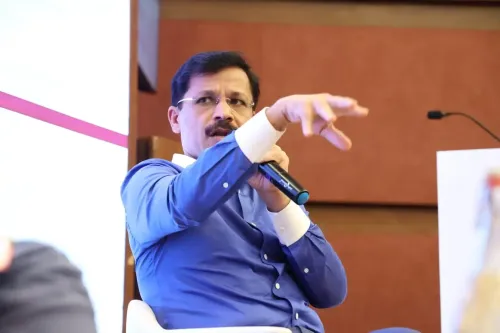
Maharashtra FDA Commissioner Tukaram Mundhe addressed students at Karnavati University, Gandhinagar on 26 September 2026 in a nearly two-and-a-half-hour session.
He warned that unchecked consumption of WhatsApp forwards and social media reels leads to decisions based on unverified or false information.
Mundhe described social media algorithms as a form of 'new colonialism' , shaping opinions without users realising it.
He urged students to shift from passive consumers to active creators of digital content.
His central message: critical thinking must begin as self-examination before extending to external information.
Maharashtra Food and Drug Administration (FDA) Commissioner Tukaram Mundhe on Saturday, 26 September called on students to interrogate the information they consume online, cautioning that social media reels, forwarded messages, and algorithmic feeds risk quietly colonising their thinking if left unchecked. Mundhe made the remarks during a nearly two-and-a-half-hour interaction with students at Karnavati University in Gandhinagar.
The 'WhatsApp University' Warning
Mundhe described the uncritical acceptance of social media content as one of the defining challenges of the current generation. 'One of the major challenges we have is social media influence or WhatsApp University,' he told the gathering. He pointed out that users routinely accept reels and forwarded messages at face value, rarely pausing to ask whether the content is accurate, authentic, or advancing a particular narrative.
'We take decisions on that basis, but we never try to understand whatever has come to you: is it really correct, is it authentic, is it real, or is it fake, or is it a narrative?' Mundhe said.
How Algorithms Shape the Mind
The FDA Commissioner explained the mechanics of algorithmic reinforcement to the student audience, noting that platforms track every scroll, skip, and engagement to curate increasingly personalised feeds. 'In one week, you will start getting what you like. Because it captures your mind, it captures your imagination,' he said.
Mundhe argued that this feedback loop amounts to outsourced thinking. 'What it means is that you have stopped thinking. You are being taught by somebody else,' he said. He labelled the phenomenon a form of 'new colonialism' — one driven not by foreign powers but by algorithms and content creators shaping behaviour and opinion from within.
A Call for Critical Self-Examination
Mundhe framed the solution as an internal reboot, beginning with self-interrogation rather than reflexive scepticism of others. 'We have become too shallow. We are not living deeply, we are not thinking, we are not questioning,' he said, urging students to first examine their own conduct and values before scrutinising information around them.
'You have to start questioning yourself first. Who am I? Am I responsible or irresponsible? And if I cannot, who else can?' he said.
He challenged students to shift from passive consumers to active creators of digital content. 'Do you want to be ruled by a reel, or do you want to create a reel?' he asked, urging them to pause before sharing, cross-reference with other evidence, and then decide. 'The moment you start, stop for a, give it a pause, give it a moment and ask, collaborate with some other evidence, look into it, and then you will realise, oh, this is where it is going wrong, stop it, discard it,' he said.
Linking Media Literacy to Ethical Decisions
Mundhe connected the social media discussion to a broader message on ethical decision-making, arguing that surrendering information-processing to platforms was equivalent to surrendering agency altogether. 'Are you making a decision, or are your decisions being taken by somebody else, is the question,' he said.
He concluded by calling for a fundamental shift in individual mindset. 'I believe that reboot has to begin in your mind, not just in reels,' he said, adding that such critical thinking would promote originality, legality, and ethical behaviour in everyday life. His remarks come amid a growing national conversation about misinformation, digital literacy, and the real-world impact of unverified online content on public health and civic decision-making.
Point of View
But a senior regulatory official deploying it in an academic setting signals that misinformation is no longer seen as a communications problem alone — it is increasingly a public health and governance problem. What is missing from the conversation, however, is institutional accountability: platforms that design addictive algorithms bear responsibility that individual 'mindset reboots' cannot substitute for.
NationPress
26 Sept 2026
Frequently Asked Questions
Who is Tukaram Mundhe and why is he speaking about social media?
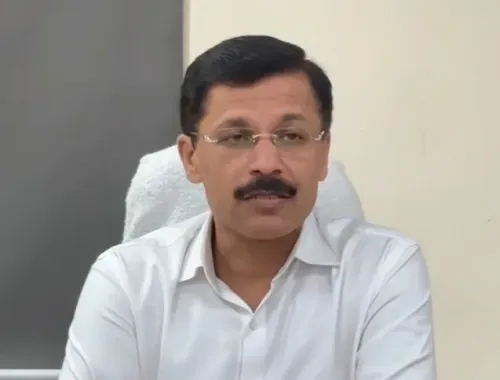
Tukaram Mundhe is the Commissioner of the Maharashtra Food and Drug Administration (FDA). He spoke about social media misinformation during a student interaction at Karnavati University in Gandhinagar on 26 September, connecting uncritical online consumption to flawed decision-making in public health and everyday life.
What did Mundhe mean by 'WhatsApp University'?
Mundhe used the term 'WhatsApp University' to describe the phenomenon where people accept forwarded messages and viral reels as facts without verifying their accuracy. He argued this leads individuals to make important decisions based on content that may be false, misleading, or driven by a hidden narrative.
How do social media algorithms reinforce misinformation, according to Mundhe?
Mundhe explained that platforms track user behaviour — what they watch, skip, or engage with — and then serve progressively more of the same content. Within a week, he said, users end up in a personalised bubble that reinforces existing beliefs, effectively outsourcing their thinking to an algorithm.
What practical steps did Mundhe suggest for students?
He advised students to pause before sharing or acting on information, cross-reference it with other credible sources, and consciously decide whether to accept or discard it. He also encouraged them to become creators of digital content rather than passive consumers, arguing that creative engagement builds critical awareness.
Why does Mundhe's message matter beyond a student audience?
Mundhe's warning is relevant to anyone consuming digital content in India, where smartphone penetration and short-video usage have grown rapidly. Misinformation spread via WhatsApp and reels has been linked to real-world harms including public health scares and communal tensions, making media literacy a broader civic concern.