Could Maharashtra Witness a 600% Surge in State Expenditure Following the VB G RAM G Bill?
Synopsis
The Maharashtra government anticipates a staggering 600% increase in state expenditure following the proposed VB G RAM G Bill, aiming to replace MGNREGA. This significant financial shift is a response to soaring public debt and fiscal deficits, promising to reshape employment generation across the state. Discover the implications of this potential spending surge.
Key Takeaways
Maharashtra anticipates a 600% increase in state expenditure with the VB G RAM G Bill.
The state’s share of employment generation costs shifts to 60% .
Total expenditure for the current fiscal may reach Rs 9,000 crore .
The proposed Bill could alleviate financial burdens on road construction.
Maharashtra's total debt is projected to exceed Rs 9,32,242 crore .
Mumbai, Dec 17 (NationPress) In the face of escalating public debt and expanding revenue and fiscal deficits, the BJP-led Mahayuti administration in Maharashtra anticipates a minimum 600% increase in state expenditures for the upcoming fiscal year, contingent on the passage of the proposed Viksit Bharat -- Guarantee for Rozgar and Ajeevika Mission (Gramin) (VB G RAM G) Bill, which aims to succeed the current MGNREGA, pending approval from both Houses of Parliament.
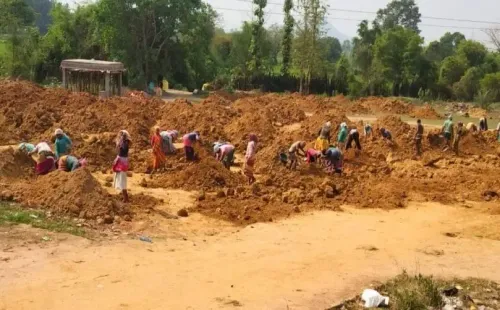
According to statistics from the state's Employment Guarantee Scheme (EGS) Department, Maharashtra has consistently elevated its financial contributions to MGNREGA projects over the last five years, despite a significant rise in overall spending. In the fiscal year 2020-21, total expenditure was recorded at Rs 2,020.96 crore, growing to Rs 2,422.75 crore in 2021–22, Rs 3,024.23 crore in 2022–23, Rs 4,460.83 crore in 2023-24, and projected to reach Rs 5,972.23 crore in the fiscal year 2024-25.
“We anticipate total expenditure for the current fiscal to hit Rs 9,000 crore,” stated a senior official overseeing MGNREGA implementation in Maharashtra.
So far this fiscal, total expenditure has already reached Rs 5,207.08 crore. The proposed Bill outlines a change in the Centre-State expenditure sharing ratio for employment generation to 60:40 from the previous 90:10. Previously, Maharashtra's contribution was limited to 10%, with expenditures of approximately Rs 200 crore in 2020-21, Rs 240 crore in 2021–22, Rs 300 crore in 2022–23, Rs 446 crore in 2023-24, and Rs 597 crore in 2024-25, indicating a consistent upward trajectory. With a targeted total expenditure of Rs 9,000 crore, the state's contribution for the current fiscal could reach as much as Rs 900 crore.
“Under the current version of the Bill, we expect a budget allocation of about Rs 15,000 crore. With the state covering 40% of the costs, we would need to contribute at least Rs 6,000 crore to access the remaining 60%,” the official elaborated, noting that this would equate to nearly a 600% increase in state expenditures.
The official also noted that the proposed rise in guaranteed workdays from 100 to 125, along with the addition of projects such as road and bridge construction under the new Bill, could prove advantageous for the state.
“There are ongoing road construction schemes under the Rural Development Department for which the state currently shoulders 100% of the expenses. Incorporating these projects under the new Bill, once enacted, could alleviate the state's financial burden by roughly 60%,” the official added.
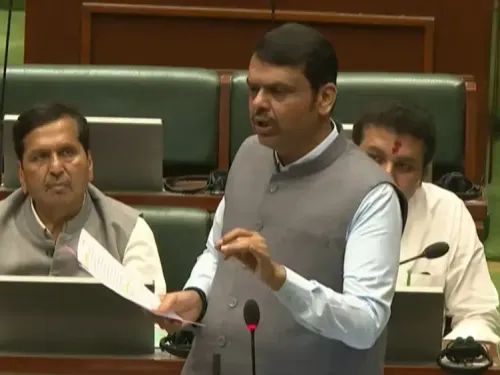
Chief Minister Devendra Fadnavis acknowledged in the state legislature last week that Maharashtra's finances are under strain due to numerous welfare initiatives. However, both he and Deputy Chief Minister and Finance Minister Ajit Pawar asserted that the state continues to meet critical economic stability indicators and remains one of the strongest economies among Indian states.
“We do not have an overflowing treasury, and I will not claim that we do. Yet, among the larger states in the country, Maharashtra still qualifies on all metrics for a stable and robust economy,” stated the Chief Minister during his response to debates in the Legislative Assembly.
In March 2025, Pawar presented a state budget showing a revenue deficit of Rs 45,891 crore. By June 2025, supplementary demands totaling Rs 57,509.71 crore pushed the revenue deficit over Rs 1 lakh crore. With additional demands totaling Rs 75,286.37 crore presented in the recently concluded winter session, the state's revenue deficit is now nearing Rs 2 lakh crore.
The Budget Estimate for 2025-26 has already escalated Maharashtra's total debt stock to Rs 9,32,242 crore, representing 18.87% of the Gross State Domestic Product (GSDP)—the highest level recorded in the past five years.
Point of View
But it also raises concerns about fiscal sustainability amidst rising public debt. It is crucial to monitor how these developments unfold and their long-term implications for the state's economy.
NationPress
1 Oct 2026
Frequently Asked Questions
What is the VB G RAM G Bill?
The VB G RAM G Bill is a proposed legislation aimed at replacing the existing MGNREGA scheme in Maharashtra, focusing on employment generation and social welfare.
How much does Maharashtra expect to spend under the new Bill?
Maharashtra anticipates a total expenditure of around Rs 15,000 crore under the new Bill, with a potential state contribution of Rs 6,000 crore.
What are the implications of the proposed expenditure increase?
The proposed increase could boost employment generation significantly but may also strain the state's finances further amidst rising public debt.
How does the new expenditure sharing ratio work?
The new Centre-State expenditure sharing ratio for employment generation will shift from 90:10 to 60:40, increasing the state's financial responsibility.
What impact does this have on Maharashtra's debt?
The proposed increase in expenditures could further elevate Maharashtra's total debt, which is already at Rs 9,32,242 crore, representing 18.87% of the GSDP.