Nisith Pramanik: Mamata Banerjee's Malda Incident a Staged Act of Fear
Synopsis
In a bold claim, former MoS Nisith Pramanik accuses West Bengal CM Mamata Banerjee of staging the Malda incident to create a climate of fear among residents. He discusses the implications for the upcoming elections and the pressing need for change in governance.
Key Takeaways
Nisith Pramanik alleges that Mamata Banerjee staged the Malda incident.
The incident is framed as an attempt to create a fear psychosis .
Pramanik emphasizes the need for border fencing to address security concerns.
He criticizes the government for failing to provide employment opportunities for youth.
Public sentiment is shifting towards a demand for political change in Bengal.
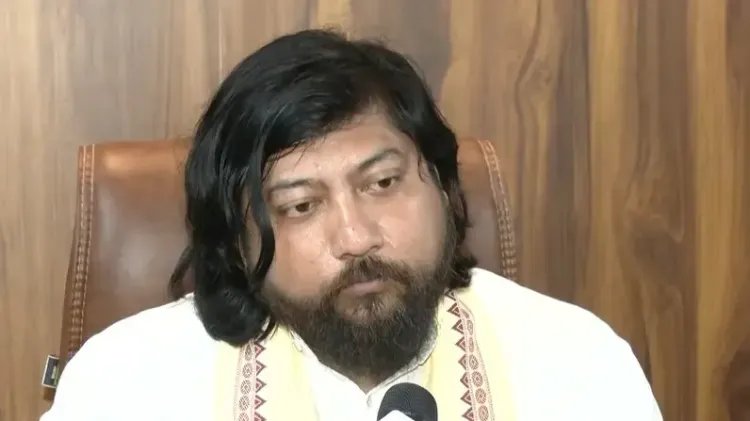
Kolkata, April 6 (NationPress) Former Union Minister of State (MoS) for Home Affairs, Nisith Pramanik, has alleged that West Bengal Chief Minister Mamata Banerjee orchestrated the recent Malda incident to instill what he calls a "fear psychosis" among the state's residents.
In an exclusive interview with IANS, Pramanik, the BJP candidate from the Mathabhanga Assembly constituency of Bengal, claimed that the Trinamool Congress (TMC) government has been harboring Bangladeshi infiltrators to maintain its political dominance, asserting that the electorate is now aware and yearning for a shift in governance.
Discussing the Malda incident, where judicial officers involved in the Special Intensive Revision (SIR) of electoral rolls were reportedly surrounded and attacked by a mob on April 1, Pramanik stated, "Mamata didi had previously mentioned that such events could occur. She has indicated that a specific community is under her influence, while Hindus and Sanatanis are not. This leads one to wonder about the identity of that community."
He further claimed, "She had the audacity to assert that if she loosened her grip on that community, even momentarily, it would lead to a profound change in the state. The Malda incident was a deliberate act staged by Mamata Banerjee to further her agenda."
Pramanik argued that the incident was a calculated move to instill fear among the populace, asserting, "Mamata did this to foster a climate of fear psychosis. Throughout her tenure, she has cultivated an atmosphere of intimidation, utilizing her power to expand her control."
The BJP leader also criticized the state administration regarding border fencing along the India-Bangladesh border, questioning why necessary land has not been allocated to the Centre for this purpose.
"Given the federal structure, if the Central government cannot directly acquire the land, why hasn’t Mamata Banerjee provided the 400 km of land needed? Is it to accommodate Rohingyas, fraudulent voters, or Bangladeshi Muslims? It appears to be the emerging truth," he remarked.
Addressing the issue of infiltration, he added, "The problem persists at the India-Bangladesh border. Typically, as one approaches the zero line at other borders, populations diminish; however, near the Bangladesh border in Bengal, the population density increases. This is indicative of infiltration."
"The Trinamool Congress facilitates the issuance of fake documents to these infiltrators. Without these fraudulent voters, the Mamata government would also collapse, which is why she opposes the SIR process," he asserted.
Expressing confidence ahead of the Assembly elections, Pramanik noted that the public is poised for a political transformation.
"The people of Bengal are demanding change. They seek a progressive government after enduring 15 years of lawlessness and appeasement politics. They are eager to uproot this government and party (TMC)," he stated.
Highlighting what he termed as "key issues" likely to influence the election outcome, Pramanik remarked, "A significant national security threat stems from the unfenced 450 km stretch of Bengal. If it remains unfenced, Mamata Banerjee bears the responsibility. The youth of Bengal lack job opportunities, and the industrial infrastructure is inadequate—she is to blame for this situation."
He raised concerns about the employment landscape for Bengal's youth, saying, "Educated youth, after completing their degrees, find themselves compelled to seek labor work in states like Gujarat, Rajasthan, or Bengaluru. In response, Mamata Banerjee mocks them with comments like, 'Why don’t you make pakoras or Jhalmuri here in Kalighat?' The youth have become aware of this reality."
Criticizing Trinamool Congress MP Abhishek Banerjee, Pramanik said, "The youth now understand the situation and question why Mamata cannot ask her nephew, Abhishek Banerjee, to make pakoras and Jhalmuri instead of mocking the educated youth. Charity begins at home; why doesn’t she extend this to her own family? This has led to a realization among the youth that change is imperative."
Point of View
Suggesting a deliberate attempt to manipulate public perception. While the claims highlight significant concerns regarding governance and security, they also reflect the heightened tensions in the lead-up to elections in West Bengal, showcasing a critical moment in the region's political narrative.
NationPress
14 Sept 2026
Frequently Asked Questions
What is the Malda incident referred to by Nisith Pramanik?
The Malda incident involves judicial officers engaged in the revision of electoral rolls who were reportedly attacked by a mob on April 1.
What does Nisith Pramanik accuse Mamata Banerjee of?
Pramanik accuses Banerjee of orchestrating the Malda incident to create a 'fear psychosis' among the people of West Bengal.
What concerns does Pramanik raise about the India-Bangladesh border?
He questions why the government has not provided land for border fencing and highlights issues of infiltration along the border.
What political changes does Pramanik anticipate?
He believes the electorate is ready for a shift in governance, seeking a progressive government to replace the current administration.
How does Pramanik view the current employment situation for Bengal's youth?
He expresses concern that educated youth are forced to seek labor work outside Bengal, criticizing the current government's lack of job opportunities.