How Did ‘Mann Ki Baat’ Unveil Forgotten Buddhist Ruins in a J&K Village?

Synopsis
Prime Minister Narendra Modi's ‘Mann Ki Baat’ unveiled the remarkable Buddhist ruins in Zehanpora, Kashmir, shedding light on the region's rich history. This rediscovery, aided by modern technology, reveals a vibrant Buddhist culture and enhances our understanding of ancient Kashmir's significance in the Kushan Empire.
Key Takeaways
Rediscovery of ancient Buddhist ruins in Zehanpora, Kashmir.
Significant archaeological findings dating back to the Kushan period.
Use of drones and radar technology in archaeological exploration.
Connection to historical narratives from ancient monks.
Kashmir's central role in the early spread of Buddhism .
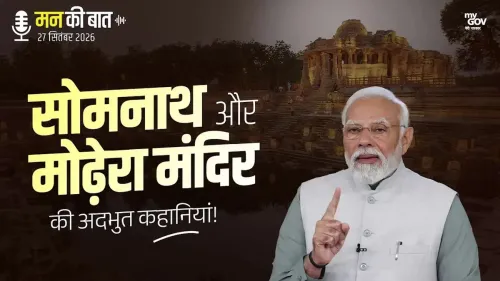
Srinagar, Dec 28 (NationPress) Prime Minister Narendra Modi's ‘Mann Ki Baat’ on Sunday illuminated the rich heritage and archaeological treasures of Kashmir.
During his address, PM Modi highlighted ancient Buddhist remnants located in Zehanpora village within the Baramulla district, where the renowned Kushan-era Buddhist remains known as the Zehanpora mounds were unearthed.
This noteworthy site is thought to be the vestiges of a grand Buddhist complex dating back to the Kushan period, with excavations uncovering stupas, walls, pottery, and artefacts, showcasing a thriving Buddhist center in ancient Kashmir and offering invaluable insights into the region's cultural and religious history.
PM Modi referenced blurred images in a French museum that brought the Zehanpora mounds into the global spotlight.
The mounds are recognized as a key early historic Buddhist site, potentially dating back around 2000 years. Significant finds include numerous stupas, ancient walls, terracotta art (such as Gandhara-style heads), pottery, and copper artefacts.
These discoveries suggest the existence of a major Buddhist center during the Kushan dynasty (1st-3rd centuries CE), a time when Buddhism flourished in Kashmir. This excavation provides fresh perspectives on Kashmir's extensive past, connecting to historical narratives by Chinese monks like Xuanzang, who visited similar sites like Ushkur (Hushkapur).
The findings followed comprehensive surveys employing drones and ground-penetrating radar to locate the mounds ahead of excavation.
The site is situated near Zehanpora in the Baramulla district. The Zehanpora mounds represent a substantial archaeological discovery, revealing a significant Kushan-era Buddhist settlement crucial for understanding the history and Buddhist heritage of ancient Kashmir.
Dr Harmeet Singh Soodan, professor and head of the political science department at Government Degree College, Katra, highlighted in a recent article that the journey to uncover the Zehanpora story began not with tools, but with drones.
“For years, locals observed the unusual mounds, assuming they were merely remnants of past settlements or geological formations. However, drone-based aerial surveys transformed the understanding. The mounds exhibited symmetrical circular and rectangular shapes that were unmistakably man-made. This led to a thorough ground exploration. Brick foundations were revealed, forming what appears to be a stupa base. Adjacent sections displayed monastic structures: cells, platforms, and pathways that reflected the arrangement of Buddhist monastic complexes found throughout the Gandhara region,” he explained.
“The discovery was so meticulous that even the layering of construction matched known patterns from the Kushan era. Interestingly, these findings also validate earlier archaeological observations made in 1869 by colonial explorers. Their notes, largely forgotten, mentioned structural remnants in the vicinity that bore resemblance to Gandhara architecture. Lacking modern tools, they could only speculate. Today, their marginalia are vindicated. Zehanpora is both a rediscovery and a realization: a heritage ignored for over a century has finally made its voice heard,” Soodan stated.
He emphasized that to grasp the significance of this discovery, one must view it within the broader historical context of the Kushan Empire. Between the 1st and 3rd centuries CE, the Kushans governed an extensive territory spanning from Central Asia to northern India. They were among the foremost patrons of Buddhism, fostering its institutions and facilitating its spread along the Silk Routes. One of the most significant Kushan rulers, Emperor Huvishka, is believed to have relocated part of his administrative and religious activities to Kashmir.
“Ancient coins, inscriptions, and historical accounts repeatedly refer to a royal center named Huvishkapura, whose exact location has long remained elusive. Scholars have proposed multiple sites, but none have been definitively confirmed. Could Zehanpora be part of this mysterious capital’s landscape? The evidence is compelling. The sheer dimensions of the structures, their chronological context, and their artistic affiliations align closely with the Kushan architectural legacy. The existence of stupas, monumental symbols of Buddhist patronage, reinforces the notion that Kushan influence in this area was not marginal but central,” Soodan articulated in his article.
“If Zehanpora was not the capital itself, it may have served as a satellite settlement, a monastic extension, or a spiritual hub within the capital’s extensive domain. What is certain is that this discovery bolsters Kashmir’s role in the history of early Buddhism, revealing a valley deeply intertwined with the currents of Kushan-era culture, politics, and spirituality,” he added.
Kashmir’s historical ties to Gandhara are frequently cited in ancient texts; the Nilamata Purana is a significant Sanskrit text that provides detailed insights into the pilgrimage sites, rituals, and ceremonies practiced by the people of Kashmir.
This text offers information about the origins of Kashmir. The insights derived from the Nilamata Purana aid in reconstructing the social and religious history of ancient Kashmir, but visible archaeological evidence in the region has been comparatively scarce. Zehanpora alters that perception.
The architectural features uncovered thus far—circular stupa bases, brick patterns, rectilinear monastic cells—reflect characteristics found in prime Gandharan sites like Swat, Taxila, and Takht-i-Bahi.
Moreover, the site’s strategic positioning would have placed it directly along ancient pathways linking Srinagar to Gandhara via Baramulla and beyond to the mountain passes of the northwest. This route was not merely a road; it was a cultural artery.
Monks, traders, sculptors, and pilgrims traversed it, exchanging ideas and images that shaped the Buddhist world. Zehanpora, in this context, was not an isolated enclave.
“It was part of a flourishing exchange network—a place where ideas thrived, where teachers engaged in debate, and where scriptures may have been copied, translated, or composed. For Kashmir, this discovery reaffirms its historical significance as a crossroads of civilizations, not just a frontier zone... What makes the Zehanpora discovery profoundly meaningful is not solely its antiquity, architectural significance, or its ties to the Kushans. It serves as a reminder that Kashmir’s narrative is multifaceted. It is a tapestry woven from diverse civilizational threads—Hindu, Buddhist, Islamic, Persian, Central Asian, and local Himalayan. For too long, the valley’s early Buddhist period has been overshadowed by later narratives. This discovery reopens that chapter with clarity and urgency,” Professor Soodan concluded.
Point of View
The revelations in Kashmir underscore the importance of archaeological discoveries in reconnecting modern society with its rich historical roots. The involvement of Prime Minister Modi in highlighting these findings is crucial, as it not only promotes regional pride but also fosters a deeper appreciation for India's diverse cultural heritage.
NationPress
5 Oct 2026
Frequently Asked Questions
What are the Zehanpora mounds?
The Zehanpora mounds are significant archaeological findings in Kashmir, believed to be remnants of an ancient Buddhist complex from the Kushan period, dating back about 2000 years.
How were the mounds discovered?
The mounds were identified through extensive surveys using drones and ground-penetrating radar, revealing their man-made symmetrical patterns.
What historical significance do the mounds hold?
The mounds represent a major Buddhist center during the Kushan dynasty, offering valuable insights into the cultural and religious heritage of ancient Kashmir.
Who highlighted the importance of these findings?
Prime Minister Narendra Modi discussed the mounds in his 'Mann Ki Baat' address, emphasizing their role in understanding Kashmir's rich history.
What does the discovery suggest about early Buddhism in Kashmir?
The discovery indicates that Kashmir was a vital part of early Buddhist culture and a hub for the exchange of ideas and beliefs along ancient trade routes.