Did Mizoram CM Just Inaugurate a Game-Changing Bridge Over the Tlawng River for Connectivity with Tripura and Bangladesh?
Synopsis
Mizoram Chief Minister Lalduhoma has inaugurated the Lengtekai bridge, a pivotal structure over the Tlawng River that is set to revolutionize connectivity with Tripura and Bangladesh, enhancing trade and socio-economic growth in the region.
Key Takeaways
Strategic Infrastructure: The Lengtekai bridge significantly improves connectivity.
Economic Enhancement: The bridge will facilitate trade and socio-economic growth.
Safety Improvements: Designed for heavy loads, ensuring safer transport.
Government Support: Funded by the Ministry of Road Transport and Highways.
Community Impact: Serves the Mamit district, benefiting local residents and agriculture.
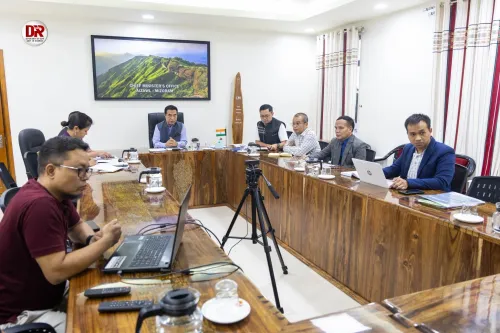
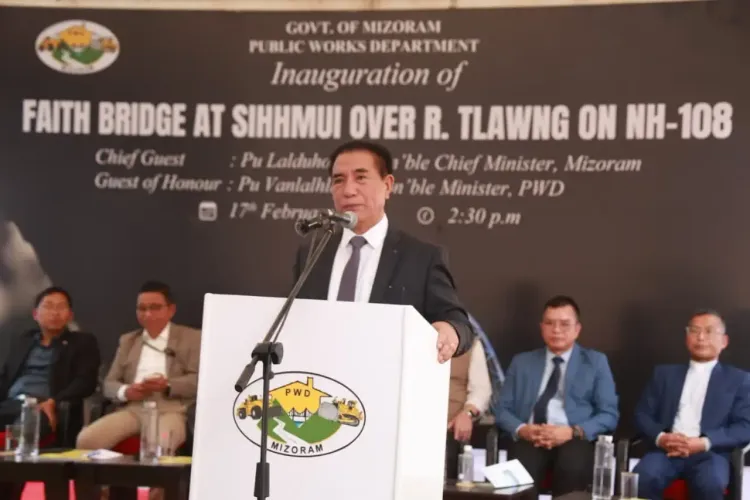
Aizawl, Feb 17 (NationPress) The Chief Minister of Mizoram, Lalduhoma, officially opened the Lengtekai bridge on Tuesday, an essential infrastructure initiative designed to enhance connectivity with both Tripura and the neighboring country of Bangladesh.
Spanning the Tlawng River, this strategically significant bridge was constructed at a cost of Rs 43.83 crore, funded through the Ministry of Road Transport and Highways.
The new infrastructure is anticipated to greatly boost regional connectivity, facilitate trade and transportation, and aid in the broader socio-economic advancement of the state.
Officially designated as the ‘Faith Bridge’, the structure measures 100 metres in length and 7.5 metres in width, featuring a 1.5 metre footpath on each side. It has been engineered to support loads up to 385 metric tons, thereby significantly enhancing transport safety and capacity in the western part of the state.
During the inauguration, the Chief Minister recounted the obstacles faced during the bridge's initial launch attempt in December 2024, which was delayed due to a pulley failure.
After several months of thorough technical preparations, another attempt was made in April 2025, successfully positioning the structure without any issues. Final touches, including connecting roads, were completed in September 2025, paving the way for Tuesday’s official opening.
The Chief Minister highlighted that this new bridge supersedes older Bailey structures that had limited capacity and had frequently been damaged. The new design eliminates load restrictions and the need for vehicle unloading, ensuring a safer and more consistent traffic flow. He described the project as a symbol of reliability and faith, mirrored in its name, and a significant step toward strengthening Mizoram’s core infrastructure.
Focusing on the bridge’s strategic importance, he pointed out that it serves as a crucial corridor for the Mamit district, which houses around 85,000 residents across approximately 90 villages (Census 2011). The district boasts strong agricultural potential, including rubber cultivation projects under the state’s Chief Minister Rubber Mission. This route not only connects Mizoram with Tripura and Bangladesh but also supports the transport of locally valued Langkaih river sand, provides access to Lengpui Airport, and assists institutions like the National Institute of Technology Mizoram.
The hilly state shares its borders with Assam, Tripura, and Manipur on the inter-state level, and with Bangladesh and Myanmar internationally.
The Mamit–Bairabi corridor will continue to gain significance as regional connectivity improves. Emphasizing the government's commitment to timely and quality project completion, the Chief Minister noted that Mizoram's road density—currently at about 46.37 km per 100 sq km—is significantly below the national average. Therefore, accelerating infrastructure development remains a top priority.
He expressed gratitude to Union Road Transport and Highways Minister Nitin Gadkari and the Central government for their sustained cooperation and responsiveness to the state's demands. Stringent quality assurance measures were implemented throughout the bridge's construction, including continuous material testing in an on-site laboratory. The steel components were produced in Rourkela and transported in sections for assembly. Specialized carbon steel tension rods manufactured in Thailand were utilized for the hanger system. Upon completion, extensive load testing validated the bridge’s operational safety and capacity to accommodate all vehicle classes.
Point of View
The inauguration of the Lengtekai bridge signifies an important step in enhancing regional connectivity and economic integration. As Mizoram continues to develop its infrastructure, the federal support reflects a commitment to improving lives and opportunities in this strategically located state.
NationPress
10 Oct 2026
Frequently Asked Questions
What is the significance of the Lengtekai bridge?
The Lengtekai bridge enhances connectivity between Mizoram, Tripura, and Bangladesh, facilitating trade and socio-economic development.
How much did the bridge cost?
The bridge was constructed at a cost of Rs 43.83 crore, funded by the Ministry of Road Transport and Highways.
What is the load capacity of the bridge?
The bridge is designed to support loads up to 385 metric tons, significantly improving transport safety.
Who inaugurated the bridge?
The Chief Minister of Mizoram, Lalduhoma, inaugurated the bridge on February 17.
What issues were faced during construction?
Construction faced delays due to pulley failures during the initial launch attempt, but subsequent attempts were successful.