Why did PM Modi criticize 'slave mentality' regarding the Somnath Temple restoration?
Synopsis
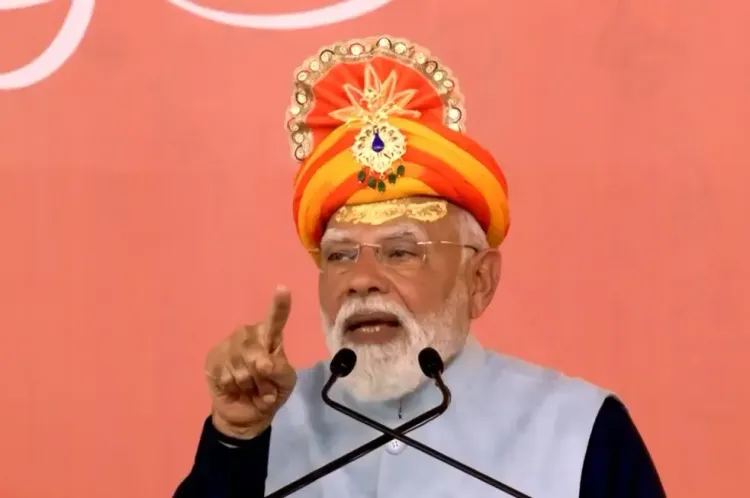
In a passionate address, PM Modi condemned the 'slave mentality' opposing the Somnath Temple's restoration, accusing them of whitewashing historical religious attacks for political gains. He highlighted the temple's significance as a symbol of India's resilience and called for unity against divisive forces, urging citizens to honor their rich heritage.
Key Takeaways
Critique of 'slave mentality' in political discourse.
Significance of the Somnath Temple in India's cultural identity.
Call for unity against divisive forces.
Historical context of the temple's restoration.
Vision for a developed India over the next 1000 years.
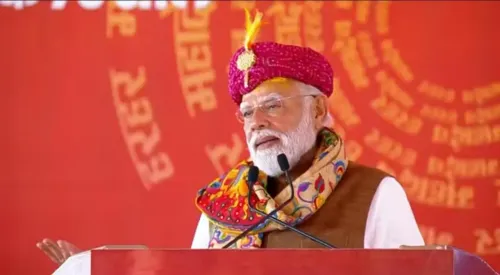
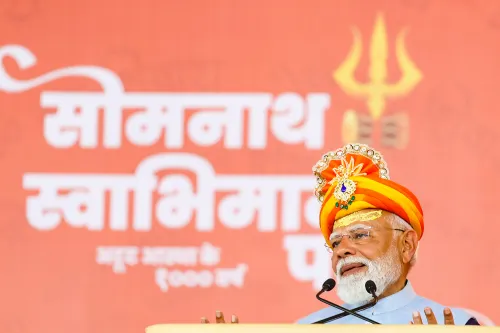
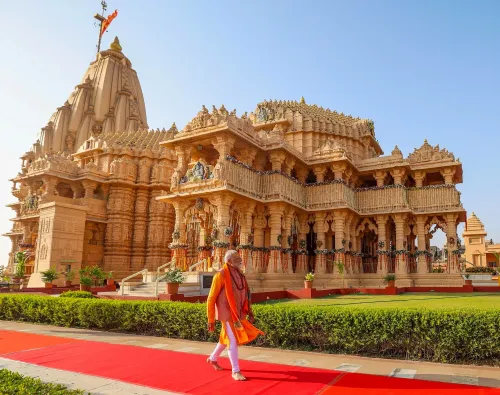
Somnath (Gujarat), Jan 11 (NationPress) Prime Minister Narendra Modi vehemently criticized on Sunday those with a 'slave mentality' who resisted the restoration of the Somnath Temple in 1951. He asserted that such entities persist in utilizing 'evil tactics' against India.
He highlighted that there have been efforts to 'whitewash' religiously motivated assaults for the sake of 'appeasement politics', claiming that the narrative of hatred and cruelty has been obscured from public knowledge.
Addressing a significant audience at Sadbhavna Maidan, PM Modi remarked, 'India boasts ancient sites like Somnath, symbolizing our strength, resilience, and traditions. Sadly, after Independence, individuals with a slave mentality sought to disassociate from these landmarks. They endeavored to erase the history of this revered location.'
Honoring those who sacrificed for the Somnath Temple's preservation, PM Modi passionately declared, 'Regrettably, the sacrifices of those who fought for the temple's integrity were overlooked, while some political figures attempted to downplay religiously motivated assaults, labeling them as mere acts of looting for their appeasement politics. However, Somnath faced multiple attacks.'
'If the assault on Somnath was purely economic, it would have ceased after the initial major plunder 1000 years ago; yet, it faced repeated attacks. We were misled into believing Somnath was looted for wealth, while the history of hatred and cruelty was concealed from us,' he continued.
PM Modi noted that true adherents of their faith would never condone such extremism, yet some still opposed the restoration of the shrine for their appeasement agendas.
'Those engaged in appeasement politics have bowed to extremist forces. When India gained Independence and Sardar Vallabhbhai Patel resolved to restore the Somnath Temple, he faced opposition. Similarly, when President Dr. Rajendra Prasad visited in 1951, there was also resistance. At that time, Swaraj Jam Sahib Maharaja Digvijaysinhji stepped forward to fund its reconstruction, donating Rs one lakh for the temple's restoration.'
PM Modi recounted the period when then Prime Minister Jawaharlal Nehru did not support the temple's reconstruction and resisted having key constitutional figures associated with it.
Despite Nehru's objections, Sardar Patel, K.M. Munshi (who spearheaded the building efforts), and President Rajendra Prasad became staunch advocates for the temple's restoration. The reconstruction was ultimately financed through public donations rather than government funds.
The Prime Minister asserted that those who opposed the Somnath Temple's restoration are still present in India, continuing to act against it.
'Regrettably, today, those forces who opposed the temple's restoration remain in India. Presently, instead of swords, other nefarious tactics are employed against the nation. Thus, we must remain vigilant, grow stronger, and stand united to combat every force aiming to divide us.'
'During the Ram Temple's 'Pran Pratishtha', I envision a grand dream for India over the next 1000 years. I spoke about advancing with the concept of 'Dev to Desh'... Today, every citizen is resolute in achieving 'Viksit Bharat'.'
Prime Minister Modi emphasized that India is 'advancing with pride in its heritage'. In Somnath, he reiterated that this pride and heritage continue to flourish. He acknowledged that the cultural growth of the Somnath temple, the establishment of the Somnath Cultural University, and the vibrancy of the Madopur fair - 'all these aspects reinforce our heritage.'
'We must ensure our thousand-year-old heritage is recognized in every part of the nation and introduce our legacy to the world. We should celebrate this new festival of 75 years and continue until 2027, awakening every citizen so that a conscious nation can progress towards realizing its aspirations.'
Point of View
It is essential to acknowledge PM Modi's remarks as a reflection of a broader conversation about India's heritage and identity. His emphasis on the restoration of the Somnath Temple underscores the importance of recognizing historical narratives and the need for unity against divisive politics. This discourse is vital for fostering a sense of national pride and collective responsibility.
NationPress
24 Sept 2026
Frequently Asked Questions
What did PM Modi say about the Somnath Temple?
PM Modi criticized those opposing the temple's restoration, labeling them as having a 'slave mentality' and accused them of whitewashing historical attacks for political motives.
Why is the Somnath Temple significant?
The Somnath Temple represents India's rich heritage and resilience, symbolizing the sacrifices made by many for its preservation throughout history.
What does PM Modi suggest about unity in India?
PM Modi urged citizens to remain vigilant and united against divisive forces, emphasizing the importance of collective strength in upholding India's heritage.
How did the Somnath Temple get restored?
The temple was restored through public donations, driven by political figures like Sardar Patel and K.M. Munshi, despite initial resistance from then Prime Minister Nehru.
What future vision did PM Modi share?
PM Modi expressed a vision for a 'Viksit Bharat' and a celebration of India's thousand-year heritage, encouraging citizens to awaken and strive for progress.