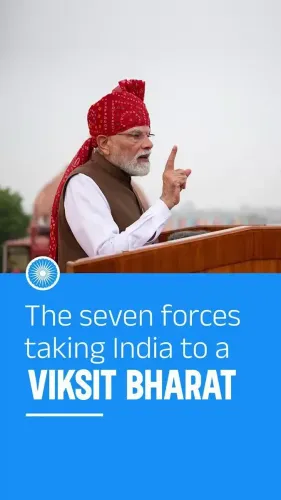
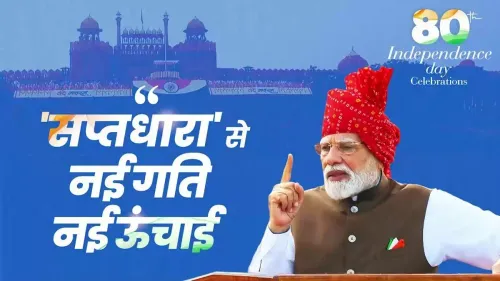
PM Modi launches 'Sapta Dhara' vision on Independence Day to power Viksit Bharat
Synopsis
Modi's Independence Day address wasn't a list of schemes — it was a civilisational pitch. By invoking 'Sapta Dhara' against the backdrop of the ancient 'Sapta Sindhu,' he framed India's next growth phase as both a policy agenda and a cultural identity. Seven streams, no budget lines yet — the real test begins when the vision meets implementation.
Key Takeaways
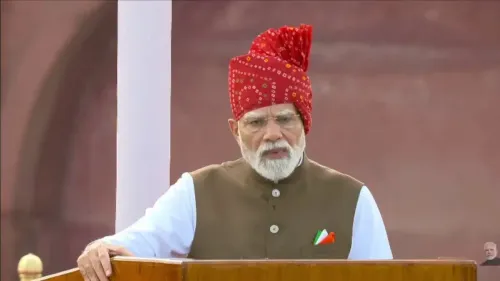
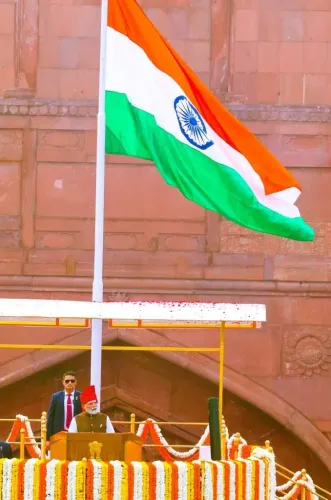
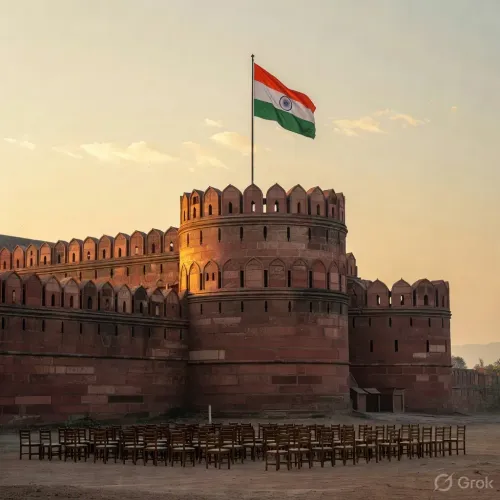
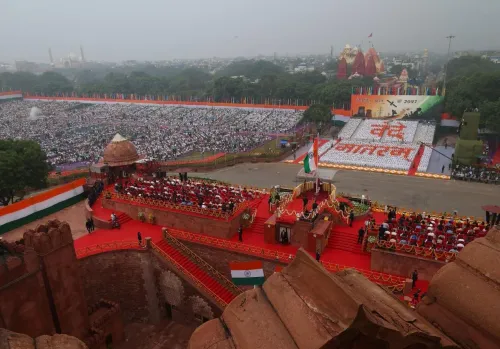
PM Modi unveiled the 'Sapta Dhara' (Seven Streams) framework on 15 August 2025 from the Red Fort , New Delhi .
The seven streams are: Manufacturing Power , Agriculture and Food Processing , Technology and Innovation , Gati Shakti (Infrastructure), Raksha Shakti (Defence), Green and Blue Economy , and Soft Power .
Modi described the next five to seven years as a critical window to achieve what 'could not be accomplished over several previous decades.' Defence priorities include drone systems , counter-drone tech, hypersonic capabilities and cybersecurity , with a goal of becoming a Global Defence Supplier .
No specific budget outlays or implementation timelines were announced; the framework remains a vision document as of the Independence Day address.
India's youth were positioned as the central execution force across all seven streams.
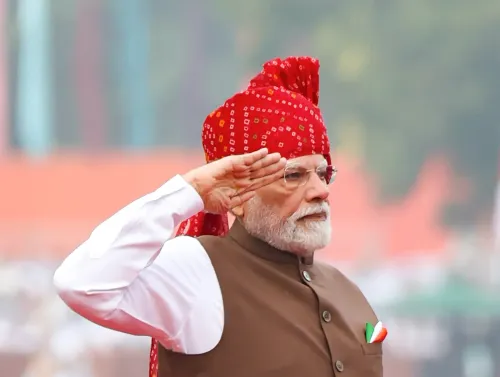
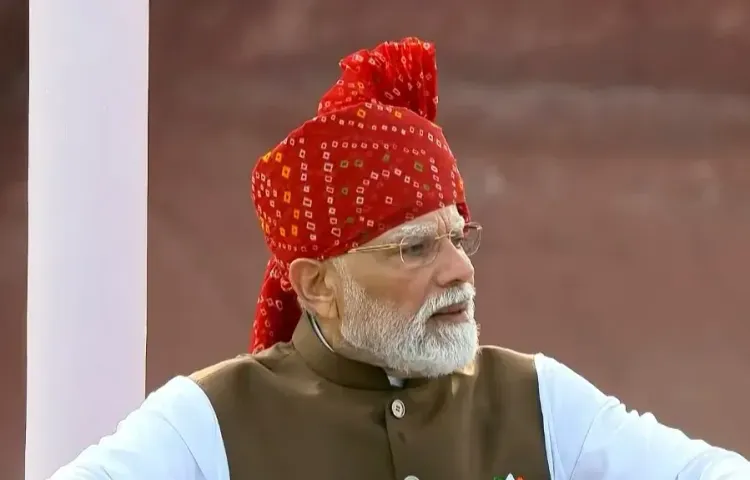
Prime Minister Narendra Modi on 15 August 2025 unveiled the 'Sapta Dhara' (Seven Streams) framework during his Independence Day address from the ramparts of the Red Fort in New Delhi, outlining seven strategic pillars he said would drive India's next phase of growth and accelerate the journey toward a 'Viksit Bharat' (Developed India). Modi described the coming five to seven years as a defining window, arguing that the combined force of the seven streams could help India achieve in the near term what had eluded it over several previous decades.
The Historical Framing
Drawing on the ancient concept of 'Sapta Sindhu' (Seven Rivers), Modi cast the new framework as a civilisational update — a modern current of national strength to replace a historical one. 'Today, from the ramparts of the Red Fort, I invoke the Sapta Dhara of strength before the nation,' he said, positioning the vision as both a policy agenda and a cultural call to arms. The framing is notable for linking economic ambition to India's historical self-image, a rhetorical device Modi has deployed consistently across his three terms.
The Seven Streams Explained
The first stream is Manufacturing Power. Modi called on entrepreneurs, manufacturers and MSMEs to build end-to-end value chains, meet global benchmarks on cost, quality and scale, and establish India as a 'trusted global supply chain hub.' His core mantra: 'Zero Defect' precision manufacturing and, repeatedly, 'Quality, Quality, Quality.'
The second stream is Agriculture and Food Production, combined with large-scale Food Processing. Modi said global markets have opened for Indian farmers and stressed the need to 'bridge the journey from farm to export market,' connecting agricultural output directly to international demand.
The third stream is Technology and Innovation. Citing Artificial Intelligence, Quantum technology, space, robotics and data centres as the defining forces of the era, Modi said India must move beyond being a consumer market and become the 'Global Hub of Innovation,' building on the foundation of UPI and digital public infrastructure.
The fourth stream is Gati Shakti — infrastructure and connectivity — encompassing high-speed rail, modern highways, inland waterways, advanced airports and multimodal logistics systems. The fifth is Raksha Shakti (Defence Power), with Modi stressing Aatmanirbharta (self-reliance) in defence as non-negotiable. He specifically flagged drone systems, counter-drone systems, hypersonic defence technologies and cybersecurity as priority areas, and said India must aspire to become a 'Global Defence Supplier' rather than remain an arms market for other nations.
The sixth stream is the Green Economy and Blue Economy. Modi called for global scale in Green Hydrogen, Renewable Energy, Energy Storage, Green Mobility and Green Manufacturing, while also highlighting India's extensive coastline as a gateway to fisheries, coastal tourism and ocean technologies. The seventh and final stream is Soft Power — spanning Yoga, Ayurveda, handicrafts, films, VFX, animation, gaming and digital content. Modi cited the WAVES Summit (World Audio Visual and Entertainment Summit) as a platform already projecting India's creative capabilities to the world.
Youth at the Centre
Across all seven streams, Modi emphasised the role of India's youth as the primary engine of execution. He said the power and potential of young Indians would be 'fully harnessed and integrated into nation-building,' framing demographic dividend not as a passive asset but as an active force to be mobilised across manufacturing, technology and defence.
What Comes Next
The Sapta Dhara framework, as presented, is a vision document rather than a budgeted scheme. No specific outlay figures, timelines or implementation agencies were announced on Saturday. Policy specifics — including how the seven streams will be operationalised, funded and measured — are expected to follow in subsequent government communications. Industry bodies and analysts are likely to scrutinise the framework for the same detail that was notably absent from the Red Fort address.
Point of View
No rupee figures, no sector-specific targets, and no accountability mechanisms were announced alongside the seven streams. The manufacturing stream, in particular, echoes the original Make in India pitch from 2014 and subsequent PLI rounds — neither of which has moved India's manufacturing share of GDP meaningfully beyond 17%. Whether Sapta Dhara becomes a governing blueprint or a rhetorical frame will depend entirely on what follows in the Union Budget and sectoral policy over the next 12 months.
NationPress
29 Sept 2026
Frequently Asked Questions
What is 'Sapta Dhara' announced by PM Modi on Independence Day?
'Sapta Dhara,' meaning Seven Streams, is a strategic vision framework unveiled by Prime Minister Narendra Modi on 15 August 2025 from the Red Fort. It identifies seven areas — Manufacturing, Agriculture and Food Processing, Technology and Innovation, Infrastructure (Gati Shakti), Defence (Raksha Shakti), Green and Blue Economy, and Soft Power — as the pillars of India's next growth phase toward a Viksit Bharat.
Why did Modi invoke 'Sapta Sindhu' in his Independence Day speech?
Modi drew a parallel with 'Sapta Sindhu' (Seven Rivers), an ancient concept associated with India's civilisational identity, to frame the new 'Sapta Dhara' as a modern equivalent — a fresh current of national strength. The comparison was rhetorical, linking economic ambition to historical self-image.
What are the seven streams of Sapta Dhara?
The seven streams are: (1) Manufacturing Power, (2) Agriculture and Food Production with Food Processing, (3) Technology and Innovation including AI, Quantum and Space, (4) Gati Shakti covering infrastructure and connectivity, (5) Raksha Shakti or Defence Power, (6) Green Economy and Blue Economy, and (7) Soft Power encompassing Yoga, Ayurveda, culture and creative industries.
Were any specific funds or timelines announced under Sapta Dhara?
No specific budget allocations, outlay figures or implementation timelines were announced during the Independence Day address. The Sapta Dhara framework was presented as a vision; detailed policy and funding specifics are expected to follow in subsequent government announcements.
Who is expected to be most affected by the Sapta Dhara vision?
The framework is intended to affect multiple stakeholders — manufacturers and MSMEs under the manufacturing stream, farmers and agri-exporters under the agriculture stream, defence firms and startups under Raksha Shakti, and India's youth broadly, whom Modi positioned as the primary execution force across all seven pillars.