PM Modi Unveils Sapt Dhara Blueprint on Independence Day

Synopsis
Prime Minister Narendra Modi introduced the Sapt Dhara framework on Independence Day 2026, a seven-pillar blueprint integrating manufacturing, agriculture, tech innovation, Gati Shakti infrastructure, defence, green-blue economy, and soft power as the operational roadmap for Viksit Bharat by 2047.
Key Takeaways
Sapt Dhara is PM Modi's seven-pillar growth framework announced on 15 August 2026 , India's Independence Day.
The seven pillars are Manufacturing, Agriculture, Tech Innovation, Gati Shakti Infrastructure, Defence, Green and Blue Economy, and Soft Power .
It is positioned as the operational model for Viksit Bharat@2047 , the goal of making India a developed economy by its centenary of independence.
The PM Gati Shakti National Master Plan , launched 13 October 2021 , is explicitly embedded within the framework, signalling policy continuity.
Budgetary allocations and institutional mechanisms for the seven pillars are expected in the next Union Budget and NITI Aayog strategy documents.
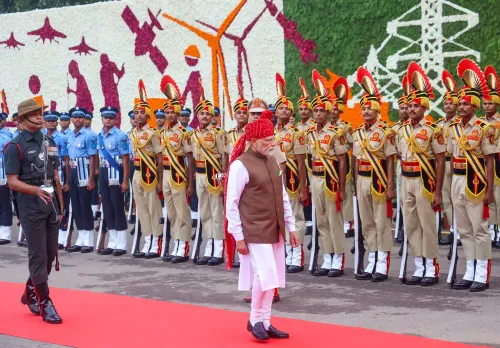
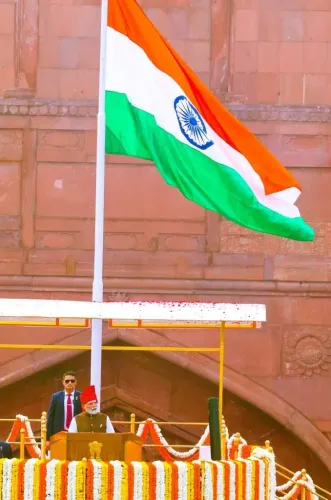
On Independence Day, 15 August 2026, Prime Minister Narendra Modi unveiled the Sapt Dhara framework — a seven-pillar growth blueprint positioned as the operational spine of the Viksit Bharat vision — in what the Chief Minister's Office of Gujarat called a 'comprehensive growth model for India's brighter future.'
Seven pillars, one 2047 horizon
The Sapt Dhara framework — sapt meaning seven in Sanskrit — binds together Manufacturing, Agriculture, Tech Innovation, Gati Shakti Infrastructure, Defence, the Green and Blue Economy, and Soft Power into a single, integrated national strategy. The framing is deliberate: rather than seven separate policy lanes, the blueprint presents these as interlocking engines, each feeding the others toward India's target of becoming a fully developed economy by 2047, the centenary of independence.
The inclusion of the Blue Economy — maritime trade, fisheries, coastal development — and Soft Power alongside the more familiar pillars of manufacturing and infrastructure is the sharpest signal of ambition here. These are domains where India has historically under-institutionalised its advantage, and their formal elevation into a prime-ministerial framework on the nation's biggest stage carries weight.
Gati Shakti and the infrastructure backbone
The PM Gati Shakti National Master Plan, launched on 13 October 2021, already serves as the central nervous system for multi-modal infrastructure coordination across ministries. Its explicit inclusion in the Sapt Dhara framework signals continuity rather than reinvention — the government is folding proven, operational programmes into a larger narrative architecture designed to carry India to 2047. For infrastructure developers and logistics players, that continuity is the story: the pipeline stays open, and the political commitment is reaffirmed at the highest level.
From Atmanirbhar to Sapt Dhara — the pattern since 2014
Independence Day has become the Modi government's preferred stage for macro-economic announcements, a pattern running consistently since 2014. The Viksit Bharat@2047 goal was first prominently articulated from the Red Fort in the 2022 Independence Day address. Atmanirbhar Bharat defence production and export targets were scaled up through a series of policy moves beginning in 2020. Sapt Dhara is the latest chapter in that same integrative playbook — bundling Make in India, Gati Shakti, green-energy missions, and now maritime and cultural diplomacy under one roof. The architecture changes; the ambition does not.
What comes next will matter as much as the announcement itself. Budgetary allocations and institutional mechanisms for each of the seven pillars are expected to surface in the next Union Budget and in forthcoming NITI Aayog strategy documents — where the blueprint will either gain operational muscle or remain a rhetorical frame.
Seven pillars named on the nation's biggest stage. The question India's manufacturers, farmers, and defence planners will now ask is simple: which one gets funded first?
Point of View
Atmanirbhar Bharat, Make in India — under a fresh overarching narrative. The addition of Blue Economy and Soft Power as formal pillars is notable, signalling an intent to institutionalise domains that have so far operated without a unified policy home. The real test will come in the next Union Budget: whether the seven pillars receive dedicated budgetary lines and institutional mandates, or whether Sapt Dhara remains a rhetorical frame, will determine its place in India's actual policy history.
NationPress
30 Sept 2026
Frequently Asked Questions
What is the Sapt Dhara framework announced by PM Modi?
Sapt Dhara is a seven-pillar national growth blueprint announced by Prime Minister Narendra Modi on Independence Day, 15 August 2026. It integrates Manufacturing, Agriculture, Tech Innovation, Gati Shakti Infrastructure, Defence, Green and Blue Economy, and Soft Power as the core drivers of India's Viksit Bharat@2047 goal.
What is Viksit Bharat and when was it announced?
Viksit Bharat, meaning 'Developed India,' is the national goal to make India a fully developed economy by 2047, the centenary of independence. PM Modi first prominently outlined the vision in his Independence Day address in 2022.
What is PM Gati Shakti and how does it relate to Sapt Dhara?
PM Gati Shakti is the National Master Plan for multi-modal infrastructure connectivity, launched on 13 October 2021. It is one of the seven pillars of the Sapt Dhara framework, embedded as the infrastructure backbone of the broader growth blueprint.
What does the Blue Economy pillar in Sapt Dhara mean for India?
The Blue Economy pillar covers maritime trade, fisheries, and coastal development. Its inclusion in Sapt Dhara signals the government's intent to formally institutionalise this sector within its long-term growth strategy, an area where India has historically under-invested in policy infrastructure.
When will details of the Sapt Dhara framework be made public?
Budgetary allocations and institutional mechanisms for the seven pillars of Sapt Dhara are expected to appear in the next Union Budget and in forthcoming NITI Aayog strategy documents.