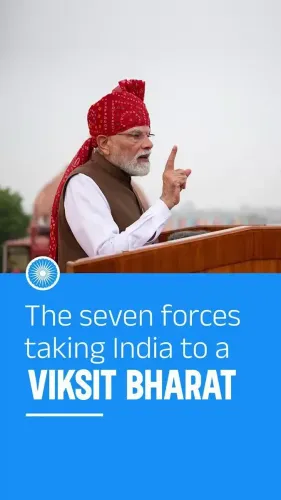
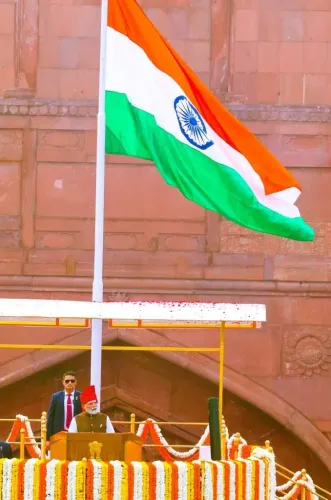
PM Modi lays out seven-pillar economic vision on Independence Day
Synopsis
On Independence Day 2026, PM Modi unveiled a seven-stream national growth framework — manufacturing, agriculture, technology, Gati Shakti, defence, green-blue economy, and soft power — building on a decade of policy groundwork from Make in India to Atmanirbhar Bharat.
Key Takeaways
PM Narendra Modi announced a seven-pillar economic vision on Independence Day, 15 August 2026 .
The framework — called saptadhara — covers Manufacturing, Agriculture and Food Processing, Technology and Innovation, Gati Shakti, Defence, Green and Blue Economy, and Soft Power .
Gati Shakti , the national infrastructure master plan launched in 2021 , is named as a standalone pillar, underscoring the centrality of logistics integration.
The Green and Blue Economy pairing reflects India's International Solar Alliance legacy (since 2015 ) and its growing Indo-Pacific maritime ambitions.
The framework builds on Make in India (2014) , Atmanirbhar Bharat (2020) , and PLI schemes (from 2020) .
Budgetary allocations and implementation roadmaps in the next Union Budget will be the key measure of the framework's depth.
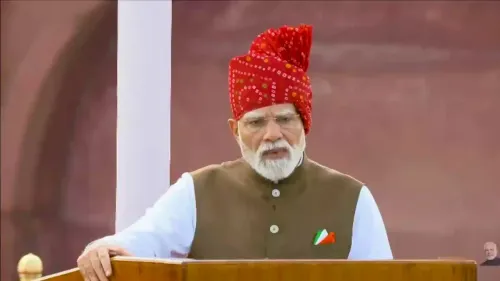
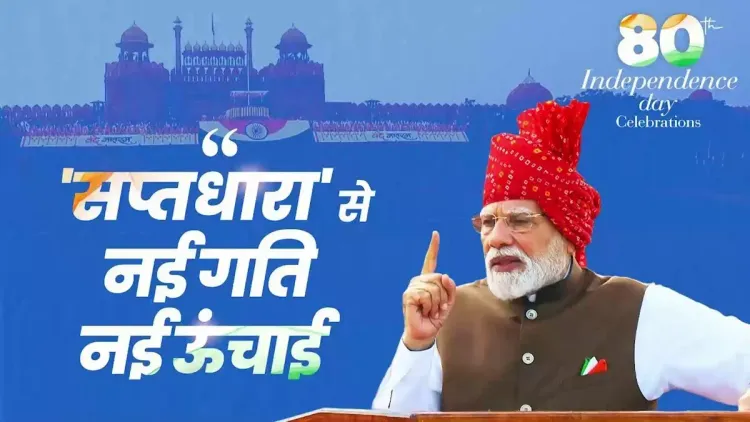
On Independence Day, 15 August 2026, Prime Minister Narendra Modi unveiled a seven-stream framework he says will deliver 'new momentum and new heights' to India — a compact but sweeping blueprint spanning manufacturing, agriculture, technology, infrastructure, defence, green and blue economies, and soft power.
In a post on X, Modi named what he called a saptadhara — a seven-stream confluence — of national strength: Manufacturing Power, Agriculture and Food Processing, Technology and Innovation, Gati Shakti, Defence Strength, Green Economy and Blue Economy, and Soft Power. The framing is deliberate: seven streams feeding one river of national ambition, announced on the one day in the calendar when such declarations carry the most weight.
A blueprint built on a decade of policy brickwork
None of the seven pillars arrived without a foundation. Manufacturing Power traces directly to the Make in India campaign launched in 2014, reinforced from 2020 onwards by Production Linked Incentive (PLI) schemes that have drawn investment across sectors from semiconductors to pharmaceuticals. Atmanirbhar Bharat, also announced in 2020, embedded self-reliance as the connective tissue linking manufacturing, defence, and technology into a single strategic posture.
Gati Shakti — the PM Gati Shakti National Master Plan, launched in 2021 — is the infrastructure integration engine underpinning several of the other six streams. By aligning roads, railways, ports, and logistics corridors across ministries through a unified digital platform, it is designed to cut the logistics costs that have long blunted India's export competitiveness. Its presence as a named pillar signals that connectivity is not a supporting act — it is a co-equal driver.
Green, blue, and the new frontiers of economic power
The pairing of Green Economy and Blue Economy in a single pillar is the sharpest signal of evolving ambition. India co-founded the International Solar Alliance in 2015, positioning renewable energy as both a domestic necessity and a diplomatic asset. The blue economy — maritime trade, fisheries, deep-sea resources, and coastal industry — adds a dimension that reflects India's expanding Indo-Pacific strategic footprint. Together, they represent the government's bet that the next wave of growth will be as much about oceans and clean energy as it is about factories.
Soft Power as an explicit economic pillar is the most intangible but arguably the most consequential long-term play. From yoga and cinema to the Indian diaspora and the global appetite for Indian cuisine and culture, soft power has been a consistent theme in Modi-era foreign policy — now formally integrated into the domestic growth framework.
Independence Day as the natural stage for national ambition
The timing is not incidental. Independence Day addresses and posts have, across successive governments, served as the primary platform for framing the national agenda. This post continues that tradition — but compresses it into a numbered list that is engineered to travel: seven concrete labels, zero bureaucratic jargon, maximum shareability. The audience is as much the global investor and the Indian diaspora as it is the domestic voter.
The real test of the saptadhara will arrive in the next Union Budget and Economic Survey — where budgetary allocations and scheme-specific roadmaps for each of the seven streams will either give the framework teeth or leave it as aspiration. Seven streams are only as powerful as the channels dug to carry them.
Point of View
Shareable Independence Day message — designed as much for global audiences as for domestic ones. The explicit inclusion of Gati Shakti as a named pillar, rather than an enabling mechanism, signals an intent to elevate infrastructure integration to the same political visibility as manufacturing or defence. The green-blue economy pairing is the most forward-looking element, acknowledging that India's next growth frontier straddles climate commitments and Indo-Pacific strategy simultaneously. Whether the framework translates into differentiated policy action or remains a unifying rhetorical device will become clear at the next Union Budget.
NationPress
30 Sept 2026
Frequently Asked Questions
What is PM Modi's saptadhara or seven-pillar vision announced on Independence Day 2026?
PM Modi's saptadhara is a seven-stream national development framework comprising Manufacturing Power, Agriculture and Food Processing, Technology and Innovation, Gati Shakti, Defence Strength, Green Economy and Blue Economy, and Soft Power, announced on 15 August 2026 .
What is Gati Shakti and why is it listed as one of India's seven pillars?
PM Gati Shakti is a national infrastructure master plan launched in 2021 that integrates roads, railways, ports, and logistics across ministries via a unified digital platform. Its inclusion as a named pillar reflects the government's view that logistics integration is a co-equal driver of economic growth, not just an enabler.
What does India's Blue Economy mean in PM Modi's framework?
The Blue Economy refers to the sustainable use of ocean resources — including maritime trade, fisheries, deep-sea resource exploration, and coastal industry — for economic growth. Paired with the Green Economy, it signals India's ambitions in both renewable energy and Indo-Pacific maritime strategy.
How does the seven-pillar vision connect to earlier Modi government schemes like Make in India and Atmanirbhar Bharat?
The seven pillars build directly on Make in India (2014) , Atmanirbhar Bharat (2020) , and Production Linked Incentive schemes (from 2020) , consolidating a decade of policy into a single unified framework announced on Independence Day.
What should Indians watch for after PM Modi's Independence Day 2026 announcement?
The next Union Budget and Economic Survey will be the critical test — budgetary allocations and scheme-specific implementation roadmaps for each of the seven pillars will determine whether the framework moves from vision to verifiable policy action.