Mehbooba Mufti flags waste dumping on Pampore saffron fields, 150 families at risk
Synopsis
Mehbooba Mufti’s allegation that the Srinagar Municipal Corporation has been dumping waste on Pampore’s saffron fields for three years is more than a local grievance — it is a flashpoint for a crop already in long-term decline. With 2,000 kanals allegedly damaged and Kashmir’s GI-tagged saffron output at historic lows, the controversy puts civic negligence and agricultural heritage on a collision course.
Key Takeaways
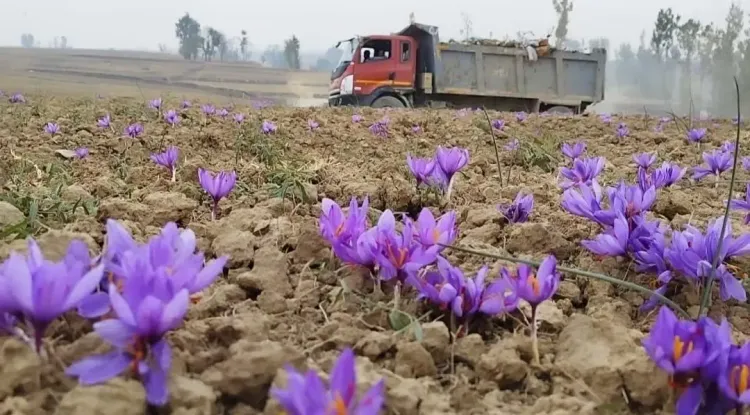
Mehbooba Mufti alleged on 21 November that Pampore’s saffron fields have been used as a municipal dumping ground for three years .
Nearly 2,000 kanals of agricultural land are reportedly damaged, threatening the livelihoods of 150 families .
The Srinagar Municipal Corporation (SMC) has reportedly been dumping waste in the Galandhar area of Pampore; no official response has been issued.
Kashmir’s saffron cultivation area has shrunk from 5,707 hectares in the 1990s to 3,200–3,715 hectares in recent years.
Dry spells in 2024 and 2025 reportedly reduced harvests to 10–30% of normal levels in some areas.
Families dependent on saffron in Pampore have declined from over 22,000 to around 16,000 as younger generations seek other work.
Peoples Democratic Party (PDP) president and former Jammu and Kashmir Chief Minister Mehbooba Mufti on Saturday, 21 November accused authorities of turning Pampore's celebrated saffron-growing land into a municipal dumping ground, alleging that nearly 2,000 kanals of agricultural land had been damaged and the livelihoods of 150 families placed under direct threat.
What Mehbooba Mufti Said
In a post on X, Mufti stated: “For three years, Pampore’s priceless saffron fields are being used as a municipal dumping ground. Nearly 2,000 kanals are damaged, 150 families’ livelihoods are threatened, and rats and rodents are destroying crops.” She added: “This is an outrageous assault on Kashmir’s saffron heritage. Such administrative negligence is indefensible. Our saffron fields are not dumping sites. They must be protected, not poisoned.”
The Srinagar Municipal Corporation (SMC) has reportedly been using the Galandhar area of Pampore to dispose of waste collected from across the city. The practice, allegedly ongoing for three years, has drawn sharp criticism from saffron growers and political leaders alike, though the SMC has not issued a public response to the allegations.
A Heritage Crop Already Under Siege
The controversy arrives at a particularly vulnerable moment for Kashmir’s saffron sector. The area under saffron cultivation has contracted sharply — from 5,707 hectares in the 1990s to an estimated 3,200–3,715 hectares in recent years. Output has become increasingly erratic: Kashmir produced roughly 16 metric tonnes of saffron in the late 1990s, but severe dry spells in 2024 and 2025 reportedly pushed harvests down to just 10–30 per cent of normal levels in some pockets.
The number of families dependent on saffron cultivation in Pampore has also fallen, from over 22,000 to around 16,000, as younger generations increasingly pursue alternative livelihoods. Encroachment, land conversion, and waste dumping have compounded the structural stress already caused by climate change, erratic rainfall, warmer winters, and reduced snowfall — all of which affect the flowering and corm development of the crop.
Systemic Pressures on Saffron Growers
Climate-linked disruptions have long strained cultivation. Several fields remain entirely dependent on rainfall, while irrigation infrastructure developed under the National Saffron Mission has reportedly faced persistent maintenance and operational problems. Growers have additionally flagged shortages of quality planting corms and recurring crop damage caused by porcupines — a localised but significant threat.
Notably, land-use pressures are not new to Pampore. Encroachment and construction have been documented concerns for over a decade, but the alleged use of prime saffron-growing land as a dumping site by a civic body marks a qualitative escalation of the problem, critics argue.
Accountability and What Comes Next
Mufti’s remarks place pressure on the Jammu and Kashmir administration and the SMC to respond formally to the allegations. No official rebuttal had been issued at the time of reporting. Environmental and agricultural advocates have long called for stricter enforcement of land-use protections around Pampore’s GI-tagged saffron belt.
With saffron’s geographical indication status making it a globally recognised product of Kashmir, any sustained degradation of its primary growing region carries reputational and economic consequences well beyond the 150 families directly cited by Mufti. Whether the administration acts on her public call will be closely watched in the coming days.
Point of View
But the underlying facts — shrinking cultivation area, collapsing output, and a civic body allegedly treating heritage farmland as a landfill — stand independent of the messenger. What mainstream coverage tends to underplay is that the National Saffron Mission, launched with considerable fanfare, has reportedly struggled with maintenance failures, suggesting institutional neglect predates any single administration. The real accountability gap is not just the SMC’s alleged dumping, but the absence of a functional enforcement mechanism to protect GI-tagged agricultural land from exactly this kind of encroachment. If Kashmir’s saffron is to survive as an economic and cultural asset, the policy response needs to be structural, not reactive.
NationPress
21 Nov 2026
Frequently Asked Questions
What did Mehbooba Mufti allege about Pampore’s saffron fields?
Mehbooba Mufti alleged that the Srinagar Municipal Corporation has been using the Galandhar area of Pampore as a municipal dumping ground for three years, damaging nearly 2,000 kanals of saffron-growing land and threatening the livelihoods of 150 families. She made the allegation in a post on X on 21 November.
Which body is accused of dumping waste on the saffron fields?
The Srinagar Municipal Corporation (SMC) has reportedly been disposing of waste collected from across the city in the Galandhar area of Pampore, according to the allegations. The SMC had not issued a public response at the time of reporting.
How serious is the decline of Kashmir’s saffron cultivation?
Kashmir’s saffron cultivation area has fallen from 5,707 hectares in the 1990s to roughly 3,200–3,715 hectares in recent years, with output becoming increasingly erratic. Severe dry spells in 2024 and 2025 reportedly pushed harvests down to just 10–30 per cent of normal levels in some areas.
What other factors are threatening Kashmir’s saffron crop?
Beyond alleged waste dumping, Kashmir’s saffron faces threats from climate change, erratic rainfall, warmer winters, reduced snowfall, encroachment, land conversion, shortages of quality planting corms, and crop damage from porcupines. Irrigation infrastructure under the National Saffron Mission has also reportedly faced maintenance problems.
How many families depend on saffron cultivation in Pampore?
The number of families dependent on saffron cultivation in Pampore has declined from over 22,000 to around 16,000, as younger generations increasingly seek alternative livelihoods. The 150 families cited by Mufti are those whose livelihoods are most directly threatened by the alleged dumping.