Anurag Thakur fires at Rahul Gandhi over power politics
Synopsis
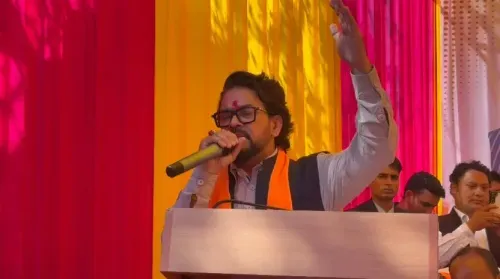
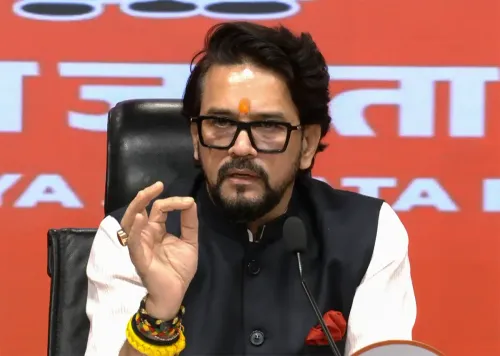
BJP MP Anurag Thakur on 21 November 2026 launched a sharp attack on Rahul Gandhi, accusing him of bypassing democracy to grab power and mortgaging the trust of 140 crore Indians, while reaffirming PM Modi's democratic mandate.
Key Takeaways
BJP MP Anurag Thakur posted a pointed attack on Rahul Gandhi on 21 November 2026 .
Thakur accused Gandhi of taking a 'cheap route' to power after failing to win democratically.
He charged that Gandhi is gambling with 'the nation's honour, its development journey, and the trust of 140 crore Indians '.
Thakur reaffirmed that the country has 'democratically entrusted the right to serve' to PM Narendra Modi .
The attack follows a consistent BJP pattern since 2014 of framing Congress opposition as rejection of the people's electoral verdict.
No formal response from Congress leadership had been issued at the time of publication.
A child throwing a tantrum at a fair for not getting his favourite toy — that is the image BJP MP Anurag Thakur reached for on Saturday, 21 November 2026, to describe what he called Rahul Gandhi's response to repeated electoral defeat, levelling one of his sharpest public attacks yet on the Congress leader's political conduct.
Thakur's post, written in Hindi, pulled no punches. 'When power cannot be won the democratic way,' he wrote, 'Rahul Gandhi is taking the cheap route to grab it.' He went further, charging that Gandhi is 'playing a dangerous gamble (satta) for power — one in which he has mortgaged the nation's honour, its development journey, and the trust of 140 crore Indians.' The BJP MP closed with a pointed epigram directed at Gandhi: 'Satta satte se nahin, seva se milti hai' — 'Power comes not from gambling, but from service' — and reminded him that the country had democratically entrusted that right to serve to Prime Minister Narendra Modi.
BJP's post-2014 democratic mandate argument
The broadside fits a well-worn but deliberate template in BJP political communication. Since the party's first outright majority in the 2014 Lok Sabha elections — which ended ten years of Congress-led UPA rule — senior BJP voices have consistently framed Congress opposition not as legitimate democratic contest but as refusal to accept the people's verdict. Each subsequent election cycle has sharpened that framing.
Thakur, as a former Union Minister of Information and Broadcasting, has been a practised front-man for this narrative, frequently deploying high-visibility rhetoric to keep the Congress on the back foot. His post carries the same logic: that democratic legitimacy belongs to whichever party holds the electoral mandate, and that extra-electoral pressure amounts to undermining the republic itself.
The 'dangerous gamble' charge and what it signals
The language Thakur chose — khatarnak satta, 'dangerous gamble' — signals an escalation beyond routine parliamentary sparring. By invoking 'national honour' and the trust of 140 crore citizens, he is casting Gandhi's political moves not merely as partisan opportunism but as a threat to the broader constitutional order. That is a heavier charge, and its timing — with the research noting a next round of elections on the horizon — suggests it is designed to prime the electoral conversation early.
Congress has not, as of publication, issued a formal response to this specific post. But the exchange — BJP asserting a democratic mandate, Congress pushing back on governance — has defined the fault-line of Indian national politics for over a decade, and shows no sign of narrowing.
The question now is whether Gandhi's camp will absorb the blow quietly or return fire in kind — because in this particular political bazaar, silence is rarely the last word.
Point of View
' he elevates a party rivalry into a constitutional stakes argument, making any Congress counter-attack appear anti-people. The timing, ahead of a fresh electoral cycle, suggests this is as much a campaign primer as a spontaneous response. If Congress does not answer the 'seva vs satta' frame on its own terms, the BJP's narrative may set the terms of the next contest by default.
NationPress
21 Nov 2026
Frequently Asked Questions
What did Anurag Thakur say about Rahul Gandhi?
On 21 November 2026, Thakur accused Rahul Gandhi of taking a 'cheap route' to seize power after failing to win elections democratically, saying Gandhi is playing a 'dangerous gamble' that mortgages the honour and trust of 140 crore Indians.
What does 'satta satte se nahin, seva se milti hai' mean?
It is a Hindi epigram used by Thakur meaning 'Power comes not from gambling, but from service' — a pointed jibe at Gandhi framing his political efforts as opportunistic rather than earned through public service.
Why is Anurag Thakur attacking Rahul Gandhi?
Thakur is pushing the BJP's long-running argument that the Congress refuses to accept democratic mandates won by the BJP since 2014, and is instead trying extra-electoral routes to power.
Has Rahul Gandhi responded to Anurag Thakur's post?
No formal response from Rahul Gandhi or the Congress leadership to this specific post had been issued at the time of publication.
Who is Anurag Thakur?
Anurag Thakur is a BJP Lok Sabha MP from Hamirpur, Himachal Pradesh, and a former Union Minister of Information and Broadcasting as well as Youth Affairs and Sports.