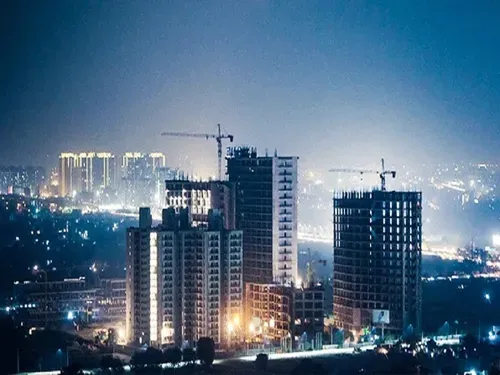
Mumbai prime residential values rise 1.4% in H1 2026, outpace global markets

Synopsis
Mumbai's prime residential market grew 1.4% in capital values in H1 2026 — more than double the global average of 0.6% across 30 cities. At $1,130 per sq ft, the city now sits in the same tier as Bangkok and Barcelona, with infrastructure upgrades and redevelopment activity poised to reshape which corridors command a premium next.
Key Takeaways
Mumbai's prime residential capital values rose 1.4% in H1 2026 , against a global average of 0.6% across 30 cities .
Prime rents in Mumbai climbed 1.2% in the same period, per the Vallum Capital report.
Mumbai's prime capital value stood at $1,130 per sq ft in June 2026 , comparable with Bangkok ($1,120) and Barcelona ($1,030).
Vallum Capital forecasts 0%–1.9% prime capital value growth for Mumbai in H2 2026 .
Infrastructure projects — Atal Setu , Coastal Road , Metro expansion , and Navi Mumbai International Airport — are expanding the city's residential catchment.
Buyers are increasingly prioritising asset quality and location over market-wide appreciation trends.
Mumbai's prime residential market posted a 1.4% rise in capital values and a 1.2% increase in rents during the first half of 2026, outperforming a moderating global trend, according to a report released on Wednesday, 19 August 2026. The findings, from Vallum Capital, place Mumbai's prime capital value at $1,130 per square foot as of June 2026, keeping the city competitive with several established international markets.
Mumbai's Standing in the Global Prime Market
At $1,130 per sq ft, Mumbai's prime residential values are broadly on par with Bangkok at $1,120 per sq ft and Barcelona at $1,030 per sq ft. The city remains below higher-value markets such as Singapore at $1,850 per sq ft and Seoul at $1,950 per sq ft, according to the report. Across 30 global cities tracked, average capital values rose just 0.6% and rents 1.1% in the same period, with 60% of markets recording positive capital value growth — making Mumbai's performance notably stronger than the global average.
Shifting Buyer Preferences
The report notes that buyers in Mumbai are growing more selective following several years of particularly strong capital appreciation. Purchasing decisions are increasingly driven by asset quality, location, lifestyle proposition, and long-term value — rather than broad market momentum alone. This shift signals a maturing market where individual asset positioning matters more than macro tailwinds.
Shveta Jain, Managing Director, Residential Services, Savills India, said: 'Mumbai's prime residential market continues to demonstrate resilience, even as the pace of growth becomes more measured. The structural transformation underway across the city is notable with redevelopment reshaping established neighbourhoods and unlocking constrained land parcels.' Jain added that the transition from ageing housing stock to well-planned, amenity-rich developments is creating a new quality benchmark across established micro-markets.
Infrastructure Reshaping the Residential Landscape
A wave of infrastructure investment is expanding Mumbai's residential catchment and redefining connectivity. Projects including the Atal Setu, the Coastal Road, and the expanding Metro network are improving access across the city. The upcoming Navi Mumbai International Airport and enhanced Mumbai–Navi Mumbai links are drawing residential interest into previously peripheral corridors.
The Mumbai–Nagpur Samruddhi Mahamarg is further strengthening the city's ties with wider Maharashtra, supporting the emergence of new economic and residential belts. Redevelopment activity is simultaneously unlocking constrained land parcels within established micro-markets, broadening supply in areas where new construction had been limited.
Outlook for H2 2026
Vallum Capital forecasts prime capital value growth of between 0% and 1.9% for Mumbai in the second half of 2026. The range reflects a more cautious environment where end-user demand remains healthy but buyers are applying greater scrutiny to individual assets. With global prime markets moderating and Mumbai's own appreciation cycle maturing, the next phase of growth is expected to be quality-led rather than volume-driven.
Point of View
Not confidence. The real story is structural: as buyers shift from chasing market-wide appreciation to scrutinising individual assets, developers who bet on location and amenity quality will pull ahead, while mid-tier projects in peripheral corridors could stagnate. Infrastructure spending is doing the heavy lifting that demand alone cannot, and the question for the second half is whether connectivity gains translate into transaction volumes or merely into aspirational pricing.
NationPress
3 Oct 2026
Frequently Asked Questions
How much did Mumbai prime residential capital values grow in H1 2026?
Mumbai's prime residential capital values rose 1.4% in the first half of 2026, reaching $1,130 per square foot by June 2026, according to a Vallum Capital report. This outpaced the global average capital value growth of 0.6% across 30 cities tracked in the same period.
How does Mumbai compare to other global prime residential markets?
At $1,130 per sq ft, Mumbai's prime values are broadly comparable with Bangkok ($1,120 per sq ft) and Barcelona ($1,030 per sq ft). The city remains below higher-value markets such as Singapore ($1,850 per sq ft) and Seoul ($1,950 per sq ft).
What is the outlook for Mumbai's prime residential market in H2 2026?
Vallum Capital forecasts prime capital value growth of between 0% and 1.9% for Mumbai in the second half of 2026. End-user demand is expected to remain healthy, but buyers are likely to be more selective, with asset quality and location playing a greater role in purchasing decisions.
What infrastructure projects are influencing Mumbai's residential market?
Key projects include the Atal Setu, the Coastal Road, and the expanding Metro network, all of which are improving intra-city access. The upcoming Navi Mumbai International Airport and the Mumbai–Nagpur Samruddhi Mahamarg are also expanding the wider residential catchment and supporting new corridors.
Why are Mumbai homebuyers becoming more selective?
Several years of particularly strong capital appreciation have raised the bar for buyers, who are now placing greater emphasis on asset quality, location, lifestyle proposition, and long-term value. According to the Vallum Capital report, purchasing decisions are increasingly driven by the positioning of individual assets rather than broad market momentum.