Odisha Cabinet clears 'Gyanodaya' scheme: Free education KG to PG from 2026
Synopsis
Odisha has approved the most expansive free-education scheme in its history — wiping out fees from Class IX all the way through postgraduate study for students in government institutions. With ₹5,467 crore committed over five years and 32 lakh students in scope annually, Gyanodaya is a direct assault on the dropout crisis at the secondary-to-higher-education transition point.
Key Takeaways
The Odisha Cabinet approved the 'Gyanodaya – Prosperity through Education' scheme on 1 July 2025 .
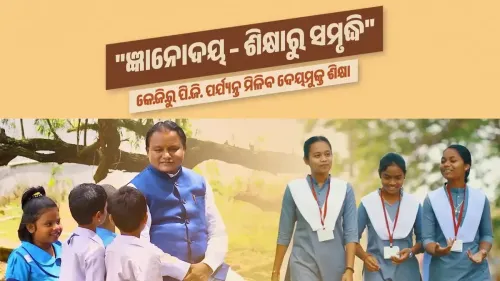
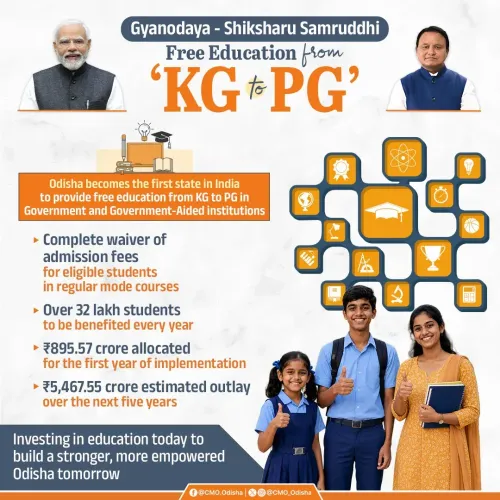
The scheme provides free education from KG to PG in government and government-aided institutions, effective 2026–27 .
It covers students in Classes IX–XII and those in regular undergraduate and postgraduate programmes.
Over 32 lakh students are expected to benefit annually.
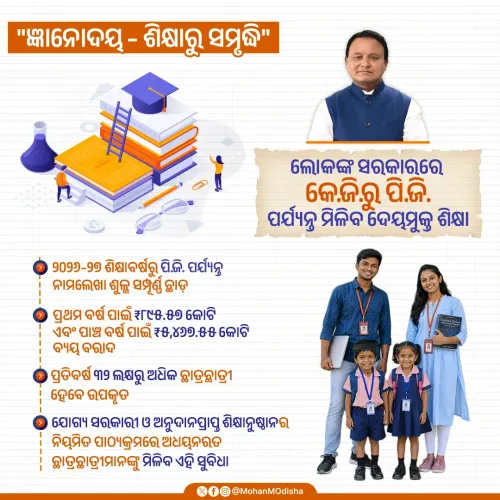
The approved financial outlay is ₹895.57 crore in year one and ₹5,467.55 crore over five years.
Self-financing courses, private unaided institutions, PPP-mode institutions, and professional/technical programmes are excluded .
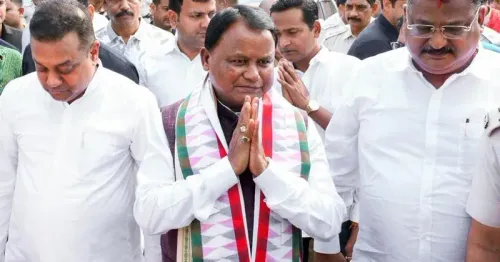
The Odisha Cabinet on Wednesday, 1 July 2025, approved the 'Gyanodaya – Prosperity through Education' scheme, guaranteeing free education for students from Kindergarten (KG) to Postgraduate (PG) level across government and government-aided institutions in the state. The decision, taken at a cabinet meeting chaired by Chief Minister Mohan Charan Majhi at Lok Seva Bhawan, Bhubaneswar, was among 12 key proposals cleared on the day.
What Gyanodaya Covers
The scheme will provide a complete waiver of admission and enrolment fees for students enrolled in regular courses under the School and Mass Education (S&ME) and Higher Education departments. It will cover students in Classes IX to XII in government and government-aided schools, as well as those pursuing regular undergraduate and postgraduate programmes in state public universities, government colleges, and government-aided colleges.
Notably, since education from Kindergarten to Class VIII is already free in Odisha, the Gyanodaya scheme bridges the remaining gap — completing the state's KG-to-PG free education continuum. The scheme is set to take effect from the 2026–27 academic year.
What the Scheme Does Not Cover
The benefits are restricted to regular-course students in public institutions. Excluded from coverage are self-financing courses, private unaided institutions, institutions operating under the Public-Private Partnership (PPP) mode, and professional or technical programmes. Only students enrolled in regular courses will be eligible.
Financial Outlay and Scale
The Odisha Cabinet approved an estimated outlay of ₹895.57 crore for the first year, scaling to ₹5,467.55 crore over five years. The scheme is projected to benefit more than 32 lakh students annually, making it one of the largest single investments in Odisha's education sector.
What the Government Said
Chief Minister Mohan Charan Majhi described the approval as a landmark step. 'I had announced this initiative earlier, and today the Cabinet has formally approved it. This historic decision will ensure that not a single student in Odisha is deprived of education or discontinues studies due to financial constraints,' he said.
Majhi added that the initiative is expected to raise enrolment, improve attendance, and reduce the dropout rate — particularly among students from economically weaker and disadvantaged sections. 'This initiative will empower every family through education, and it is a testament to the state government's firm commitment to realising the vision of a "Samruddha Odisha" based on knowledge, opportunity and all-round development,' he said.
Broader Context
The Gyanodaya scheme arrives at a time when several Indian states are competing to reduce out-of-pocket education costs as a lever for improving human development indicators. Odisha's dropout rate at the secondary level has historically been above the national average, and fee barriers at the Class IX entry point are widely cited as a trigger. This is the state government's most sweeping education-access intervention since the universalisation of free mid-day meals. Whether implementation keeps pace with the ambition — particularly at the university level, where administrative complexity is higher — will be the scheme's defining test.
Point of View
Where affiliated colleges have their own fee structures and funding dependencies. The ₹5,467 crore five-year outlay is substantial, but its adequacy will depend on enrolment growth triggered by the scheme itself; if the initiative successfully raises participation, the cost base could outpace projections. Odisha's secondary dropout rate — driven substantially by economic stress — makes the timing defensible, but the exclusion of PPP-mode and professional institutions means a large and growing segment of the student population remains outside the safety net. The scheme's real measure will be in verified dropout-rate data two years from now, not in the enrolment numbers at launch.
NationPress
30 Sept 2026
Frequently Asked Questions
What is the Gyanodaya scheme approved by the Odisha Cabinet?
The Gyanodaya – Prosperity through Education scheme is a state government initiative that provides complete fee waivers for students from Kindergarten to Postgraduate level in government and government-aided institutions in Odisha. Approved on 1 July 2025, it is set to take effect from the 2026–27 academic year and is expected to benefit over 32 lakh students annually.
Who is eligible for the Gyanodaya scheme?
Students enrolled in regular courses in Classes IX to XII in government and government-aided schools, and those pursuing regular undergraduate and postgraduate programmes in state public universities, government colleges, and government-aided colleges are eligible. Students in self-financing courses, private unaided institutions, PPP-mode institutions, and professional or technical programmes are not covered.
When will the Gyanodaya scheme be implemented?
The scheme is set to be implemented from the 2026–27 academic year, following formal Cabinet approval on 1 July 2025.
What is the budget allocated for the Gyanodaya scheme?
The Odisha Cabinet has approved an outlay of ₹895.57 crore for the first year of implementation and ₹5,467.55 crore over five years. Chief Minister Mohan Charan Majhi described it as one of the government's biggest investments in the education sector.
Does Gyanodaya make all education in Odisha free?
Effectively yes, for students in government and government-aided institutions. Education from Kindergarten to Class VIII was already free in Odisha. The Gyanodaya scheme extends fee waivers through Class XII and up to the postgraduate level, completing the KG-to-PG free education continuum for eligible students.