Odisha Plans ₹5,467 Cr Free KG-to-PG Education Push
Synopsis
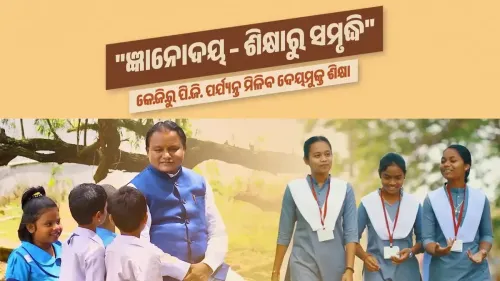
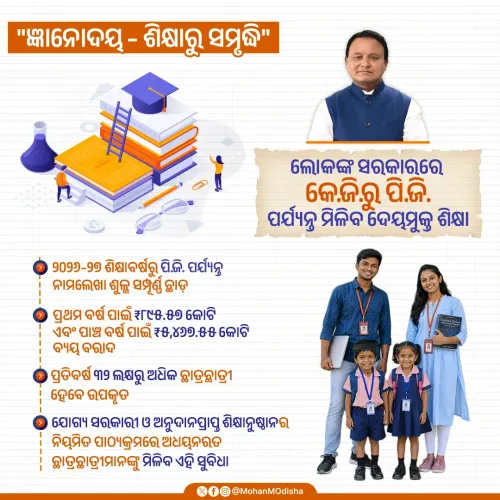
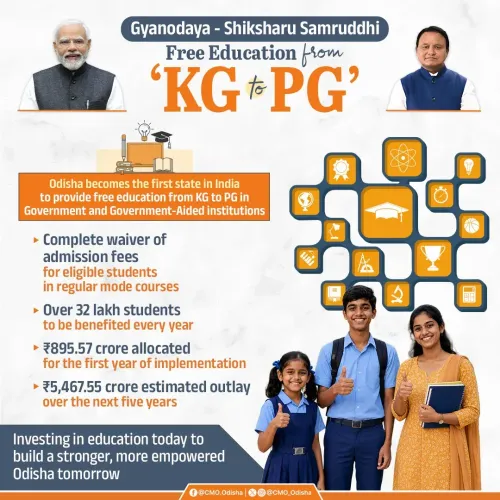
The Chief Minister's Office of Odisha announced a ₹5,467 crore outlay over five years to make education free from kindergarten through postgraduate level, extending well beyond the RTE-mandated elementary stage and aligning with the National Education Policy 2020's universal-access goals.
Key Takeaways
₹5,467 crore will be spent over the next five years on free education in Odisha .
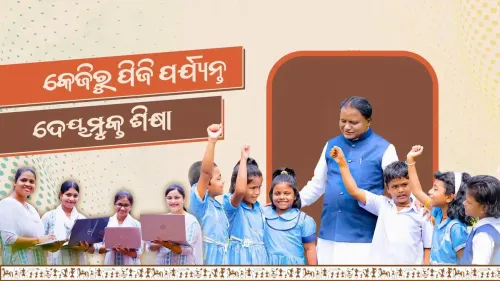
The scheme covers the full continuum from kindergarten (KG) to postgraduate (PG) level.
The outlay goes far beyond the Right to Education Act 2009 , which mandates free schooling only up to age 14 .
Primary beneficiaries include school students, college students , and low-income families across the state.
The initiative aligns with National Education Policy 2020 targets for universal access and higher public education spending.
Annual budget allocations and enrolment reports will be key indicators of implementation progress.
The Chief Minister's Office of Odisha announced on Saturday, 4 July 2026 that the state government will spend ₹5,467 crore over the next five years to provide free education from kindergarten through postgraduate level, covering the full schooling and higher-education continuum for residents of the eastern state.
Context
The announcement signals one of Odisha's most ambitious single-outlay commitments to public education in recent memory. By extending the free-education guarantee from pre-primary all the way to the postgraduate stage, the state moves well beyond the floor set by the Right to Education Act of 2009, which mandated free and compulsory schooling only for children aged 6 to 14. The five-year outlay — averaging roughly ₹1,093 crore per year — is intended to remove financial barriers at every stage of formal learning.
Odisha, home to over 46 million residents, has progressively expanded access to government-run schools and colleges, but a large share of families — particularly in rural and tribal belts — have historically dropped out of the education pipeline before reaching higher secondary or college level. The new commitment directly targets that attrition.
Policy Backdrop
The initiative sits squarely within the framework of the National Education Policy 2020, which called on state governments to raise public spending on education and achieve universal access from pre-primary through higher education. NEP 2020 set a target of raising public expenditure on education to 6 per cent of GDP, urging sub-national governments to treat human capital investment as a long-term growth lever.
Odisha had earlier demonstrated institutional intent through the Mo School Abhiyan, launched in 2017, which mobilised alumni and community resources to upgrade government school infrastructure. The KG-to-PG scheme builds on that foundation by adding a sustained fiscal commitment rather than relying solely on community contributions. Multiple other Indian states have experimented with free education beyond the RTE-mandated elementary level, but a single integrated outlay spanning the entire continuum from kindergarten to postgraduate study is a notable structural step.
Stakeholders and Impact
The primary beneficiaries are school students, college students, and low-income families across Odisha who currently bear out-of-pocket costs for tuition, examinations, and related fees at the secondary, undergraduate, and postgraduate stages. For tribal and Scheduled Caste communities concentrated in Odisha's interior districts, where dropout rates remain elevated, the removal of cost barriers could meaningfully improve gross enrolment ratios at the higher secondary and college levels.
Teachers, school administrators, and state university staff are also indirect stakeholders: a sustained multi-year outlay typically necessitates parallel investment in teacher recruitment, infrastructure upgrades, and academic capacity — areas that advocacy groups have flagged as bottlenecks in Odisha's public education system.
What's Next
Implementation will depend on how the ₹5,467 crore is phased across annual state budgets, beginning with the 2026-27 fiscal year. Budget allocations for 2027-28 and subsequent years will be the first concrete test of whether the commitment translates into line-item appropriations. Annual enrolment reports and infrastructure audits will serve as the primary accountability benchmarks.
If Odisha executes the scheme at scale, it could become a reference model for other states seeking to operationalise the KG-to-PG vision embedded in NEP 2020 — and could apply pressure on the Union government to expand central matching grants for state-level free-education programmes.
Point of View
467 crore KG-to-PG commitment is a structurally significant move because it converts an aspirational NEP 2020 goal into a time-bound fiscal pledge — a step most states have avoided, preferring piecemeal schemes over integrated outlays. The real test will be whether the appropriations survive annual budget negotiations and whether teacher recruitment and infrastructure keep pace with enrolment expansion. If implemented faithfully, the scheme could reframe the political economy of education spending in eastern India, making free higher education a voter expectation rather than a discretionary benefit. It also puts quiet pressure on the Union government to revisit central-state cost-sharing norms for post-elementary education.
NationPress
3 Oct 2026
Frequently Asked Questions
What is Odisha's KG-to-PG free education scheme?
It is a state government plan to provide free education from kindergarten through postgraduate level in Odisha, backed by a ₹5,467 crore outlay over five years announced in July 2026.
How much is Odisha spending on free education?
Odisha has committed ₹5,467 crore over the next five years, averaging roughly ₹1,093 crore per year, to fund the KG-to-PG free education initiative.
Who benefits from Odisha's KG-to-PG scheme?
School students, college students, and low-income families across Odisha benefit, with particular impact expected for tribal and rural communities where dropout rates are high.
How does Odisha's scheme relate to the Right to Education Act?
The Right to Education Act 2009 mandates free schooling only for children aged 6 to 14. Odisha's new scheme extends the free-education guarantee to pre-primary and all higher education stages, well beyond the RTE floor.
Is Odisha's free education plan in line with NEP 2020?
Yes. The National Education Policy 2020 recommends universal access from pre-primary through higher education and calls for increased public spending on schooling. Odisha's KG-to-PG outlay directly operationalises those targets.