Is Pakistan’s Military Attempting to Justify Enforced Disappearances?
Synopsis
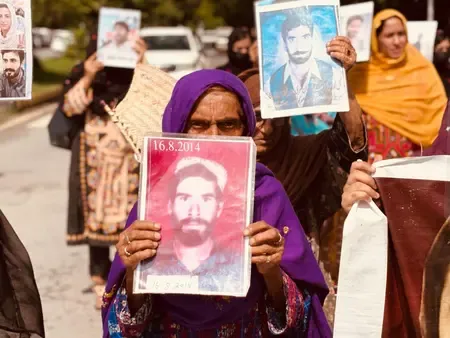
The Baloch Yakjehti Committee (BYC) has accused Pakistan’s military media of attempting to legitimize enforced disappearances and extrajudicial killings. Their statements highlight ongoing repression and the failure of state institutions to address human rights violations in Balochistan. The BYC vows to continue advocating for justice amidst a climate of fear and oppression.
Key Takeaways
Baloch Yakjehti Committee (BYC) accuses Pakistan’s military of state repression.
Claims of unjustified enforced disappearances and killings persist.
Recent press conference labeled as a distraction from documented abuses.
Legal acquittals highlight ongoing struggles for activists.
BYC vows to advocate for justice amidst state violence.
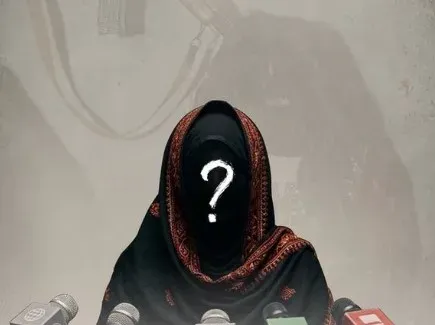
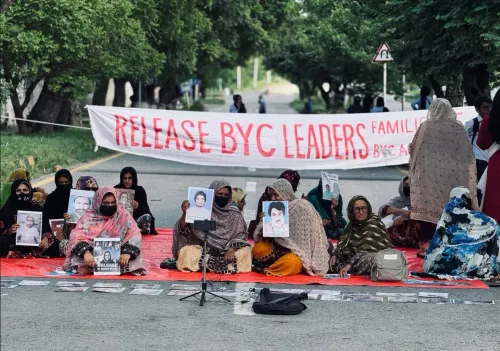
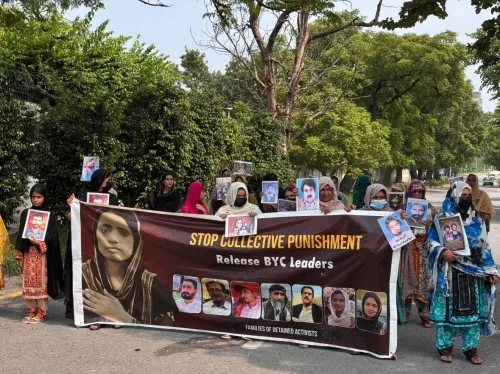
Quetta, Jan 11 (NationPress) The Baloch Yakjehti Committee (BYC) has leveled accusations against Pakistan’s military media division, asserting that it is attempting to legitimize enforced disappearances and extrajudicial killings. They described the recent press conference held by the Inter-Services Public Relations (ISPR) as a "systematic effort" to rationalize state oppression in Balochistan, according to local media sources.
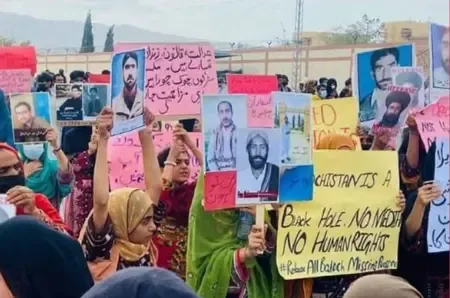
In their statement, the BYC remarked that the comments made by the ISPR Director General reaffirmed that the state policies in Balochistan remain unchanged. They noted that state institutions persist in employing "various terminologies and narratives" to defend human rights violations, as reported by The Balochistan Post.
The BYC emphasized that during the press briefing, political and human rights organizations were specifically targeted, including activists who have bravely vocalized their concerns regarding disappearances, "despite arrests, FIRs, threats, and ongoing state violence." They criticized the press conference for presenting no new information and relying on an "old, worn-out scripted narrative" designed to distract from documented abuses.
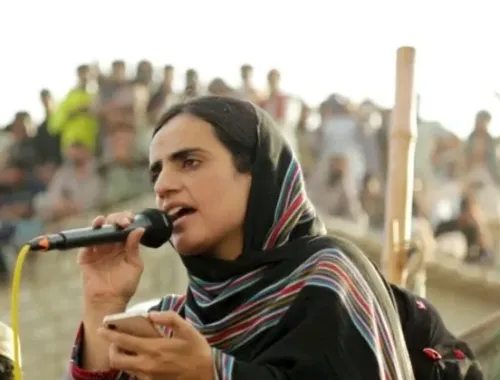
A spokesperson for the BYC stated that the ongoing allegations against the BYC and its leader, Mahrang Baloch, are part of a campaign that has intensified in recent months. They asserted that the DG ISPR has not substantiated even a single accusation against them, which they labeled as "identical, baseless, and false allegations".
The BYC took aim at the journalists present during the press conference, highlighting their failure to pose critical inquiries, leading them to conclude that "journalism itself appeared paralyzed." They stated that reporters, "sitting under the shadow of guns," seemed unable to ask logical or probing questions.
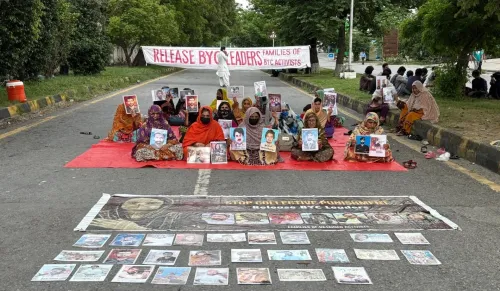
The group pointed out that lawyers, civil society organizations, and human rights entities have consistently declared that enforced disappearance is unlawful, asserting that the media trials of victims and activists foster "fear, expand repression, and paralyze Baloch society." They pledged to bring attention to each case until individuals are presented in court, emphasizing that no authority can label anyone a criminal "at gunpoint."
Last week, a Pakistani court acquitted BYC's Deputy Organiser Lala Abdul Wahab Baloch along with 11 other activists, a development the BYC hailed as a legal reprieve following a "prolonged and politically motivated trial."
The BYC reported that Civil Judge and Judicial Magistrate Naim Akhtar of the Karachi City Court ordered the acquittal after the prosecution failed to prove the charges. Those acquitted include Sarfraz Baloch, Zain Baloch, Aftab Baloch, Qazi Amanullah, Murad Baloch, Waheed Baloch, Ahmed Nisar, Ehsan Hameed, Sajid Baloch, Aamir Baloch, and Ahsan Faraz Baloch.
Despite the acquittal in this particular case, the BYC contends that several other leaders, including its chief organizer, Mahrang Baloch, remain imprisoned.
The BYC expressed concern that the judiciary appears to exercise its authority in a way that keeps these leaders detained, raising significant worries about justice, prolonged detention, and the manipulation of legal processes to stifle political opposition.
The rights group noted that the case, filed under the Pakistan Penal Code on January 18, 2025, had been under trial for almost a year. They reported that the court concluded the allegations were "unsubstantiated" and granted an "honorable acquittal" to all the accused.
“The arrests originated from rallies organized by the Baloch Yakjehti Committee on January 25, 2025, designated as ‘Baloch Genocide Day.’ Demonstrations took place throughout Balochistan and in Karachi, including in Lyari and Sharafi Goth, Malir,” the BYC stated.
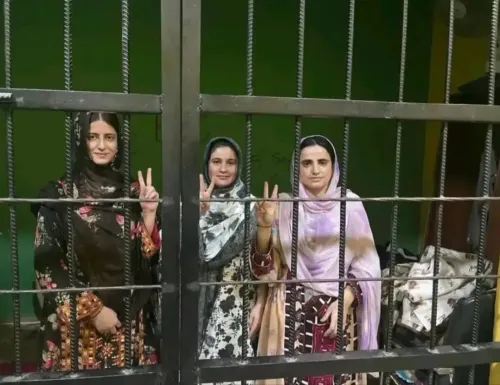
During the crackdown, BYC reported that its leaders, women, and activists were allegedly subjected to violence and detained under fabricated charges.
Point of View
It is imperative to recognize the serious implications of the BYC's allegations against Pakistan’s military. The ongoing claims of enforced disappearances and extrajudicial killings highlight a critical human rights situation that must be addressed. Our commitment to reporting the truth remains unwavering as we stand with those seeking justice and accountability.
NationPress
20 Sept 2026
Frequently Asked Questions
What is the Baloch Yakjehti Committee (BYC)?
The Baloch Yakjehti Committee (BYC) is an organization advocating for the rights of the Baloch people, focusing on issues such as enforced disappearances and human rights abuses.
What are enforced disappearances?
Enforced disappearances refer to the practice where individuals are secretly abducted or imprisoned by state authorities, often without any legal proceedings.
What were the recent developments in the BYC's case?
Recently, a Pakistani court acquitted BYC's Deputy Organiser and 11 other activists after the prosecution failed to prove the charges against them.
How does the BYC view the state of journalism in Pakistan?
The BYC has criticized journalists for failing to ask critical questions at press conferences, suggesting that journalism is being stifled under the pressure of state violence.
What actions does the BYC plan to take regarding enforced disappearances?
The BYC has vowed to continue highlighting cases of enforced disappearances until justice is served, emphasizing that no authority can declare individuals criminals unjustly.