Pakistan's $10 billion ESF request: economic lifeline or geopolitical trap?
Synopsis
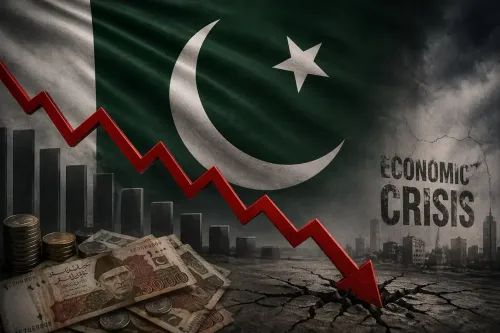
Pakistan's reported bid for a $10 billion US Treasury ESF facility isn't just a balance-of-payments move — analysts describe it as 'borrowed dollars as geopolitical rent.' With Islamabad already leaning on Gulf deposits and eyeing a $6.7 billion Saudi oil deal, the pattern of external dependence is deepening, and Washington may be gaining durable leverage over Pakistan's China policy and trade stance.
Key Takeaways
Pakistan has reportedly sought a $10-billion Bilateral Exchange Stabilization Support Facility from the US Treasury's ESF .
The request draws comparisons with a $20-billion currency swap the US extended to Argentina in 2025 .
A CADTM analysis warns the facility could give the US leverage over Pakistan on trade, China policy, and regional strategy.
Pakistan repaid $3.5 billion in UAE deposits earlier this year and secured a $3-billion Saudi commitment to support reserves.
Reports suggest Islamabad is also negotiating a $6.7-billion oil facility with Saudi Arabia over fifteen years .
Neither the US Treasury nor the Pakistani government has formally confirmed the ESF arrangement.
Pakistan has reportedly sought a $10-billion Bilateral Exchange Stabilization Support Facility from the US Treasury's Exchange Stabilization Fund (ESF), triggering fresh debate over whether the arrangement would deliver lasting economic relief or entrench the country's reliance on external powers. The request, flagged in an analysis by the Committee for the Cancellation of the Third World Debt (CADTM), draws immediate comparisons with a $20-billion currency swap framework the US extended to Argentina in 2025.
What Pakistan Is Seeking
The proposed facility is structured as a bilateral exchange stabilisation arrangement routed through the US Treasury's ESF — a mechanism typically used to shore up foreign exchange reserves and calm currency markets. On paper, analysts note, it resembles conventional liquidity support. In practice, however, critics argue the arrangement carries considerably more weight.
'The facility looks like technical liquidity support on paper, but it functions as a point of leverage the US could deploy in future negotiations — over trade terms, China policy or other strategic and regional questions,' the CADTM report stated.
The Strategic Dimension
The CADTM analysis describes the proposed facility as 'borrowed dollars as geopolitical rent' — a phrase that captures the dual nature of the arrangement. While any US backing would likely reassure investors and credit-rating agencies in the near term, the report cautioned that it would do little to resolve Pakistan's deep-rooted structural economic challenges. The implicit trade-off, according to the report, is strategic flexibility: Washington gains a point of leverage it could invoke on issues ranging from trade terms to Islamabad's posture toward China.
Pakistan's Mounting External Pressures
The request comes against a backdrop of significant external financing strain. Pakistan repaid approximately $3.5 billion in deposits to the UAE earlier this year, before securing a $3-billion deposit commitment from Saudi Arabia to bolster its foreign exchange reserves. Reports also indicate that Islamabad is in separate talks with Riyadh for a further $6.7-billion oil facility spread over fifteen years.
'Pakistan's borrowing habits make this episode unsurprising. The current government is desperate to pull more dollars into the system,' the report observed.
A Pattern of External Dependence
The CADTM report noted that Pakistan has historically turned to external partners — whether the International Monetary Fund, Gulf states, or China — whenever its economy has come under pressure. The ESF request fits squarely within that pattern. Notably, each such episode has typically come with conditions, either explicit or implicit, that constrain Islamabad's policy space in subsequent years. This is among the most consequential such requests in recent memory, given the scale of the sum and the identity of the lender.
What Comes Next
No formal confirmation of the ESF facility has emerged from either the US Treasury or the Pakistani government as of the time of reporting. Whether Washington agrees to the arrangement — and on what terms — will likely shape Pakistan's fiscal trajectory and its diplomatic posture in the region for years ahead.
Point of View
But the geopolitical subtext is hard to miss. Washington rarely extends bilateral Treasury support without expecting something in return — and for Pakistan, the most obvious ask would involve distancing from China or adjusting its posture on regional security. What the CADTM analysis surfaces, and mainstream coverage tends to underplay, is that Pakistan's serial dependence on external rescues has progressively narrowed its strategic autonomy. Each bailout — IMF, Gulf, now potentially US Treasury — comes with invisible strings. The cumulative effect is a foreign policy that is increasingly mortgaged to creditors rather than shaped by national interest.
NationPress
7 Oct 2026
Frequently Asked Questions
What is the $10 billion ESF facility Pakistan has reportedly requested?
Pakistan has reportedly sought a Bilateral Exchange Stabilization Support Facility worth $10 billion from the US Treasury's Exchange Stabilization Fund (ESF). The arrangement is designed to shore up Pakistan's foreign exchange reserves, though analysts warn it carries significant geopolitical implications beyond simple liquidity support.
Why is the ESF request considered strategically significant?
According to a CADTM analysis, the facility could function as a lever for the US in future negotiations with Pakistan — on issues including trade terms, China policy, and regional security questions. Critics describe it as 'borrowed dollars as geopolitical rent' rather than neutral financial assistance.
How does this compare to the Argentina ESF arrangement?
The proposed Pakistan facility has been compared to a $20-billion currency swap framework the US extended to Argentina in 2025. Pakistan's request, at $10 billion, is half that scale but similarly structured as a bilateral exchange stabilisation mechanism routed through the US Treasury.
What other external financing is Pakistan currently pursuing?
Pakistan repaid approximately $3.5 billion in UAE deposits earlier this year and secured a $3-billion deposit commitment from Saudi Arabia to support reserves. Reports also indicate Islamabad is in talks with Riyadh for a $6.7-billion oil facility spread over fifteen years.
Has the US Treasury confirmed the ESF facility for Pakistan?
No formal confirmation has emerged from either the US Treasury or the Pakistani government as of the time of reporting. The request remains at the proposal stage, and the terms — if any deal is struck — have not been publicly disclosed.