How Did PM Modi Tackle Challenges and Implement Reforms to Propel India's Growth?
Synopsis
Prime Minister Narendra Modi's pragmatic approach to international trade challenges and domestic reforms has led to notable economic growth in India. This article explores how his leadership may offer lessons for European leaders grappling with similar issues.
Key Takeaways
Modi's pragmatic handling of international trade challenges.
Strengthened India-China relations and upcoming trade deals.
Significant reforms in taxation and labor laws .
India's GDP grew by 8.2% , raising growth forecasts.
Foreign investment trends indicate caution amidst economic adjustments.
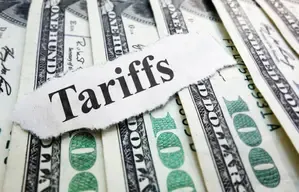
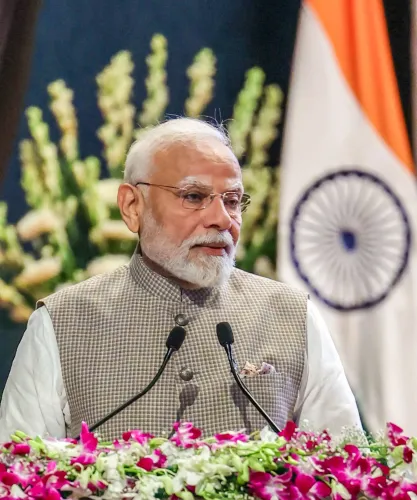
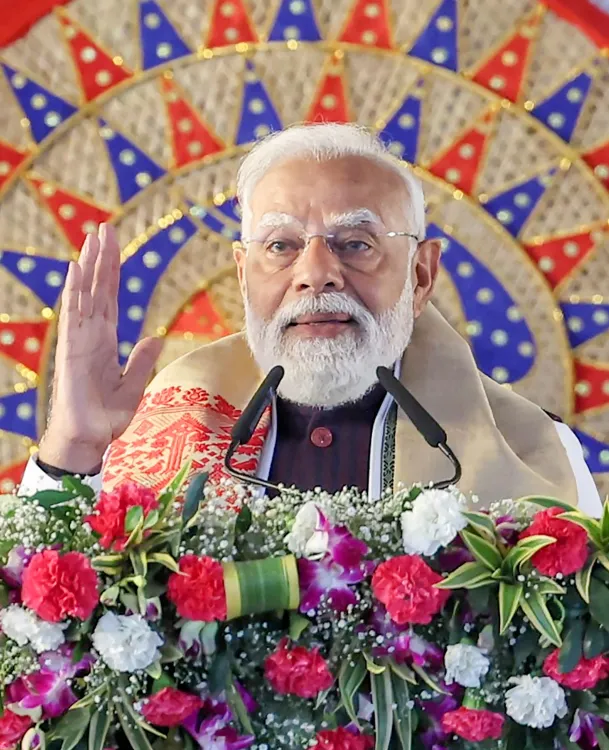
New Delhi, Jan 23 (NationPress) European leaders grappling with the pressures of Washington’s trade tariffs could learn from how Prime Minister Narendra Modi has navigated these challenges with remarkable agility, as indicated by recent reports.
In a new newsletter showcasing a series of articles in its current edition, The Economist highlighted PM Modi’s adept management of difficulties, coercion, and limitations through pragmatism, determination, and resilience.
The publication noted that under his leadership, relations with China have improved, investment restrictions have been lifted, and significant trade agreements have been established, including one anticipated with the EU later this month. Despite the ongoing US tariffs impacting some exporters, the strategy has been to illustrate that India is capable of adapting and “will not be coerced into any regrettable decisions,” as observed by the magazine, which has effectively diminished President Donald Trump’s influence.
Moreover, PM Modi has leveraged international pressure to drive domestic reforms. He has simplified taxation, deregulated the nuclear sector, and is facilitating private investment and foreign competition in the electricity industry, according to the report.
“Crucially, he has revamped India’s labor laws to assist manufacturers in growing and competing. All these efforts are framed as essential work in an increasingly hostile global environment. The Indian populace largely supports these initiatives — notably, the significant labor deregulation faced unexpectedly limited opposition,” the newsletter remarked.
The road hasn’t been entirely smooth; much of his second term was consumed by challenges stemming from widespread protests against his agricultural reforms. “However, if European leaders can glean a lesson from India, it is that a silver lining can emerge amid the Trump turbulence,” the newsletter observed.
In one article, India is labeled as the “Rising Giant,” attributing the “ascent of India’s economy” to a mix of luck, a commitment to economic reforms, and a push from Donald Trump.
New Delhi has faced a 25 percent “reciprocal tariff” from Washington, coupled with an additional levy “imposed as a penalty for purchasing heavily discounted Russian crude oil.”
Meanwhile, private-sector investment remains tepid; foreign investors have been pulling out of India’s overvalued stock market, and the rupee hit a record low against the dollar at the end of the previous year. “Yet, a combination of three factors — luck, macroeconomic policy, and structural reform — offers reasons for optimism in both the short and long terms,” the article suggested.
It also noted that during the year leading up to the third quarter, “GDP surged by 8.2 percent, significantly surpassing expectations,” and the government has adjusted its forecast for the fiscal year ending March 31, 2026, “from a range of 6.3-6.8 percent to 7.4 percent,” which is anticipated to influence the budget on February 1. Thus, it pointed out that while the world's most populous country has remained somewhat marginal in the global economy, it is now displaying “remarkable potential.”
When his party faced a setback in 2024, with the BJP losing its status as the single-largest party and needing to rely on allies for support, doubts arose.
The article recounted expectations that the re-election of Donald Trump, with whom PM Modi “once had a strong rapport,” would bolster his position. Instead, it resulted in the US President “hitting most Indian exports with tariffs that now total 50 percent.” Challenges persist, but “It seems that India has concluded that the risks of attempting to transform its economy are less daunting than being left behind.”
Point of View
It's vital to recognize the pragmatic approach taken by Prime Minister Narendra Modi in navigating both domestic and international challenges. His commitment to economic reform amidst adversity reflects a forward-thinking strategy that aligns with the nation's growth trajectory.
NationPress
29 Sept 2026