IIMs as Viksit Bharat pillars: Pradhan chairs coordination meet in Ahmedabad
Synopsis
India's Education Minister used a rare all-IIM coordination meet in Ahmedabad to push a pointed message: the country's top management schools must earn their national mandate, not just their global rankings. From MBA admission norms to faculty reservation rosters, the agenda signals a policy shift that could reshape how IIMs operate — and who they serve.
Key Takeaways
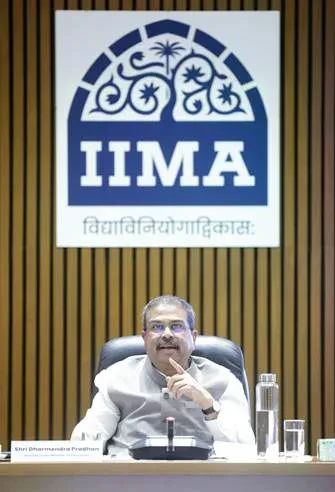
Dharmendra Pradhan chaired the IIM Coordination Forum at IIM Ahmedabad on 14 May .
The meeting focused on IIMs' role in achieving Viksit Bharat 2047 goals, including innovation and global competitiveness.
Discussions covered aligning UG entrance exams with future national needs and standardising MBA admission procedures.
Pradhan led deliberations on fee refund policies , faculty secondment across IIMs, and reservation rosters for faculty and non-faculty.
Higher Education Secretary Vineet Joshi stressed the Coordination Forum's role in strengthening institutional collaboration among IIMs.
Union Education Minister Dharmendra Pradhan on Thursday, 14 May chaired the Coordination Forum of Indian Institutes of Management (IIMs) at the IIM Ahmedabad campus, asserting that the IIMs must evolve into national assets that drive India's ambition of becoming a developed nation by 2047. Pradhan underscored the need for IIMs to nurture innovation ecosystems and adapt to fast-changing global challenges as part of the Viksit Bharat vision.
Key Discussions at the Forum
The meeting, convened by the Department of Higher Education, Ministry of Education (MoE), brought together Chairpersons of Boards of Governors of IIMs, Directors of IIMs, and senior officials from the Department of Higher Education, as well as representatives from the state governments of Gujarat and Uttar Pradesh. Deliberations spanned a wide range of institutional and academic concerns, with a shared goal of strengthening inter-IIM cooperation.
Participants brainstormed on aligning undergraduate entrance examinations with futuristic national requirements, developing standardised operating procedures for MBA admissions, and enabling inter-IIM student migration — a move that could enhance academic flexibility across the network.
What the Minister Said
Pradhan described the IIMs as 'strong catalysts of nation-building and economic transformation,' adding that they have earned recognition as global models of excellence in leadership and management education. He led further discussions on fee refund policies, a secondment framework to give young faculty members cross-institutional exposure, and the implementation of reservation rosters for both faculty and non-faculty positions.
Role of Higher Education Secretary
Higher Education Secretary Vineet Joshi highlighted the significance of the Coordination Forum as a structural mechanism for deepening collaboration among IIMs. Joshi's remarks pointed to a broader administrative intent: to move the IIM network from loosely coordinated autonomy toward a more cohesive institutional architecture that serves national development goals.
Why This Matters
The meeting signals a deliberate policy push to position India's premier management institutions not merely as elite professional schools, but as active contributors to the country's long-term economic and innovation agenda. Notably, the focus on aligning entrance examinations with 'futuristic requirements' suggests a possible rethink of how management education entry points are structured — a conversation that could affect thousands of aspirants annually. With Viksit Bharat 2047 serving as the overarching policy frame, IIMs are increasingly being asked to justify their public mandate beyond placement statistics.
Point of View
Depending on implementation. Faculty reservation rosters and secondment policies, meanwhile, touch on sensitive institutional autonomy questions that IIM boards have historically guarded closely. Whether this forum becomes a genuine policy engine or a periodic optics exercise will depend on whether its decisions are tracked, enforced, and reported — none of which the current statement addresses.
NationPress
1 Oct 2026
Frequently Asked Questions
What was the IIM Coordination Forum meeting about?
The meeting, chaired by Education Minister Dharmendra Pradhan at IIM Ahmedabad on 14 May, focused on IIMs' contribution to Viksit Bharat 2047, MBA admission norms, inter-IIM student migration, faculty policies, and aligning entrance exams with future national needs.
What is Viksit Bharat 2047 and why are IIMs central to it?
Viksit Bharat 2047 is the Indian government's vision to make India a fully developed nation by its centenary of independence. IIMs are being positioned as innovation and leadership hubs that can support this goal through management education, research, and institutional capacity.
What policy changes were discussed for IIM admissions?
The forum discussed developing standardised operating procedures for MBA admissions, enabling inter-IIM student migration, and aligning undergraduate entrance examination criteria with the country's emerging and future requirements.
What did the meeting decide on faculty policies?
Discussions covered a secondment policy to give young faculty members exposure across different IIMs, as well as the implementation of reservation rosters for both faculty and non-faculty positions — though no final decisions were publicly announced.
Who attended the IIM Coordination Forum?
Attendees included Chairpersons of IIM Boards of Governors, Directors of IIMs, senior officials from the Department of Higher Education, and representatives from the state governments of Gujarat and Uttar Pradesh.