Acharya Prashant to NEET protesters: 'First the mirror, then the march'
Synopsis
Acharya Prashant's message to NEET protesters isn't a rebuke — it's a mirror. Citing 13,999 student suicides in 2022 even in leak-free years, he argues the exam paper theft only exposed a machine India built itself: one that ties a teenager's worth to a rank. The revolution he proposes begins with self-examination, not a placard.
Key Takeaways
Acharya Prashant addressed the NEET paper leak protests on 24 July , calling the movement's sequence 'inverted' without asking it to stop.
He demanded the harshest prosecution for syndicates selling exam papers and a deep audit of agencies that enabled them.
India recorded 13,999 student suicides in 2022 — a rise of more than 80 per cent since 2011 — in years when no paper was leaked.
More than 1,500 young people under thirty died by suicide in 2021 with 'failure in examination' listed as the cause.
He proposed a sequence for change: self-education, voter education, voting, organising, contesting, and only then marching.
His philosophical argument drew on the Bhagavad Gita : clarity before action, not instead of it.
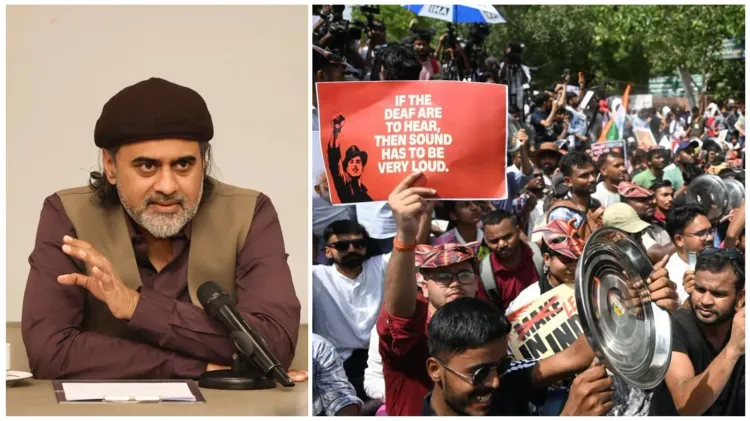
Philosopher and author Acharya Prashant on 24 July addressed the wave of student protests over the NEET paper leak, arguing that the movement's sequence is inverted — that the demand for accountability has grown so loud it has shielded the protester from self-examination. Speaking in New Delhi, he said he has no quarrel with the street, only with the blindness on it.
The Core Argument: Accountability Begins Within
Prashant mourned the young lives lost during the agitation and described the leaked paper as a theft of students' years. He did not spare the state. 'An administration under which question papers travel faster than justice has failed its first duty,' he said, demanding the harshest prosecution for syndicates selling students' futures, and a deep audit of the agencies that allowed them to operate.
Yet he turned the lens inward just as sharply. Somebody sold the leaked paper, he noted — and somebody also bought it. 'Show me one young man who bought the leaked paper, took his advantage from it, and is on the road today shouting that the system is rotten,' he said. That person, he argued, does not exist on any stage, placard, or hashtag — because the loudest demand to 'do something' is also the most effective way to keep the doer unexamined.
The Numbers Behind the Crisis
Prashant drew attention to a statistical reality that predates the leak. In 2022, India recorded 13,999 student suicides — a rise of more than 80 per cent since 2011. In 2021, more than 1,500 young people under thirty ended their lives with 'failure in examination' listed as the cause. The examinations in those years were clean. 'The leak did not build the machine that equates a rank with a life,' he said. 'The leak only exposed it.'
The deeper cause, he argued, is a civilisational conclusion drilled into seventeen-year-olds: that self-worth is tied to a scorecard. 'When the result collapses, the young person concludes that he has collapsed. That conclusion is the real killer.'
On Voters, Accountability, and the Ego's Trophy
On political accountability, Prashant offered an analogy: when a monkey wrecks a house, does the returning mother slap the monkey or the child who left the door open? Both inquiries must run, he said — but he asked why one has ten million investigators and the other has none. Reminding the youth that those they want removed were placed in office by voters, he posed a direct question: 'What exactly were you doing in the polling booth?'
He also challenged the movement's demand for ministerial resignations, arguing that a scalp is a trophy and trophies educate nobody. 'A compensated victim never again faces the mirror,' he said. Real accountability, in his framing, means prosecution in courts with genuine enforcement power — not political theatre.
History's Warning and the Gita's Sequence
From history, Prashant recalled that leaders of the country's largest student uprising against corruption half a century ago later faced the very charges their movement was born to prevent. The crusader of the capital's anti-corruption wave fifteen years ago went on to govern and accumulate corruption cases of his own. 'Rotate the patients as often as you like. The disease holds the ward,' he said. His conclusion was precise: 'They do not prove that marching is useless. They prove that unfit marchers are useless.'
His philosophical anchor was the Bhagavad Gita. Krishna stood on a battlefield, not in a hermitage, and gave Arjuna clarity before the order to fight — not instead of it. 'The Gita is not a manual of retreat,' Prashant said. The bar he set is honesty, and 'honesty does not take years at all.'
The Sequence He Proposes
Prashant was explicit that he was not calling for the protests to stop — he framed his intervention as a fitness test, not a prohibition. The sequence he proposed: first educate yourself in the self, then educate the voter beside you, then vote, then organise, then contest, then march. 'The march of the awakened is not merely permitted. It is awaited,' he said.
He closed with a distinction between rage and love. Rage rearranges the world and leaves the actor intact, he said. 'Love alone changes the actor.' His final address to the youth was direct: 'First the mirror, then the march. First the eyes, then the road. The real revolution is not housed in any ministry or maidan. It first lives in you. Claim it first. Then come out, and I will be marching in your middle.'
Prashant is an alumnus of IIT Delhi and IIM Ahmedabad and the founder of the PrashantAdvait Foundation. His work reaches more than 100 million subscribers across social media. He was recently named among the world's most influential living thinkers in the Watkins 2026 list.
Point of View
Which is the one move that mainstream commentary almost never makes. His suicide data point is the sharpest: 13,999 deaths in a clean-exam year demolishes the implicit claim that fixing the leak fixes the crisis. What he is really challenging is the protest movement's implicit theory of change — that removing a minister or jailing a syndicate constitutes a revolution. History, as he notes, has run that experiment repeatedly. The deeper question his argument raises, and does not fully answer, is whether the 'fitness test' he proposes is a genuine precondition or an inadvertent counsel to wait — and in a country where institutional reform moves slowly, waiting has its own cost.
NationPress
22 Oct 2026
Frequently Asked Questions
What did Acharya Prashant say about the NEET paper leak protests?
Acharya Prashant said the protest movement is not wrong but its sequence is inverted — the demand for accountability has grown so loud that the protester himself is never examined. He called for the harshest prosecution of paper-leak syndicates while simultaneously asking students to turn the lens inward before marching.
Why did Acharya Prashant bring up student suicide statistics?
He cited 13,999 student suicides in 2022 — up more than 80 per cent since 2011 — to argue that the crisis predates the paper leak. In those years the exams were clean, yet students still died, which he said proves the real problem is a civilisational equation of self-worth with exam rank, not the leak alone.
Is Acharya Prashant asking students to stop protesting?
No. He explicitly said his message is 'not a prohibition' but a 'fitness test.' He proposed a sequence — self-education, voter education, voting, organising, contesting — with marching as the final, qualified step, not an abandoned one.
What is Acharya Prashant's argument about ministerial resignations?
He argued that demanding a minister's resignation is a 'trophy,' not accountability. A compensated victim, he said, never faces the mirror again. Real accountability means prosecution in courts with genuine enforcement power.
Who is Acharya Prashant?
Acharya Prashant is a philosopher, author, and the founder of the PrashantAdvait Foundation. An alumnus of IIT Delhi and IIM Ahmedabad, his work reaches more than 100 million subscribers across social media. He was named among the world's most influential living thinkers in the Watkins 2026 list.