Indian Railways clears ₹993 crore Arakkonam-Chengalpattu doubling project in Tamil Nadu
Synopsis
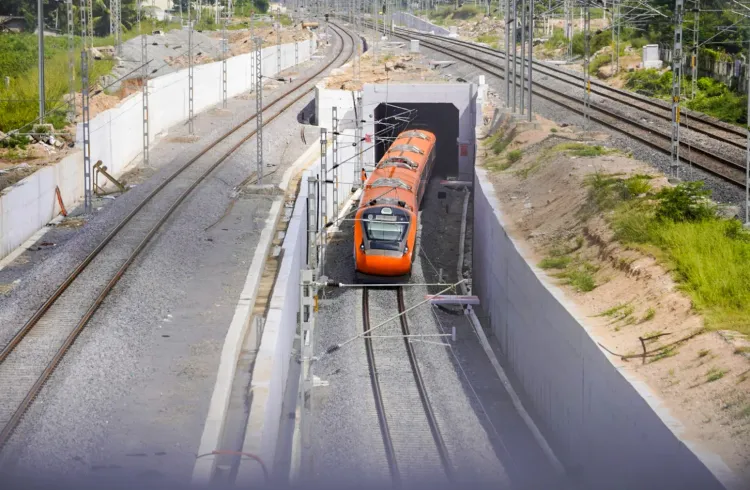
Indian Railways has cleared a ₹993 crore line-doubling project on the 68-km Arakkonam-Chengalpattu corridor — a stretch that serves Chennai's suburban commuters and some of Tamil Nadu's densest industrial clusters, including Sriperumbudur and Oragadam. With the proposed Parandur Airport also nearby, this approval carries implications well beyond today's congestion fix.
Key Takeaways
The Ministry of Railways approved the Arakkonam-Chengalpattu Doubling Project on 19 May 2025 at a cost of ₹993 crore .
The project covers a 68-km corridor under Southern Railway , forming part of the Chennai suburban circular rail network .
It will improve frequency and punctuality of suburban services and reduce train detention times.
Key industrial zones served include Mahindra World City , Sriperumbudur , Oragadam , and Irungattukottai .
The proposed Parandur Airport near Kancheepuram lies close to the corridor, raising its long-term strategic value.
Freight commodities set to benefit include cement , automobiles , food grains , and iron and steel .
The Ministry of Railways on Tuesday, 19 May approved the Arakkonam-Chengalpattu Doubling Project under Southern Railway at an estimated cost of ₹993 crore, aimed at boosting suburban and freight connectivity across a critical 68-km corridor in Tamil Nadu. The project forms a key segment of the Chennai suburban circular rail network, linking Chennai Beach, Tambaram, Chengalpattu, and Arakkonam.
What the Project Covers
The doubling of the existing line is designed to address high capacity utilisation on a section that already operates near its operational ceiling. Traffic volumes on the corridor are projected to rise further in coming years, making the infrastructure upgrade necessary, according to the ministry. The work is expected to reduce train detention times, improve punctuality, and raise the frequency of suburban services.
What the Government Said
Union Minister for Railways Ashwini Vaishnaw said the project will play a key role in easing congestion on the busy Chennai suburban rail network while improving punctuality and operational efficiency. He added that the corridor will see strengthened passenger and freight movement, benefiting the transportation of commodities including cement, automobiles, food grains, and iron and steel.
Industrial and Strategic Importance
The route serves several major economic and industrial hubs — Mahindra World City, Sriperumbudur, Oragadam, and Irungattukottai — which together host significant automobile, cement, and manufacturing operations. Notably, the proposed Parandur Airport near Kancheepuram falls close to the project alignment, adding long-term strategic weight to the corridor beyond its current freight and commuter role.
Broader Rail Infrastructure Push
The ministry described the approval as part of Indian Railways' wider effort to modernise infrastructure, enhance network capacity, and improve operational efficiency across key corridors. The project is expected to support regional industrial growth and deliver faster, safer, and more reliable rail services to commuters and freight operators alike. With Tamil Nadu's manufacturing belt expanding rapidly along this corridor, the doubling is seen as both an infrastructure and economic intervention.
Point of View
But its geography is not. The Arakkonam-Chengalpattu corridor threads through Tamil Nadu's most export-intensive manufacturing belt — Sriperumbudur, where Apple's supply chain operates, and Oragadam, home to Renault-Nissan and Daimler plants. Capacity constraints on this line are effectively a bottleneck on industrial logistics, not just commuter convenience. The Parandur Airport proximity adds a layer that planners should be integrating now, not after construction begins. Whether the Railways' project timeline accounts for that interface will determine whether this doubling is future-proof or just catches up to 2020 demand.
NationPress
2 Oct 2026
Frequently Asked Questions
What is the Arakkonam-Chengalpattu Doubling Project?
It is a ₹993 crore rail infrastructure project approved by the Ministry of Railways to double the existing 68-km track between Arakkonam and Chengalpattu under Southern Railway . The project aims to ease congestion on the Chennai suburban circular rail network and improve freight movement in Tamil Nadu.
Why is this corridor strategically important?
The corridor connects major industrial hubs including Mahindra World City , Sriperumbudur , Oragadam , and Irungattukottai , which host significant automobile and manufacturing operations. The proposed Parandur Airport near Kancheepuram also lies close to the alignment, enhancing its long-term significance.
How will the project benefit commuters?
The doubling is expected to reduce train detention times, improve punctuality, and increase the frequency of suburban rail services on the busy Chennai suburban network. The existing section is currently operating at high capacity utilisation, with traffic projected to rise further.
Which freight commodities will benefit from the project?
According to the Ministry of Railways, the project will strengthen movement of commodities including cement , automobiles , food grains , and iron and steel along the corridor.
What did Railway Minister Ashwini Vaishnaw say about the project?
Union Minister Ashwini Vaishnaw said the Arakkonam-Chengalpattu Doubling Project will play a key role in easing congestion on the Chennai suburban rail network while improving punctuality and operational efficiency, and will also strengthen passenger and freight movement across the corridor.