CM Naidu Thanks Modi for Guntakal-Ballari Rail Line Nod
Synopsis
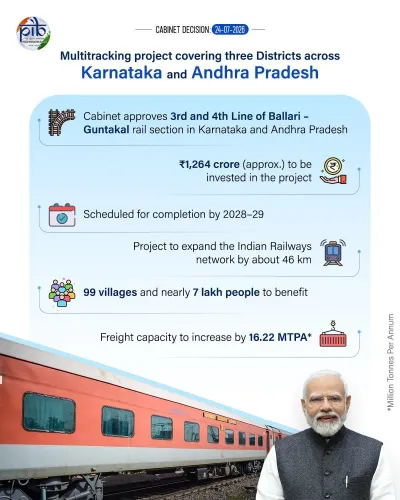
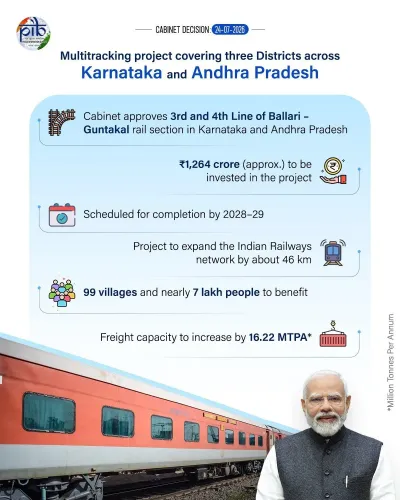
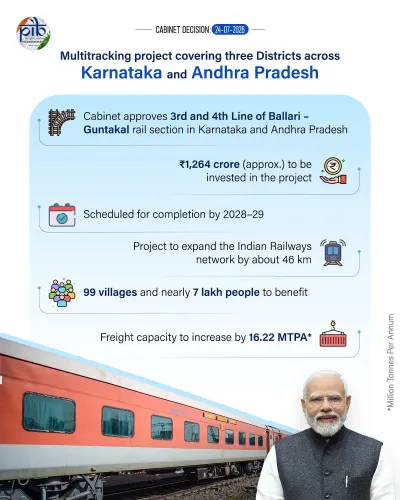
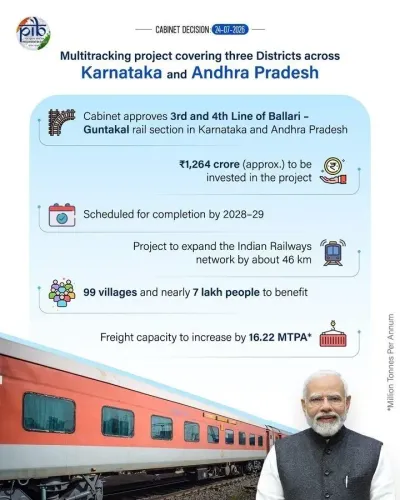
The Union Cabinet has approved the 3rd and 4th railway lines between Guntakal and Ballari at ₹1,264 crore. CM Chandrababu Naidu welcomed the decision, saying it will strengthen the East-West rail corridor, decongest existing tracks, and boost connectivity to Krishnapatnam and Ramayapatnam ports.
Key Takeaways
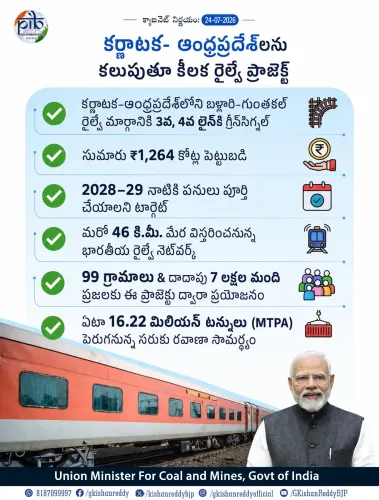
The Union Cabinet approved the 3rd and 4th railway lines between Guntakal (Andhra Pradesh) and Ballari (Karnataka) on or before 25 July 2026 .
Total project investment is ₹1,264 crore , with nearly ₹600 crore allocated within Andhra Pradesh.
The project is designed to strengthen the East-West rail corridor and improve connectivity between Rayalaseema , North Karnataka , and Goa .
Enhanced rail access to Krishnapatnam Port and the upcoming Ramayapatnam Port is a stated goal of the project.
Chandrababu Naidu credited PM Narendra Modi and Railway Minister Ashwini Vaishnaw for the Cabinet nod.
The project aligns with India's broader multi-tracking strategy to decongest busy rail routes and lower logistics costs.
Andhra Pradesh Chief Minister N. Chandrababu Naidu on Saturday, 25 July 2026, thanked Prime Minister Narendra Modi and Union Railway Minister Ashwini Vaishnaw after the Union Cabinet approved the construction of the 3rd and 4th railway lines between Guntakal in Andhra Pradesh and Ballari in Karnataka, a project backed by an investment of ₹1,264 crore.
Context
In his post, Chief Minister Naidu described the approval as a 'strategic project' that will 'significantly strengthen the East-West rail corridor' and 'enhance connectivity between Rayalaseema, North Karnataka and Goa.' He added that nearly ₹600 crore of the total outlay will be spent within Andhra Pradesh. The Cabinet nod marks a formal step in expanding capacity on one of South India's busiest rail arteries, which currently handles a dense mix of passenger and freight traffic.
Policy Backdrop
The Guntakal–Ballari corridor sits within the broader South Central Railway network, a zone that successive governments have targeted for multi-tracking since 2014 to address chronic congestion and rising freight volumes. India's systematic push to add third and fourth lines on saturated routes is part of a national strategy to lower logistics costs and improve throughput without building entirely new corridors. The project also dovetails with the Sagarmala Programme, launched in 2015, which promoted dedicated rail links connecting hinterland industrial zones to coastal ports.
Chief Minister Naidu specifically highlighted the project's role in improving rail access to Krishnapatnam Port, a deep-water facility on Andhra Pradesh's coast, and the upcoming Ramayapatnam Port. Better rail connectivity to these ports is expected to reduce dependence on road transport for bulk cargo, cutting turnaround times for exporters and importers in the region.
Stakeholders and Impact
The additional lines are expected to benefit rail passengers through reduced delays and more train slots, while freight operators — particularly those moving iron ore, steel, and agricultural produce between Rayalaseema and Karnataka — stand to gain from faster transit and greater reliability. Industries clustered around Ballari, a city closely associated with mining and steel production, are among the direct economic beneficiaries. Naidu stated the project will 'create new economic opportunities and benefit millions across Andhra Pradesh and Karnataka.'
Port authorities at Krishnapatnam and the agencies developing Ramayapatnam Port are also stakeholders, as smoother rail links are a prerequisite for scaling up port throughput. The corridor's connection to Goa further positions it as part of a longer East-West freight and passenger spine across peninsular India.
What's Next
With Cabinet approval secured, the project now moves toward tendering, land acquisition, and construction scheduling. Observers will watch whether land acquisition in both states proceeds without significant delays — historically a key variable in rail expansion timelines in the region. Progress on linked approvals for Ramayapatnam Port rail connectivity will also be closely tracked, as the two projects are complementary. If executed on schedule, the new lines could materially reshape freight economics and passenger mobility across the Andhra Pradesh–Karnataka border belt.
Point of View
With the TDP's return to the NDA fold translating into tangible project clearances for Andhra Pradesh. For CM Naidu, the announcement reinforces his 'infrastructure-first' governance narrative ahead of any future electoral cycle, while simultaneously allowing the Centre to demonstrate delivery on its southern connectivity agenda. The port-linkage angle — covering both Krishnapatnam and Ramayapatnam — signals that this is not merely a capacity project but part of a deliberate logistics corridor strategy. The real test, however, will be land acquisition speed and construction execution, areas where similar South Indian rail projects have historically lagged their approval timelines.
NationPress
24 Oct 2026
Frequently Asked Questions
What is the Guntakal to Ballari railway project approved by the Union Cabinet?
The Union Cabinet approved the construction of 3rd and 4th railway lines between Guntakal in Andhra Pradesh and Ballari in Karnataka, at a total cost of ₹1,264 crore. The project aims to decongest the existing corridor, strengthen the East-West rail route, and improve connectivity to ports and industrial zones.
How much will Andhra Pradesh receive from the Guntakal-Ballari rail project?
Nearly ₹600 crore of the total ₹1,264 crore project investment will be spent within Andhra Pradesh, according to CM Chandrababu Naidu's statement.
How will the Guntakal-Ballari rail project benefit Krishnapatnam Port?
The additional railway lines will improve freight rail connectivity to Krishnapatnam Port, a deep-water facility on Andhra Pradesh's coast, enabling faster and more reliable movement of cargo between the port and hinterland industrial regions.
Which states will benefit from the Guntakal to Ballari railway line?
Both Andhra Pradesh and Karnataka will benefit directly. The project connects Rayalaseema in Andhra Pradesh with North Karnataka and extends toward Goa, serving passengers, freight operators, and port-linked industries across the region.
Why did CM Chandrababu Naidu thank PM Modi for the railway project?
CM Naidu thanked PM Modi and Railway Minister Ashwini Vaishnaw because the approval came from the Union Cabinet, which is the central government body responsible for sanctioning major railway infrastructure projects in India.