Cabinet Clears ₹1,264 Cr Rail Line Between Ballari–Guntakal
Synopsis
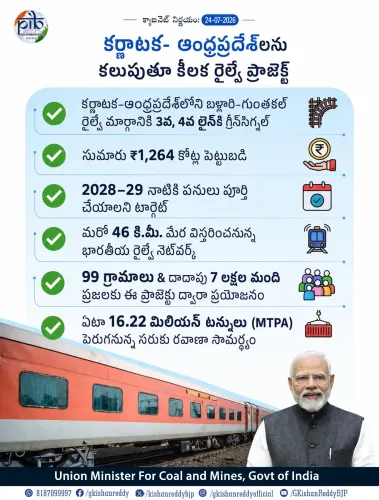
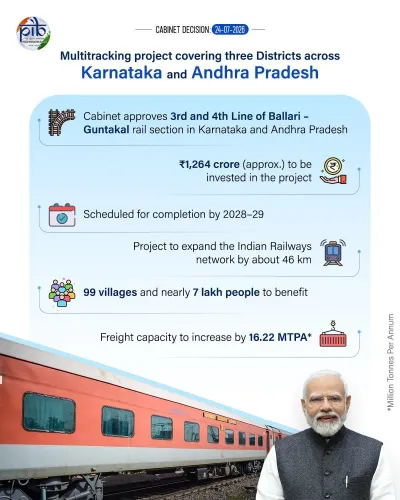
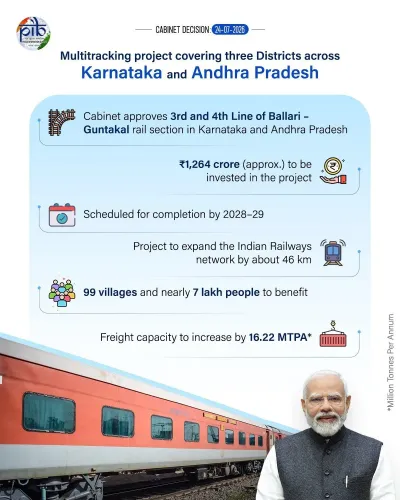
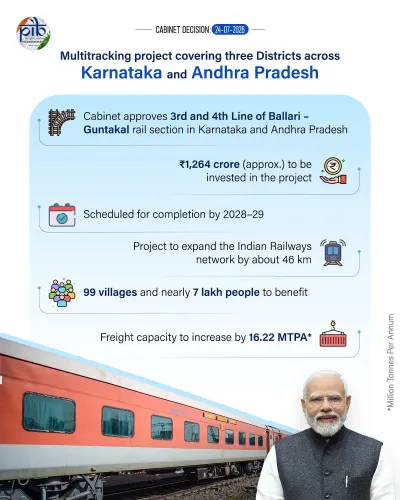
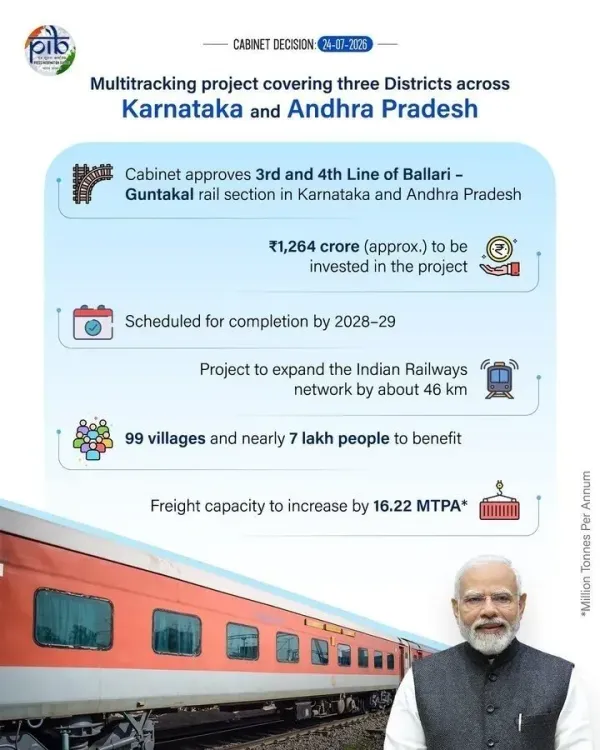
The Union Cabinet has approved a ₹1,264 crore project to add 3rd and 4th rail lines between Ballari, Karnataka and Guntakal, Andhra Pradesh. The 46 km expansion will serve 99 villages, benefit nearly 7 lakh people, and boost freight capacity on one of southern India's busiest rail corridors.
Key Takeaways
The Union Cabinet approved the 3rd and 4th rail lines between Ballari (Karnataka) and Guntakal (Andhra Pradesh) on 24 July 2026 .
The project is valued at ₹1,264 crore and will expand the rail network by 46 km .
An estimated 7 lakh people across 99 villages in the two states are expected to benefit.
The corridor is critical for freight movement, particularly iron ore and steel, from the Ballari mining belt.
The project aligns with the PM Gati Shakti National Master Plan and the broader push for multi-tracking on saturated southern rail routes.
South Western Railway and South Central Railway zones will oversee execution, with land acquisition the key near-term milestone.
Union Consumer Affairs Minister Pralhad Joshi announced on Friday, 24 July 2026 that the Union Cabinet, under Prime Minister Narendra Modi, has approved the construction of the 3rd and 4th rail lines between Ballari in Karnataka and Guntakal in Andhra Pradesh — a ₹1,264 crore project expected to benefit nearly 7 lakh people across 99 villages and expand the rail network by 46 km.
Context
Joshi shared the Cabinet decision in a bilingual post — in English and Kannada — welcoming the approval for this inter-state rail capacity project. In his words, the project will 'boost freight capacity, strengthen regional connectivity and economic growth.' The Kannada portion of the post reads: 'ಪ್ರಧಾನಮಂತ್ರಿ ಶ್ರೀ @narendramodi ಅವರ ದೂರದೃಷ್ಟಿ ನಾಯಕತ್ವದಲ್ಲಿ, ಕೇಂದ್ರ ಸಚಿವ ಸಂಪುಟವು ಕರ್ನಾಟಕ ಮತ್ತು ಆಂಧ್ರಪ್ರದೇಶದ ಬಳ್ಳಾರಿ–ಗುಂತಕಲ್ ನಡುವಿನ 3ನೇ ಮತ್ತು 4ನೇ ರೈಲು ಮಾರ್ಗ ನಿರ್ಮಾಣಕ್ಕೆ ಅನುಮೋದನೆ ನೀಡಿದೆ' (Under the visionary leadership of Prime Minister Modi, the Union Cabinet has approved the construction of the 3rd and 4th rail lines between Ballari and Guntakal in Karnataka and Andhra Pradesh).
Policy Backdrop
The Ballari–Guntakal corridor is a strategically significant rail route linking the iron-ore-rich districts of northern Karnataka with Guntakal, one of the largest railway junctions in southern India that connects lines fanning out across Telangana, Tamil Nadu, and Kerala. Multi-tracking on such saturated corridors has been a stated priority under the PM Gati Shakti National Master Plan, launched in 2021, which sought to integrate rail and logistics planning to reduce freight transit times. The broader push to add third and fourth lines on high-density routes follows the policy lineage of the Dedicated Freight Corridor programme, first approved in 2006 and substantially accelerated after 2014.
The current administration has approved several such multi-tracking projects across southern India in recent years, targeting routes where single or double lines have become bottlenecks for both passenger and freight movement. The Ballari region's significance as a hub for iron ore and steel freight makes additional line capacity particularly consequential for industrial logistics in the two states.
Stakeholders and Impact
The project is projected to directly benefit residents of 99 villages spread across the two states, with improved rail access for both commuters and goods movement. Freight operators — particularly those transporting minerals, steel, and agricultural produce from the Karnataka hinterland — stand to gain from reduced congestion and faster transit. The South Western Railway and South Central Railway zones, which jointly oversee this corridor, will be responsible for execution.
For Karnataka, the project carries additional political salience: Ballari has historically been a BJP stronghold, and Joshi — a senior BJP leader from the state — framed the announcement explicitly as a product of the Prime Minister's 'visionary leadership.' The 46 km network addition will also improve last-mile connectivity for villages currently underserved by rail infrastructure.
What's Next
The project now moves to the tendering and land acquisition phase, which will be overseen by the respective railway zones in coordination with state governments in Karnataka and Andhra Pradesh. Progress on land acquisition — often the primary bottleneck for rail expansion projects in southern India — will determine how quickly construction can begin. Parliamentary committee oversight and mentions in upcoming Railway Budget documents will be key indicators of the project's prioritisation within the Ministry of Railways' capital expenditure pipeline.
If executed on schedule, the expanded corridor could meaningfully shift freight away from road transport in this mineral-heavy belt, contributing to the government's broader goal of increasing rail's share in national logistics.
Point of View
The project addresses a genuine infrastructure gap: the corridor's freight saturation has long constrained industrial logistics for the region's mining and steel sectors. The framing by a senior Karnataka BJP minister — in both English and Kannada — signals an effort to consolidate credit for central spending in a state where the party is in opposition. Whether the project delivers on its timeline will depend heavily on land acquisition, which has historically been the Achilles' heel of rail expansion in this region.
NationPress
23 Oct 2026
Frequently Asked Questions
What is the Ballari–Guntakal rail line project approved by the Cabinet?
The Union Cabinet approved the construction of 3rd and 4th rail lines between Ballari in Karnataka and Guntakal in Andhra Pradesh at a cost of ₹1,264 crore, adding 46 km to the rail network and benefiting nearly 7 lakh people across 99 villages.
How much will the Ballari–Guntakal rail project cost?
The project has been approved at a cost of ₹1,264 crore, as announced by Union Minister Pralhad Joshi following the Cabinet decision on 24 July 2026.
How many villages will benefit from the Ballari–Guntakal rail line?
According to the Cabinet announcement, 99 villages and nearly 7 lakh people across Karnataka and Andhra Pradesh are expected to benefit from the project.
Why is the Guntakal railway junction important?
Guntakal is one of the major railway junctions in southern India, connecting rail lines to multiple states including Telangana, Tamil Nadu, and Kerala, making it a critical node for both passenger and freight movement.
What is PM Gati Shakti and how does this rail project relate to it?
PM Gati Shakti is a National Master Plan launched in 2021 to integrate infrastructure planning across transport modes. The Ballari–Guntakal multi-tracking project aligns with its goal of reducing freight transit times by adding parallel lines on high-density rail corridors.