Kishan Reddy: Cabinet OKs Ballari-Guntakal Rail Lines
Synopsis
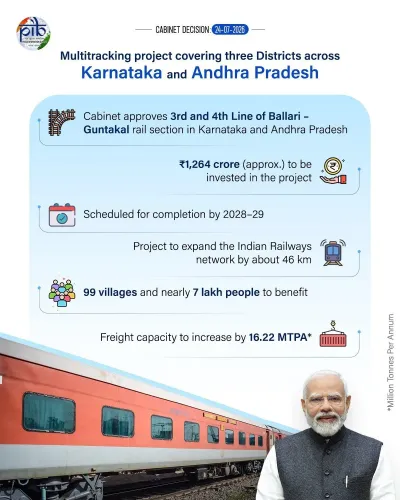
The CCEA, chaired by PM Modi, has approved the 3rd and 4th lines of the Ballari–Guntakal rail section at ₹1,264 crore. The 46 km multitracking project spanning Karnataka and Andhra Pradesh aims to boost freight movement and benefit nearly 7 lakh people, as announced by Union Minister G. Kishan Reddy.
Key Takeaways
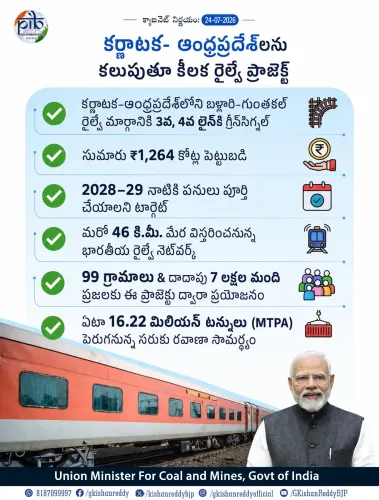
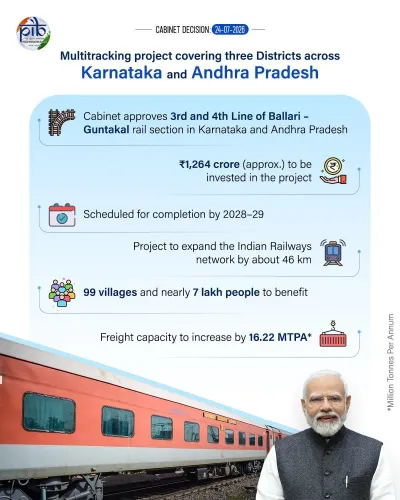
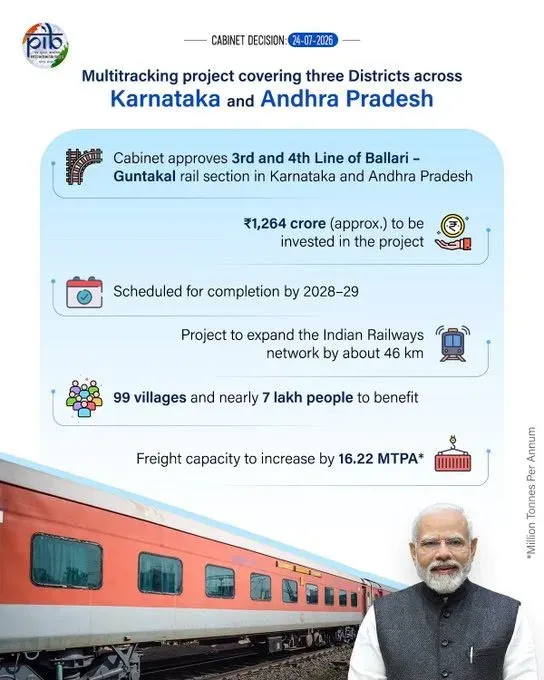
The Cabinet Committee on Economic Affairs approved the 3rd and 4th lines of the Ballari–Guntakal rail section on 24 July 2026 .
The project is estimated to cost ₹1,264 crore and will add approximately 46 km to the Indian Railways network.
The corridor spans Karnataka and Andhra Pradesh across three districts , benefiting nearly 7 lakh people .
The upgrade is expected to improve freight movement , particularly for mineral and agricultural cargo in the region.
The project aligns with the government's PM Gati Shakti framework and the Viksit Bharat 2047 infrastructure vision.
Kishan Reddy announced the approval, tagging Railway Minister Ashwini Vaishnaw in the post.
Union Coal and Mines Minister G. Kishan Reddy on Friday, 24 July 2026 announced that the Cabinet Committee on Economic Affairs (CCEA), chaired by Prime Minister Narendra Modi, has approved the construction of the 3rd and 4th lines of the Ballari–Guntakal rail section spanning Karnataka and Andhra Pradesh.
Context
The multitracking project carries an estimated cost of ₹1,264 crore and will add approximately 46 km to the Indian Railways network. According to the minister's post, the expansion is expected to benefit nearly 7 lakh people across three districts straddling the Karnataka–Andhra Pradesh border.
Kishan Reddy, who also serves as BJP Telangana state president, framed the approval as 'a significant step towards strengthening rail infrastructure and advancing the vision of an Atmanirbhar Bharat and Viksit Bharat @ 2047,' tagging Railway Minister Ashwini Vaishnaw and the Rail Ministry in his post.
Policy Backdrop
The Ballari–Guntakal corridor is a strategically important freight artery connecting mineral-rich districts in southern India. The region's iron ore and other mining outputs have historically strained single- and double-line capacity, making multitracking a long-standing demand from freight transporters and industry.
The approval fits within the central government's sustained push since 2014 to decongest high-density rail routes through doubling and tripling projects. The broader policy architecture includes the PM Gati Shakti National Master Plan, launched in 2021, which integrates rail capacity expansion with road, port, and logistics infrastructure to reduce supply-chain costs. Successive cabinets have also advanced the Dedicated Freight Corridor programme to shift bulk cargo from roads to rail.
India's railways currently carry roughly 27 percent of the country's freight by modal share; the government's stated goal is to raise this to 40 percent by 2030, making capacity additions on mineral corridors like Ballari–Guntakal directly relevant to that target.
Stakeholders and Impact
Residents and businesses across the three districts covered by the project stand to gain from improved passenger connectivity, while freight transporters — particularly those moving iron ore, coal, and agricultural produce — are expected to see reduced transit times and lower logistics costs. Mining-sector stakeholders in Ballari, one of India's largest iron-ore-producing districts, have consistently pressed for enhanced rail throughput.
Andhra Pradesh and Karnataka both benefit from the cross-border connectivity upgrade, which could also ease pressure on state highways that currently absorb heavy goods traffic in the absence of adequate rail capacity.
What's Next
The project's execution will fall under Indian Railways and the Ministry of Railways, with land acquisition and detailed engineering among the immediate procedural steps. Parliamentary committees are likely to seek updates on timelines and land-acquisition progress in the upcoming sessions.
The Ballari–Guntakal sanction could also signal further multitracking proposals for other mineral and agricultural corridors in southern India, as the government works toward its Viksit Bharat 2047 infrastructure targets. Progress on this project will be a key indicator of how swiftly Cabinet-approved rail investments translate into ground-level construction.
Point of View
Kishan Reddy — as both a Union minister and BJP's Telangana state president — is signalling the party's infrastructure dividend to a politically contested southern electorate. The project also advances the government's structural goal of raising rail's freight modal share, where the Ballari–Guntakal axis is a meaningful bottleneck. Whether land acquisition and execution timelines match the political messaging will determine the project's real-world impact.
NationPress
23 Oct 2026
Frequently Asked Questions
What is the Ballari–Guntakal rail multitracking project?
It is a central government project to add a 3rd and 4th railway line to the existing Ballari–Guntakal section connecting Karnataka and Andhra Pradesh, approved by the CCEA on 24 July 2026 at an estimated cost of ₹1,264 crore.
How much will the Ballari–Guntakal rail project cost?
The project carries an estimated cost of ₹1,264 crore, as stated in the Cabinet approval announced by Union Minister G. Kishan Reddy.
How many people will benefit from the Ballari–Guntakal rail project?
According to the ministerial announcement, nearly 7 lakh people across three districts in Karnataka and Andhra Pradesh are expected to benefit from the project.
Why is the Ballari–Guntakal corridor important for freight?
The corridor is a key mineral-freight artery in southern India, particularly for iron ore movement from Ballari, and multitracking will ease congestion and reduce logistics costs for transporters.
What is Viksit Bharat 2047 and how does this project relate to it?
Viksit Bharat 2047 is the government's national vision for a fully developed India by the centenary of independence, with advanced transport infrastructure as a core pillar; the Ballari–Guntakal project has been cited as a step toward achieving that goal.