Cabinet Approves 3rd & 4th Rail Lines on Ballari-Guntakal Section
Synopsis
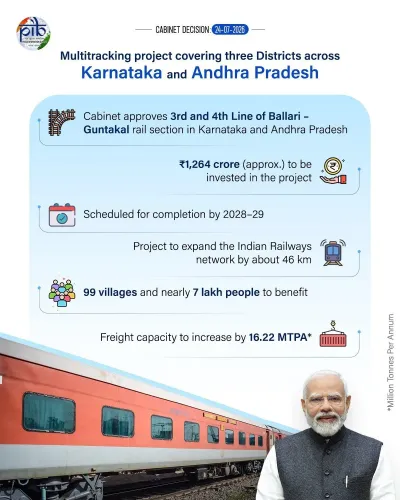
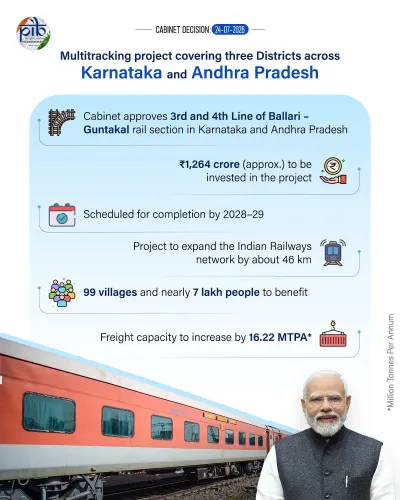
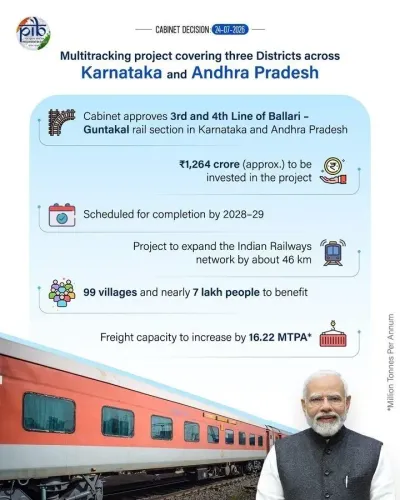
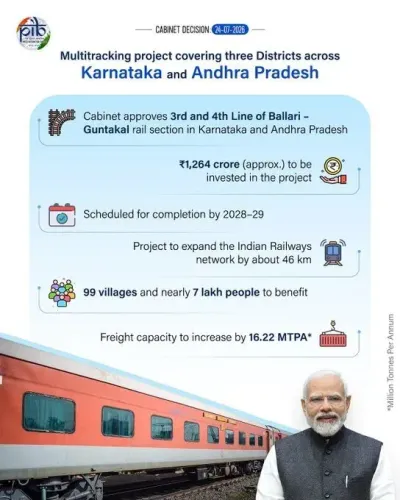
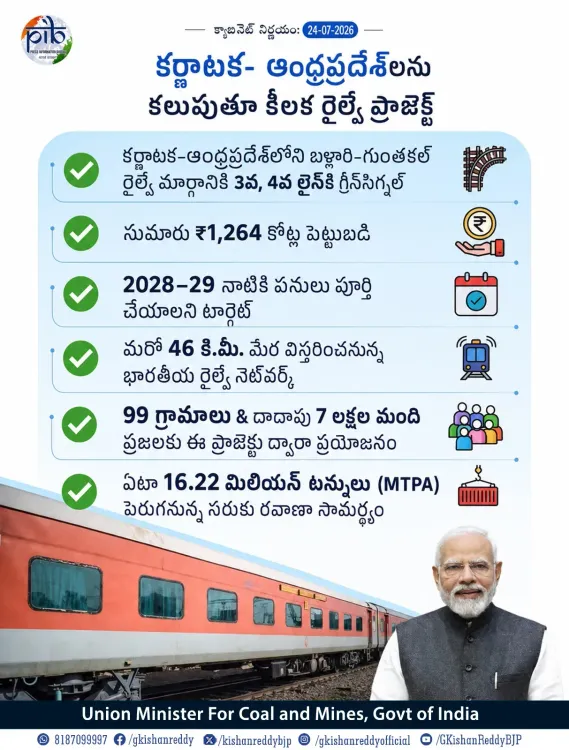
The Union Cabinet has approved construction of third and fourth railway lines on the 46-km Ballari–Guntakal corridor linking Karnataka and Andhra Pradesh at an estimated cost of ₹1,264 crore, with benefits projected for 7 lakh people across three districts.
Key Takeaways
The Union Cabinet, led by Prime Minister Narendra Modi , approved third and fourth railway lines on the Ballari–Guntakal section.
The project has an estimated cost of ₹1,264 crore and covers approximately 46 kilometres .
The corridor links the states of Karnataka and Andhra Pradesh , passing through a key mining and industrial belt.
Around 7 lakh people across three districts are expected to benefit from improved connectivity.
The expansion will boost freight movement, particularly for minerals and industrial goods, while easing passenger traffic.
Implementation will involve South Western Railway and South Central Railway , with tendering and land acquisition as immediate next steps.
Union Coal and Mines Minister G. Kishan Reddy on Friday, 25 July 2026, announced that the Union Cabinet, under the leadership of Prime Minister Narendra Modi, has approved the construction of third and fourth railway lines on the Ballari–Guntakal section, a corridor linking the states of Karnataka and Andhra Pradesh. The project carries an estimated cost of ₹1,264 crore and spans approximately 46 kilometres.
Context
Kishan Reddy shared the cabinet decision on X, highlighting the project in Telugu: 'కర్ణాటక-ఆంధ్రప్రదేశ్ రాష్ట్రాలను అనుసంధానిస్తూ..' ('Connecting the states of Karnataka and Andhra Pradesh...'). The minister noted that the expansion is expected to benefit approximately 7 lakh people across three districts, improve passenger and freight connectivity, and accelerate goods movement along this inter-state corridor. Union Railways Minister Ashwini Vaishnaw was also tagged in the post, indicating coordinated messaging from the Union government.
The Guntakal railway junction in Andhra Pradesh is one of the busiest nodes in southern India, serving as a key interchange for traffic moving between the Deccan plateau and the coastal regions. Ballari in Karnataka is an industrial and mining hub, making the corridor critical for both passenger services and heavy freight, particularly iron ore and steel products.
Policy Backdrop
The approval fits within a broader central government push to augment rail capacity on high-density southern routes. Since 2019, the Union Cabinet has cleared multiple railway doubling and tripling projects as part of capacity augmentation efforts, with the National Infrastructure Pipeline explicitly earmarking funds for southern railway sections to boost freight and passenger throughput.
Multi-tracking of busy corridors has been a stated priority of Indian Railways to separate freight from passenger traffic, raise average train speeds, and reduce transit times. The Ballari–Guntakal section forms part of wider efforts to strengthen inter-state rail links that support mining, industrial, and agricultural logistics between the two states, aligning with the long-term objective of upgrading diagonal and feeder routes connected to the Golden Quadrilateral network.
Stakeholders and Impact
Residents across three districts spanning both states stand to gain from improved frequency and reliability of train services once the additional lines are operational. Freight operators — particularly those transporting minerals, steel, and agricultural produce — are expected to see faster turnaround times as dedicated capacity reduces conflicts between goods and passenger trains on the section.
Local commuters and small traders dependent on rail connectivity between Karnataka and Andhra Pradesh also form a significant stakeholder group. The government's stated beneficiary figure of 7 lakh people underscores the social dimension of the infrastructure investment beyond its commercial and logistical value.
What's Next
Following cabinet approval, the next steps typically involve release of detailed project reports, land acquisition proceedings, and tendering by the concerned zonal railways — South Western Railway and South Central Railway. Progress on these fronts will determine the actual construction timeline and delivery of benefits to commuters and freight users in the region.
The inclusion of revised cost and completion targets in forthcoming railway plans will be closely watched by stakeholders in both states. With the cabinet sanction now in place, political attention is likely to shift to execution timelines and the pace of ground-level work on the 46-kilometre stretch.
Point of View
The announcement carries clear political value in both Karnataka — where the party is in opposition — and Andhra Pradesh, where it is allied with the ruling TDP-led coalition, making the timing of the public communication by a Telangana BJP leader noteworthy. The project also reinforces the Modi government's infrastructure-first electoral narrative ahead of future state and general election cycles. Execution pace, rather than cabinet approval, will ultimately define how this investment is perceived by the 7 lakh intended beneficiaries.
NationPress
23 Oct 2026
Frequently Asked Questions
What is the Ballari–Guntakal railway project approved by the Cabinet?
The Union Cabinet approved the construction of third and fourth railway lines on the approximately 46-km Ballari–Guntakal section, linking Karnataka and Andhra Pradesh, at an estimated cost of ₹1,264 crore.
How many people will benefit from the Ballari–Guntakal rail line expansion?
The government estimates that approximately 7 lakh people across three districts in Karnataka and Andhra Pradesh will benefit from improved transportation facilities under the project.
What is the cost of the Ballari–Guntakal third and fourth railway line project?
The estimated project cost is ₹1,264 crore, as announced following Union Cabinet approval under Prime Minister Narendra Modi.
Which states does the Ballari–Guntakal railway corridor connect?
The corridor connects Karnataka, where Ballari is located, and Andhra Pradesh, where Guntakal is a major railway junction, strengthening inter-state rail links in southern India.
What are the benefits of adding third and fourth lines on the Ballari–Guntakal section?
The additional lines are expected to improve passenger services, accelerate freight movement — particularly of minerals and industrial goods — and reduce congestion by separating goods trains from passenger trains on the busy corridor.