Rajasthan CM Sharma hails Modi's 25 years of public service at Viksit Bharat Sabha
Synopsis
Rajasthan CM Bhajan Lal Sharma used the Viksit Bharat Sankalp Sabha in Jaipur to mark PM Modi's 25-year public service milestone and catalogue a sweeping set of Centre-backed projects — from a ₹42,000 crore nuclear plant to 52 lakh Jal Jeevan Mission connections — framing Rajasthan as a frontline beneficiary of Modi's development agenda.
Key Takeaways
CM Bhajan Lal Sharma addressed the Viksit Bharat Sankalp Sabha in Jaipur on 7 October 2026 , joining PM Modi's New Delhi event via video conferencing.
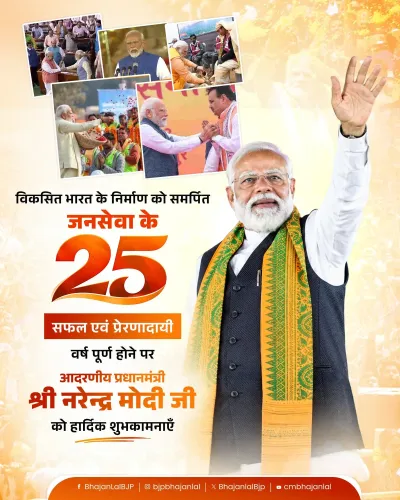
Sharma said Modi has completed 25 years of uninterrupted public service, calling the milestone 'historic, glorious and inspiring.' The Ram Jal Setu Link Project will supply drinking water to 17 districts and irrigate more than 4 lakh hectares ; over 52 lakh rural households have received tap-water connections under the Jal Jeevan Mission.
The Centre has approved Jaipur Metro Phase 2 at ₹13,000 crore — a 41-km corridor with 36 stations .
The Mahi Banswara Nuclear Power Project , with a capacity of 2,800 MW and cost of ₹42,000 crore , had its foundation stone laid on 25 September 2025 .
Rajasthan has installed renewable-energy plants of more than 5.45 GW under PM-KUSUM, and over 3.37 lakh rooftop solar systems under PM Surya Ghar Muft Bijli Yojana.
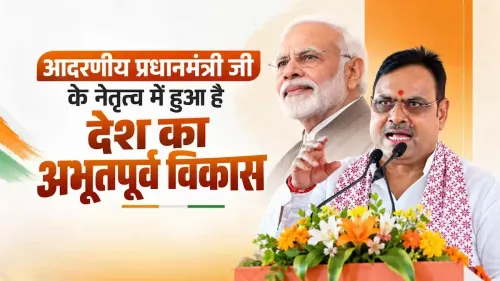
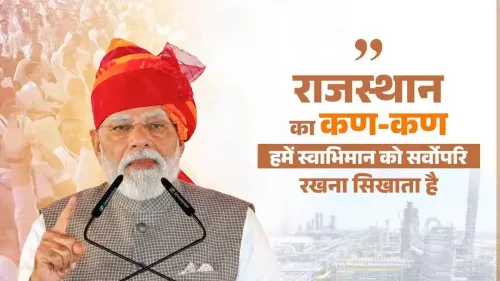
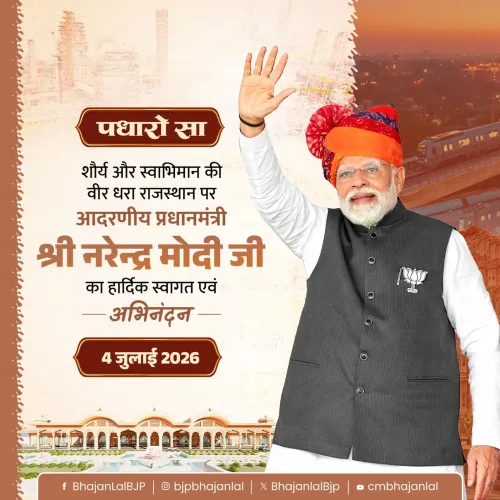
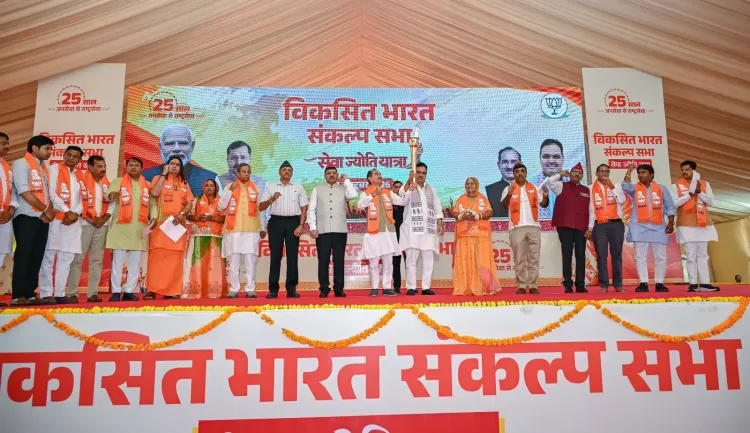
Rajasthan Chief Minister Bhajan Lal Sharma on 7 October 2026 praised Prime Minister Narendra Modi for completing 25 years of uninterrupted public service, saying Modi had 'redefined politics by transforming it from an instrument of power into a means of public service.' Sharma spoke at the Viksit Bharat Sankalp Sabha and Seva Jyoti Yatra programme held at Mela Ground, VT Road, Mansarovar, Jaipur, joining Modi's parallel event in New Delhi via video conferencing.
Key Remarks at the Event
Chief Minister Sharma described Modi's 25-year public life as 'historic, glorious and inspiring', calling it a tapasya centred on the principle of 'Nation First.' He said the nation had come together with renewed energy through the Viksit Bharat Sankalp Sabha and Seva Jyoti Yatra programmes organised to mark the milestone.
Sharma credited Modi with achieving landmark decisions in the national interest, citing the abrogation of Article 370 and the construction of the Ram Mandir as examples of 'unwavering willpower.' He added that for crores of citizens, 'the Prime Minister's name has become synonymous with fulfilling commitments and ensuring delivery.'
At the New Delhi event, Prime Minister Modi reiterated his resolve to build a Viksit Bharat (Developed India), raising the slogan 'We will do it.' Chief Minister Sharma echoed the sentiment from Jaipur.
Water Security: Key Projects and Agreements
Sharma outlined several water infrastructure milestones for Rajasthan, citing Centre-backed initiatives. The Ram Jal Setu Link Project is being implemented to supply drinking water to 17 districts and provide irrigation facilities for more than 4 lakh hectares of land, along with water for industrial use.
A Memorandum of Agreement (MoA) on Yamuna water was signed on 29 June this year. On 15 September, an agreement among six states, including Rajasthan, was signed for the Kishau Multipurpose Project, aimed at ensuring year-round water availability in the Shekhawati region.
Sharma also cited what he called a historic agreement on Narmada water among Maharashtra, Gujarat, Rajasthan, and Madhya Pradesh under Modi's leadership, reportedly resolving a decades-old inter-state dispute. Under the Jal Jeevan Mission, more than 52 lakh rural households in Rajasthan have received tap-water connections, and drinking-water infrastructure worth more than ₹33,305 crore has been developed across the state.
Infrastructure Expansion: Roads, Metro, Rail and Air
The Chief Minister listed a range of infrastructure projects being rolled out across Rajasthan. On roads, he cited the Delhi-Mumbai Expressway and its Delhi-Jaipur section, the Amritsar-Jamnagar Expressway, and the Jaipur-Kishangarh-Jodhpur-Pachpadra and Bikaner-Kotputli expressways. The ₹11,764 crore Jaipur Ring Road North project is being completed with Union government support to ease traffic congestion.
The Centre has approved Phase 2 of the Jaipur Metro Rail Project at an estimated cost of ₹13,000 crore, comprising a 41-kilometre corridor with 36 stations. Railway infrastructure is being expanded through Vande Bharat Express services, a Coach Care Complex, and the development of 83 Amrit Bharat railway stations.
On air connectivity, new services are being added in Kota, Kishangarh, Barmer, and Bikaner. A new terminal at Jodhpur Airport, built at a cost of ₹480 crore, has raised the airport's annual passenger-handling capacity from 1.2 million to 2 million. Development work is also underway at terminals in Jaipur and Kota.
Energy and Renewables: Rajasthan's Growing Capacity
Chief Minister Sharma said Rajasthan's energy capacity has seen 'unprecedented growth' over the past two years and nine months. Battery energy storage projects with a combined capacity of 6,000 MWh are being developed to strengthen the state's power infrastructure.
Under the PM Surya Ghar Muft Bijli Yojana, more than 5 lakh registrations have been recorded in Rajasthan, with over 3.37 lakh rooftop solar systems installed. Under the PM-KUSUM scheme, renewable-energy plants with a combined capacity of more than 5.45 GW have been installed, positioning Rajasthan as a national leader in solar and renewable infrastructure.
Sharma also highlighted the Mahi Banswara Nuclear Power Project, whose foundation stone Prime Minister Modi laid on 25 September 2025. The project carries an estimated cost of ₹42,000 crore and a total installed capacity of around 2,800 MW.
As the Viksit Bharat Sankalp Sabha continues to roll out events across states, Rajasthan's participation signals an effort to link Centre-state development narratives ahead of what could be a busy legislative calendar.
Point of View
But the gap between announcements and ground-level delivery remains a recurring concern in the state, particularly on water security, where inter-state disputes have historically outlasted agreements. The Narmada water deal and Kishau Project MoA are being presented as resolved, but implementation timelines were not specified. The Viksit Bharat Sankalp Sabha format, connecting state events to the Prime Minister via video conferencing, increasingly functions as a centralised optics platform — one where credit for development flows upward to the Centre regardless of which government initiated the project.
NationPress
7 Oct 2026
Frequently Asked Questions
What is the Viksit Bharat Sankalp Sabha?
The Viksit Bharat Sankalp Sabha is a programme organised to mark Prime Minister Narendra Modi's 25 years of uninterrupted public service, bringing together events across states under the theme of a 'Developed India.' In Jaipur, it was held alongside the Seva Jyoti Yatra at the Mela Ground in Mansarovar on 7 October 2026.
What did Rajasthan CM Bhajan Lal Sharma say about PM Modi?
CM Sharma said PM Modi had 'redefined politics by transforming it from an instrument of power into a means of public service,' describing his 25-year public life as a tapasya centred on 'Nation First.' He cited the abrogation of Article 370 and construction of the Ram Mandir as examples of Modi's 'unwavering willpower.'
What is the Jaipur Metro Phase 2 project?
The Centre has approved Phase 2 of the Jaipur Metro Rail Project at an estimated cost of ₹13,000 crore. It will comprise a 41-kilometre corridor with 36 stations, aimed at improving urban connectivity in Jaipur.
What is the Mahi Banswara Nuclear Power Project?
The Mahi Banswara Nuclear Power Project is a ₹42,000 crore nuclear energy initiative in Rajasthan with a total installed capacity of around 2,800 MW. Prime Minister Modi laid its foundation stone on 25 September 2025.
How has Rajasthan progressed on water security under Centre-backed schemes?
Over 52 lakh rural households in Rajasthan have received tap-water connections under the Jal Jeevan Mission, with drinking-water infrastructure worth more than ₹33,305 crore developed across the state. Additional projects include the Ram Jal Setu Link Project covering 17 districts and the Kishau Multipurpose Project for the Shekhawati region, alongside a Narmada water agreement among four states.