Rajatarangini inscribed in UNESCO Memory of the World Register 2026
Synopsis
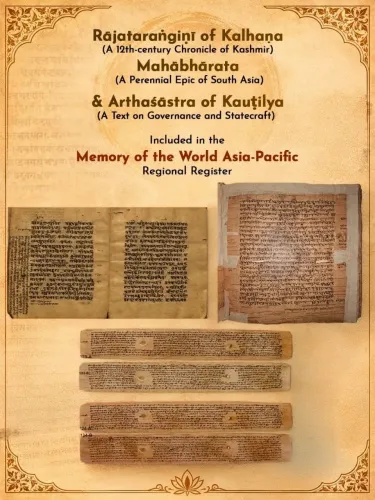
Three pillars of India's ancient knowledge tradition — Kalhana's Rajatarangini, the Mahabharata, and Kautilya's Arthashastra — have been inscribed in UNESCO's Memory of the World Asia-Pacific Regional Register. For Kashmir, it is the first global documentary-heritage recognition for its defining 12th-century historical chronicle, written by a court-connected scholar who pioneered source-critical historiography centuries before it became a Western academic standard.
Key Takeaways
Rajatarangini , composed by Kalhana in 1148–1149 CE , has been inscribed in UNESCO's Memory of the World Asia-Pacific Regional Register (MOWCAP) on 6 November 2026 .
The Mahabharata and Kautilya's Arthashastra were also simultaneously inscribed on the MOWCAP register.
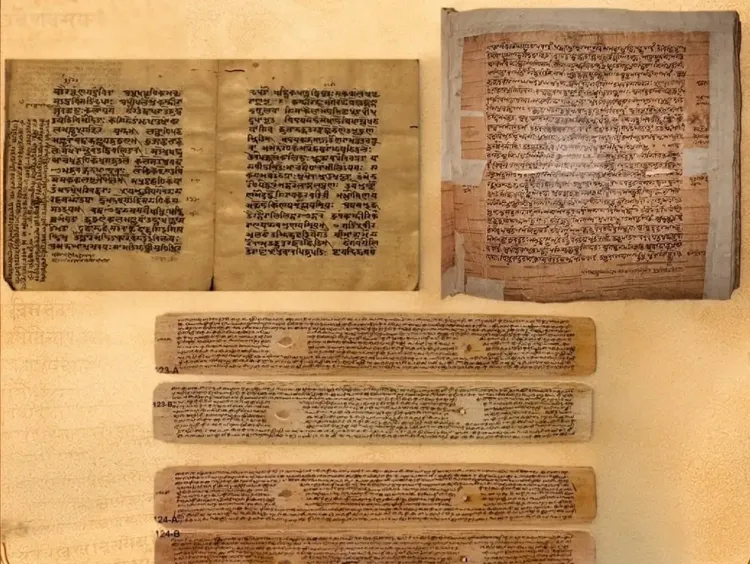
Rajatarangini is a Sanskrit chronicle covering the history of the Kashmir region from earliest times to the mid-12th century, widely regarded as the most authoritative of its kind.
J&K Lieutenant Governor's office and MEA Spokesperson Randhir Jaiswal both hailed the inscription as a proud moment for India's civilisational heritage.
Kalhana's methodology included epigraphic sources, coins, family records , and prior royal chronicles — unusually rigorous for 12th-century historiography.
Kashmir's ancient Sanskrit chronicle Rajatarangini, composed by historian Kalhana between 1148 and 1149 CE, has been inscribed in UNESCO's Memory of the World Asia-Pacific Regional Register (MOWCAP) — a recognition that places one of the subcontinent's most sophisticated historical texts on the global heritage map. The inscription was confirmed on 6 November 2026 and was welcomed by both the Jammu & Kashmir Lieutenant Governor's office and the Ministry of External Affairs.
What Was Inscribed
Rajatarangini is not the only Indian manuscript to earn this distinction. Kalhana's Rajatarangini, the Mahabharata, and Kautilya's Arthashastra were all inscribed simultaneously on the MOWCAP Regional Register, according to official statements. The collective recognition underscores UNESCO's acknowledgement of South Asia's documentary heritage as a contribution to global civilisational memory.
The Significance of Rajatarangini
Written in Sanskrit by the Kashmiri Brahman Kalhana, Rajatarangini — which translates as 'River of Kings' — is widely regarded as the finest and most historically rigorous chronicle of the Kashmir region, covering its rulers from the earliest mythological times to the mid-12th century. Kalhana's methodology was remarkably advanced for his era: he cross-referenced epigraphic sources including royal eulogies, temple endowment records, and land grants; examined coins, monumental remains, and family archives; and drew on prior chronicles such as Nripavali by Kshemendra, Parthivavali by Helaraja, and the Nilamatapurana. He also engaged closely with literary models like the Harsacarita and the Brihat-samhita.
Notably, Kalhana had privileged access to court affairs: both his father and uncle served in the Kashmir royal court, giving him near-direct knowledge of contemporary political intrigues. Scholars have nonetheless noted that his conceptual framework — rooted in the poet's role as a moral exponent — introduces an idealising tendency, particularly for the early historical periods.
Official Reactions
The office of the Jammu & Kashmir Lieutenant Governor described the inscription as 'a proud moment for Jammu Kashmir and the nation,' adding that the inclusion of Rajatarangini 'celebrates Kashmir's rich intellectual heritage.' It further stated: 'This global recognition reaffirms the timeless value of India's civilisational traditions and their contribution to humanity, reminding us of our collective responsibility to preserve and promote this invaluable wisdom for future generations.'
Ministry of External Affairs Official Spokesperson Randhir Jaiswal also welcomed the development, calling it 'a proud moment for India's timeless knowledge traditions, which continue to resonate across generations and borders.'
Why This Recognition Matters
UNESCO's Memory of the World programme was established to safeguard documentary heritage of outstanding universal value and to ensure broad access to it. Inclusion in the MOWCAP Regional Register is a precursor pathway that often leads to the global register, amplifying international scholarly and preservation attention. For Kashmir specifically, the recognition positions the valley's ancient intellectual output within a living global heritage framework — not merely as an artefact of the past, but as a continuing source of historical knowledge. This comes amid broader efforts by Indian cultural institutions to pursue global recognition for India's manuscript traditions, with several texts already listed on UNESCO's international register. The formal inscription is expected to accelerate conservation and digitisation efforts around surviving manuscripts.
Point of View
But the real question is what follows: India holds an estimated 10 million manuscripts, vast numbers of which remain uncatalogued and deteriorating. Recognition for Rajatarangini is deserved, but it risks becoming a trophy moment unless it triggers concrete digitisation funding and institutional access reform. Kalhana's work is also a reminder that rigorous historical methodology in South Asia predates European academic historiography by centuries — a point that UNESCO recognition can help re-centre in global scholarly discourse. The simultaneous inscription of the Mahabharata and Arthashastra alongside a regional chronicle is an unusually wide net, and it will be worth watching whether this signals a more systematic Indian push for documentary heritage listings across its manuscript libraries.
NationPress
6 Nov 2026
Frequently Asked Questions
What is the Rajatarangini and why is it significant?
Rajatarangini is a 12th-century Sanskrit chronicle written by Kashmiri historian Kalhana between 1148 and 1149 CE, covering the history of Kashmir's kings from mythological times to his own era. It is considered the most historically rigorous and authentic chronicle of the Kashmir region, notable for Kalhana's unusually advanced use of epigraphic, numismatic, and archival sources.
What is UNESCO's Memory of the World Register?
UNESCO's Memory of the World programme safeguards documentary heritage of outstanding universal value and promotes its broad accessibility. The MOWCAP Regional Register covers the Asia-Pacific region and often serves as a pathway toward the global register.
Which other Indian texts were inscribed alongside Rajatarangini?
The Mahabharata and Kautilya's Arthashastra were also inscribed on the UNESCO Memory of the World Asia-Pacific Regional Register at the same time as Rajatarangini, according to official statements from the J&K Lieutenant Governor's office and the Ministry of External Affairs.
Who announced the UNESCO inscription and what did they say?
The J&K Lieutenant Governor's office and MEA Official Spokesperson Randhir Jaiswal both announced the inscription. The L-G office called it 'a proud moment for Jammu Kashmir and the nation,' while Jaiswal described it as a recognition of 'India's timeless knowledge traditions.'
What impact will UNESCO recognition have on Rajatarangini's preservation?
Inclusion in the MOWCAP Regional Register typically draws increased international scholarly attention and can accelerate conservation and digitisation efforts for surviving manuscripts. It also raises the prospect of the text being elevated to UNESCO's global Memory of the World Register in future cycles.