Ram Mandir donation row: 'Plunder of faith worse than looting money', says Maulana Rashidi

Synopsis
The Ram Mandir donation controversy has drawn in voices far beyond the usual political opposition. Maulana Sajid Rashidi's 'plunder of faith' framing — invoking Babur, Champat Rai, and a ₹1,400 crore VHP allegation in one breath — signals that the trust's transparency crisis is now a multi-front political liability for the BJP, with CPI(M) directly naming Yogi Adityanath as the accountability address.
Key Takeaways
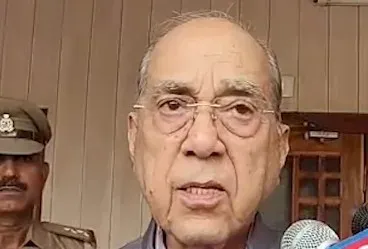
Maulana Sajid Rashidi , President of the All India Imam Association , said on 29 June that the 'plunder of faith' at the Ram Mandir is more dangerous than the looting of money.
Rashidi alleged Champat Rai 's name was previously linked to a ₹1,400 crore alleged scam connected to the VHP during the Rath Yatra era.
He questioned how a theft 'worth thousands of crores' could occur without Rai's knowledge given his reported control over trust operations.
CPI(M) General Secretary M.A.
Baby alleged that those 'heading the committee' in Ayodhya are responsible for the alleged looting, naming BJP and RSS .
Baby asked Yogi Adityanath to clarify whether actual wrongdoers are being shielded while others are made scapegoats.
The controversy comes amid broader questions about the absence of independent financial oversight for the Shri Ram Janmabhoomi Teerth Kshetra Trust .
The controversy over alleged financial irregularities in Ram Mandir donations sharpened on Monday, 29 June when Maulana Sajid Rashidi, President of the All India Imam Association, declared that the 'plunder of faith' is more dangerous than the looting of money. His remarks, directed at the functioning of the Shri Ram Janmabhoomi Teerth Kshetra Trust, added a sharp communal-political edge to an already sensitive debate over transparency in one of India's most high-profile religious institutions.
Key Allegations by Maulana Rashidi
Rashidi invoked past corruption allegations against the Vishwa Hindu Parishad (VHP), claiming the organisation had faced charges related to a ₹1,400 crore alleged scam at the time of the Rath Yatra, and that Champat Rai's name had been linked to those allegations. He also alleged that those who originally led the Ram Temple movement were subsequently sidelined when a new trust was constituted, with Rai being appointed as its general secretary.
Rashidi further questioned the financial oversight within the temple trust. 'If a theft takes place in my own house, I would be held responsible. When not even a leaf could move there without Champat Rai's approval, how could a theft worth thousands of crores take place without his knowledge?' he said. He also pointed to alleged procedural failures, noting claims that 'the cameras stopped working, there were mistakes while counting the money, and errors occurred while transporting it from one place to another.'
Concluding his remarks, Rashidi drew a pointed historical comparison: 'They say Babur came and looted the country, but he did it only once. These people, however, have disrespected people's faith. This is a plunder of faith, which is far more dangerous than the looting of money.'
Hindu Leaders Defend Champat Rai
Rashidi acknowledged that several Hindu religious leaders and VHP members have defended Champat Rai. He referenced remarks by Sadhvi Rithambara, who reportedly compared Rai's character to sandalwood — implying that even an upright person can be surrounded by detractors — as an example of the support he continues to command within certain religious circles.
CPI(M) Demands Accountability from Yogi Government
Communist Party of India (Marxist) General Secretary M.A. Baby, in a separate statement, called for restraint over religious disputes while simultaneously pressing hard on the corruption angle. 'We should not be quarrelling about Krishna Janmabhoomi or Rama Janmabhoomi. Those who are devoted to Ram, Krishna or any other God, Jesus Christ or Allah, Bhagawan Buddha — they should have the freedom to worship all that,' he said.
Baby, however, did not hold back on the financial allegations: 'Now the key issue is in Ayodhya from Ram temple, lot of looting is taking place and this is being done by those who are heading the committee. Those people are from BJP and RSS.' He directed specific accountability questions at Uttar Pradesh Chief Minister Yogi Adityanath, asking whether the administration was genuinely pursuing those responsible or shielding the principal accused while making scapegoats of others.
Political and Institutional Context
These developments come amid heightened scrutiny over governance and financial transparency within religious trusts in India. The Ram Mandir in Ayodhya, inaugurated in early 2024, received donations from millions of devotees across the country — making the alleged irregularities a matter of both religious sentiment and public accountability. Critics argue that the absence of an independent audit mechanism for the trust has allowed questions to fester without resolution. Notably, this is not the first time the trust's internal functioning has drawn political fire; opposition parties have repeatedly demanded a court-monitored probe into donation management.
With the Bharatiya Janata Party (BJP)-led government in Uttar Pradesh yet to formally respond to the latest round of allegations, pressure is likely to mount for a transparent accounting of temple funds.
Point of View
An omission that opposition parties warned about at the time. Baby's direct naming of Yogi Adityanath as the accountability address is politically calculated: it forces either a credible investigation or a visible cover-up, both of which carry costs for the BJP ahead of future electoral cycles.
NationPress
27 Sept 2026
Frequently Asked Questions
What is the Ram Mandir donation controversy about?
The controversy centres on alleged financial irregularities in the management of donations received by the Shri Ram Janmabhoomi Teerth Kshetra Trust in Ayodhya. Critics, including opposition politicians and religious leaders, have alleged that large sums were misappropriated or mishandled, and have demanded an independent probe into the trust's accounts.
What did Maulana Sajid Rashidi say about the Ram Mandir row?
Rashidi, President of the All India Imam Association, said on 29 June that the 'plunder of faith' is more dangerous than the looting of money. He alleged that Champat Rai's name had been linked to a ₹1,400 crore VHP scam during the Rath Yatra era, and questioned how large-scale financial irregularities could occur without the knowledge of the trust's top leadership.
Who is Champat Rai and why is he named in the controversy?
Champat Rai is the General Secretary of the Shri Ram Janmabhoomi Teerth Kshetra Trust. Critics allege he wielded near-total control over the trust's operations, making it implausible that financial irregularities could have occurred without his knowledge. He has been defended by several Hindu religious leaders, including Sadhvi Rithambara, who reportedly vouched for his integrity.
What has CPI(M) demanded in connection with the Ram Mandir trust?
CPI(M) General Secretary M.A. Baby alleged that those heading the Ram Mandir committee in Ayodhya — whom he identified as being from the BJP and RSS — are responsible for the alleged looting. He specifically asked Chief Minister Yogi Adityanath to clarify whether genuine wrongdoers are being pursued or whether some are being made scapegoats while others are protected.
Is there an independent audit of the Ram Mandir trust's finances?
No independent audit mechanism has been publicly established for the Shri Ram Janmabhoomi Teerth Kshetra Trust, according to critics who have repeatedly raised this concern. The absence of such oversight has been cited as a key reason why questions about donation management have persisted without resolution.